
Common Structural Steel Shapes and Their Uses

Structural steel is used in everything from homes and warehouses to high-rise buildings, factories, and bridges. However, the steel in these structures does not all look or work the same way. It is formed into different profiles so that engineers can place material where it will resist loads efficiently.
Understanding structural steel shapes makes construction drawings, material schedules, and product descriptions much easier to follow. Some sections are designed mainly for bending, while others are better suited to compression, bracing, edge support, or connections. Choosing the right profile can improve strength, reduce weight, simplify fabrication, and help control project costs.
This guide explains the most common structural steel shapes, what they look like, and where they are normally used. It provides a practical introduction, but final member sizes, grades, connections, and protective systems must always be selected by qualified professionals in accordance with the project design and applicable standards.
What Are Structural Steel Shapes?
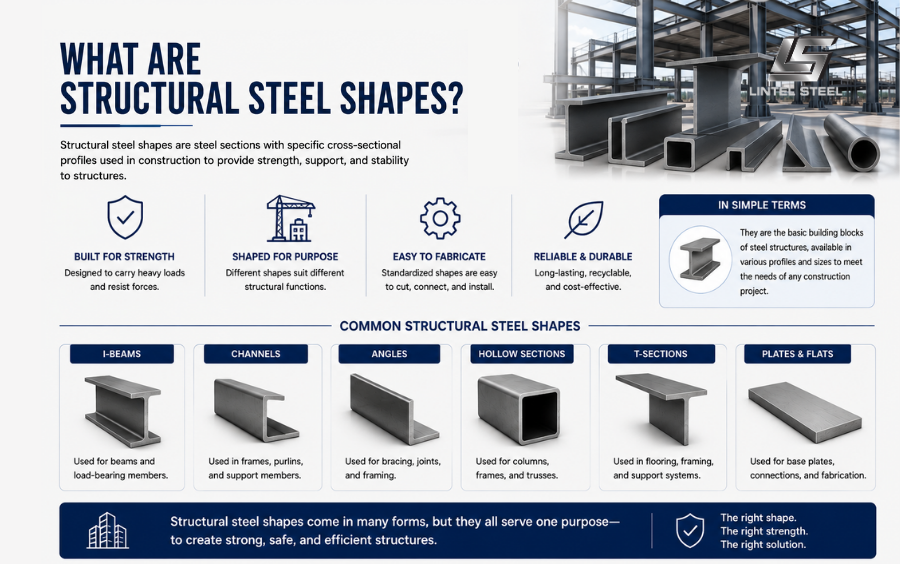
Structural steel shapes are standardized or custom-made cross-sections used to carry loads in buildings and infrastructure. A cross-section is the outline seen when a member is viewed from its end. Familiar examples include the I shape of a beam, the L shape of an angle, and the square or circular form of a hollow section.
The geometry of each profile determines how its material is distributed around its center. That distribution influences how efficiently the member resists bending, compression, tension, shear, and twisting. Two pieces of steel with the same weight can behave very differently if their cross-sections are arranged in different ways.
Many structural steel shapes are hot rolled at a mill into standard sizes. Others are cold formed from thinner sheet or plate, while large or unusual members may be fabricated by welding plates together. Standard references provide dimensions and section properties that engineers use during design. For example, the Steel Construction Institute’s Blue Book includes data for beams, columns, channels, angles, structural tees, and hollow sections.
Why Structural Steel Shapes Matter
The purpose of structural steel shapes is to use material efficiently. In a typical I-shaped beam, much of the steel is concentrated in the top and bottom flanges, where it is highly effective at resisting bending. The thinner web connects the flanges and helps carry shear. A solid rectangular member could resist the same loads, but it would often use more material and add unnecessary weight.
The choice among structural steel shapes also affects connections, fire protection, corrosion protection, transportation, and erection. An open section provides easy access for bolts and welds, while a closed hollow section may offer a cleaner appearance and better torsional behavior. A deep beam may carry a long span efficiently but interfere with ceilings or building services.
No choice among structural steel shapes is automatically best for every situation. Engineers compare strength, stiffness, buckling resistance, fabrication effort, availability, architectural requirements, and total installed cost. The most efficient solution is the one that works as part of the complete structural and building system.
Common Structural Steel Shapes and Their Uses
The names and abbreviations used for structural steel shapes vary between regions and standards. A section called a universal beam in one market may be described as a wide-flange shape in another. The underlying forms are similar, but dimensions, tolerances, grades, and naming systems are not always interchangeable. Project documents should therefore identify the governing standard as well as the section designation.
Universal Beams and Wide-Flange Beams
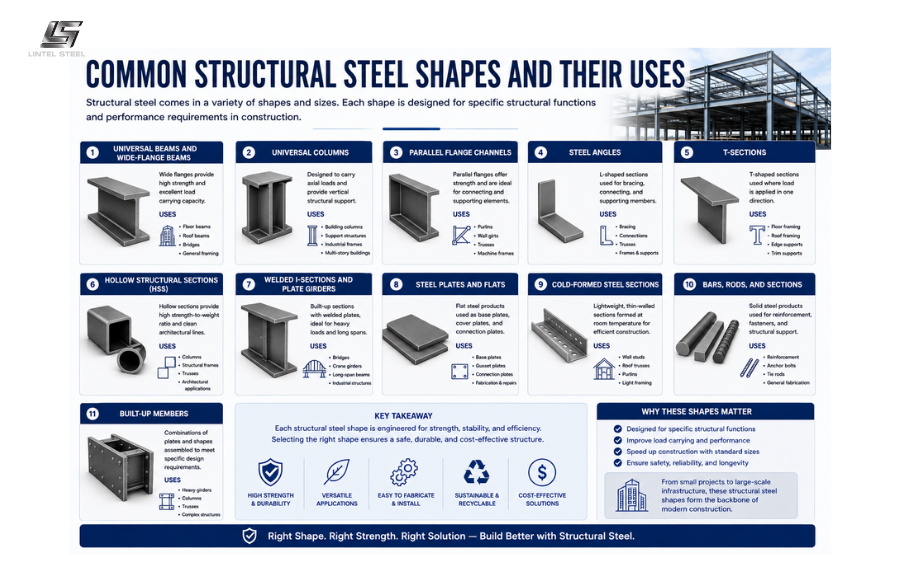
Universal beams, often abbreviated as UB, have a cross-section that resembles a capital I. In North American practice, many comparable products are known as W-shapes or wide-flange shapes. They have two wide horizontal flanges joined by a vertical web.
These are among the most recognizable structural steel shapes because their geometry is highly efficient for bending about the strong axis. The flanges carry much of the tension and compression created by bending, while the web primarily resists shear and keeps the flanges separated.
Among structural steel shapes, universal beams are commonly used for floor beams, roof beams, bridge members, transfer structures, and secondary framing. They can span between columns, support floor slabs, or form part of a moment-resisting frame. Open webs and flanges also make many beam-to-beam and beam-to-column connections relatively straightforward to fabricate and install.
Universal Columns
Universal columns, or UC sections, look similar to universal beams but are generally more compact, with flange widths closer to the overall section depth. This proportion gives them useful resistance around both principal axes and makes them well suited to carrying compression.
In multi-storey buildings, these structural steel shapes transfer loads from beams and floors down toward the foundations. Universal columns may also be used as heavily loaded beams, members in transfer frames, or parts of braced and moment-resisting systems. Their broad flanges provide practical surfaces for many common connection arrangements.
Like other structural steel shapes, universal columns must be checked for more than material strength. Column length, end restraint, axis of bending, frame stability, and the potential for buckling all influence the required size.
Parallel Flange Channels
Parallel flange channels, commonly called PFC sections, have a C-shaped cross-section. They contain one web and two flanges that project from the same side. Because the shape is open and not symmetrical about both axes, it behaves differently from an I-shaped beam and can be more sensitive to twisting when loads are applied away from its shear center.
Channels are widely used for edge beams, stair stringers, wall framing, equipment supports, lintels, and secondary structural members. Two channels may be placed back-to-back to create a built-up member with more balanced behavior. They are also useful as trimmer members around openings and as components attached to existing structures.
The open face provides convenient access for connections, but the load position and lateral restraint require careful attention. When selected correctly, channels are versatile structural steel shapes for medium and light framing tasks.
Steel Angles
Steel angles have an L-shaped cross-section and are available with equal or unequal legs. Their simple geometry makes them useful in a wide range of construction details. They can act as individual members or be combined in pairs and built-up arrangements.
These simple structural steel shapes commonly appear in roof trusses, lattice girders, towers, bracing systems, shelf supports, lintels, edge details, and steel connections. A small angle may connect a beam web to a column, while larger angles can serve as tension or compression members. Their flat legs are easy to bolt or weld to other components.
Because an angle is not symmetrical about its usual geometric axes, the member may experience combined bending and twisting if it is loaded eccentrically. Engineers account for this behavior when choosing structural steel shapes for braces, trusses, and connection elements.
T-Sections
T-sections look like a capital T, with one flange connected to a stem. They may be rolled as individual sections, fabricated from plates, or produced by cutting a universal beam or column along its web. The exact product route depends on the required size and local availability.
These sections are used for roof trusses, lintels, edge members, strengthening work, brackets, and architectural framing. A T-section can also form part of a built-up component or be attached to another member to increase its local capacity.
The flange provides useful bending resistance in one direction, while the stem offers a convenient connection surface. However, the section is not symmetrical through its depth, so orientation and load direction matter. Among structural steel shapes, tees are especially useful when a full I-section would be unnecessarily large or difficult to connect.
Read more: Structural Steel Grades Explained: A Practical Guide
Hollow Structural Sections
Hollow structural sections, often shortened to HSS, are closed profiles available in square, rectangular, and circular forms. In some regions, the terms SHS, RHS, and CHS are used for square, rectangular, and circular hollow sections.
Among modern structural steel shapes, closed profiles provide efficient resistance around more than one axis and generally perform well when torsion is important. Their smooth surfaces and balanced appearance also make them popular for exposed columns, trusses, canopies, entrance structures, and architectural features.
Square and rectangular hollow sections offer flat faces for connecting plates, cladding, and other building elements. Circular hollow sections distribute material evenly around the center and work well in members that may receive loads from different directions. They are commonly used in space frames, towers, long-span trusses, stadium roofs, and exposed bracing.
Connections to hollow sections can require more specialized detailing because the interior is not always accessible. Wall thickness, local yielding, punching, weld access, drainage, and corrosion protection must be considered. Even so, HSS products remain some of the most versatile structural steel shapes in modern architecture and engineering.
Welded I-Sections and Plate Girders
Standard rolled sections are economical when their available sizes match the design. For very heavy loads, long spans, unusual depths, or project-specific geometry, fabricators can weld separate flange and web plates together to create an I-shaped member.
Welded I-sections can be tailored by changing the web depth, flange width, or plate thickness along the member. A plate girder may include stiffeners to strengthen the web near supports, concentrated loads, or areas of high shear. Tapered members can place material where it is needed and reduce weight elsewhere.
These custom structural steel shapes are frequently used in bridges, industrial buildings, transfer girders, crane-supporting structures, and large roofs. Their flexibility is valuable, but additional fabrication, welding, inspection, transportation, and erection requirements must be included in the cost and programme.
Steel Plates and Flats
Steel plate does not have the efficient depth of a beam section, but it is essential to structural construction. It is supplied in a wide range of thicknesses and can be cut into nearly any required outline. Flats are narrower rectangular products that may be rolled directly or cut from plate.
These flat structural steel shapes are used for column base plates, beam end plates, gusset plates, stiffeners, splice plates, bearing plates, brackets, connection components, and the flanges or webs of built-up members. They can distribute concentrated forces, join members together, strengthen weak areas, and transfer loads into concrete foundations.
Although plates and flats appear simple, their thickness, grade, edge condition, weld details, bolt holes, and direction of loading require careful design. They are fundamental structural steel shapes in the broader sense because many steel frames could not be assembled or connected without them.
Cold-Formed Steel Sections
Cold-formed sections are made by bending relatively thin steel sheet at room temperature. Common profiles include C-sections, Z-sections, hat sections, tracks, studs, and deck profiles. Lips or folds are often added along the edges to improve stiffness and control local buckling.
These lightweight structural steel shapes are commonly used for roof purlins, wall girts, light-gauge framing, ceiling systems, cladding supports, mezzanine components, and secondary framing. C-sections work well as studs and joists, while Z-sections can overlap at supports to create efficient continuous purlin systems.
Cold-formed members use material efficiently, but their thin walls make local buckling, distortional buckling, screw connections, corrosion protection, and handling damage important design considerations. They should not be treated as smaller versions of hot-rolled beams because their structural behavior and design rules differ.
Bars, Rods, and Built-Up Members
Round bars, square bars, and flat bars can serve as ties, hangers, bracing members, connection components, and architectural supports. Threaded rods are widely used for hangers and tension systems, while solid bars may be machined or fitted with specialized end connections.
Built-up members combine plates, angles, channels, or other profiles using welds or bolts. Box girders, compound columns, lattice members, and custom trusses are examples. These structural steel shapes give designers freedom to meet demanding load, span, appearance, or dimensional requirements that standard rolled sections cannot satisfy.
How to Choose Structural Steel Shapes
Selection begins with the forces a member must resist. Beams need appropriate bending and shear resistance, columns require strength and stability under compression, and braces may carry tension, compression, or both. Torsion can make a closed hollow or box section more attractive than an open channel or I-section.
Span and serviceability are equally important. A member may have enough strength but still deflect too much or allow uncomfortable vibration. Increasing section depth often improves bending stiffness efficiently, although deeper structural steel shapes may conflict with ceilings, ducts, pipes, façade zones, or clearance requirements.
Connections can influence the decision from the beginning. Open sections generally provide easier access for bolts and welding. Hollow sections may deliver a cleaner finished appearance but require thoughtful connection plates, welds, and local checks. Repetitive, simple details often save more money than a small reduction in member weight.
Availability should also be confirmed early. A theoretically efficient size may not be stocked locally, while a slightly heavier standard section may be easier and faster to obtain. Fabricators and suppliers can help the design team understand regional product ranges, maximum transport lengths, rolling schedules, and economical plate thicknesses.
Fire exposure, corrosion conditions, maintenance access, and architectural intent also matter. The selected profile must be compatible with the required coating or fire-protection system. Water traps and inaccessible surfaces should be avoided, especially in external or humid environments.
Finally, engineers must use the section dimensions and properties from the correct standard. Similar names do not guarantee identical geometry across countries or product systems. The Steel Construction Institute publishes references for hot-rolled open sections and hollow sections, while the AISC Steel Construction Manual is an authoritative source for professionals working with US structural steel practice.
Structural Steel Shapes and Fabrication
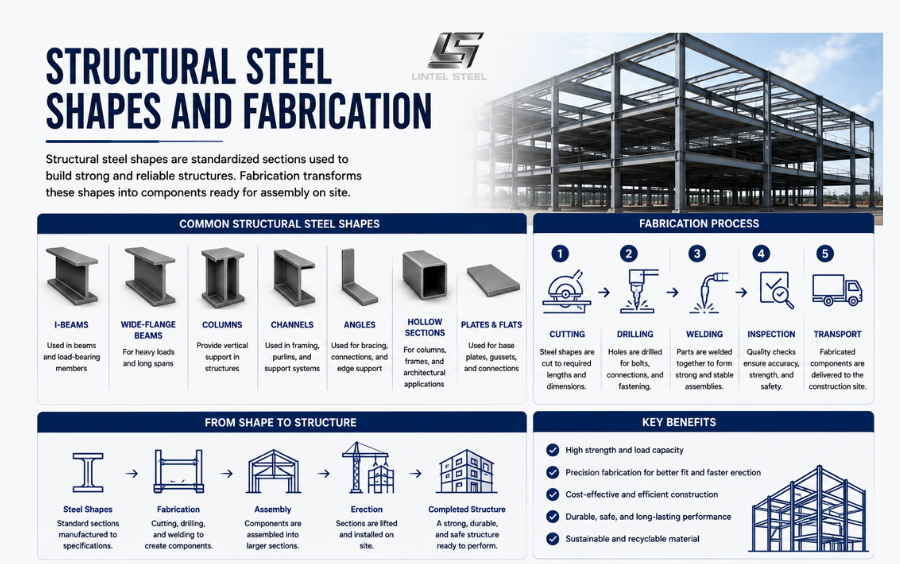
The shape selected by the engineer affects nearly every fabrication operation. Beam flanges may need holes for bolted connections, webs may be coped to fit around other members, and plates may require bevelled edges for full-penetration welds. Curved or tapered members need additional planning and specialist equipment.
Fabricators often prefer structural steel shapes that support repeatable details and efficient production. Standardized beam end connections, consistent hole patterns, accessible weld positions, and rational member lengths can reduce workshop time and errors. Digital models and automated cutting or drilling equipment improve accuracy, but good design coordination remains essential.
Transportation and erection can also control the final member arrangement. A long truss may need to be divided into transportable sections and spliced on site. A heavy girder may exceed crane capacity or require a planned lifting sequence. Early collaboration among the engineer, fabricator, erector, and contractor helps turn an efficient design into a practical construction solution.
Frequently Asked Questions About Structural Steel Shapes
What is the most common structural steel shape?
I-shaped or wide-flange sections are among the most common structural steel shapes because they efficiently resist bending and can also be used as columns. However, the most suitable profile depends on the member’s loads, span, restraint, connections, and architectural requirements.
What is the difference between a beam and a column section?
Beam sections are proportioned mainly for bending, while column sections are generally more compact and balanced for compression and bending about more than one axis. In practice, either profile may sometimes be used for a different purpose if the engineer verifies its performance.
Are hollow sections stronger than I-beams?
Neither profile is always stronger. Hollow sections offer balanced properties and useful torsional resistance, while I-shaped sections are especially efficient for bending about one main axis. A fair comparison must consider weight, dimensions, loading, unbraced length, connections, and failure modes.
Can different steel sections be substituted on site?
Not without engineering review. Two members with similar depth or weight may have different strength, stiffness, buckling resistance, connection geometry, and steel grade. Any substitution should be approved by the responsible structural engineer before fabrication or installation.
Do section names stay the same worldwide?
No. Terms such as universal beam, wide-flange shape, H-section, rectangular hollow section, and tube can mean different things under different standards. Always check the full designation, dimensions, material grade, and governing specification.
Final Thoughts
Structural steel shapes are more than a collection of familiar profiles. Their geometry determines how efficiently they carry bending, compression, tension, shear, and torsion. Universal beams, columns, channels, angles, tees, hollow sections, welded girders, plates, and cold-formed members each solve different construction problems.
Understanding the basic forms helps clients, students, contractors, and new industry professionals communicate more clearly. However, final selection depends on engineering calculations, current standards, fabrication methods, connections, protection systems, availability, and the needs of the whole building.
When structural steel shapes are selected and detailed as part of an integrated design, they can create frames that are strong, efficient, buildable, and adaptable for years to come.
Choose Lintel Steel – where precision meets performance in every structure we build.
Click here to get a quote and quantity takeoff for free.
You can find out more about us at our Fanpage Lintel Steel.


