
Structural Steel Grades Explained: A Practical Guide

Structural steel may look similar from one beam or plate to another, but its performance can vary significantly. The difference often comes down to the grade. Structural steel grades tell engineers, fabricators, and buyers what they can expect from a material, including its strength, toughness, chemical composition, and suitability for welding or use in harsh environments.
Understanding these designations can make product specifications much easier to read. It can also reduce the risk of ordering the wrong material, creating fabrication problems, or using steel that is unsuitable for the intended load or environment. This guide explains structural steel grades in clear terms and compares some of the most common systems used around the world.
What Are Structural Steel Grades?
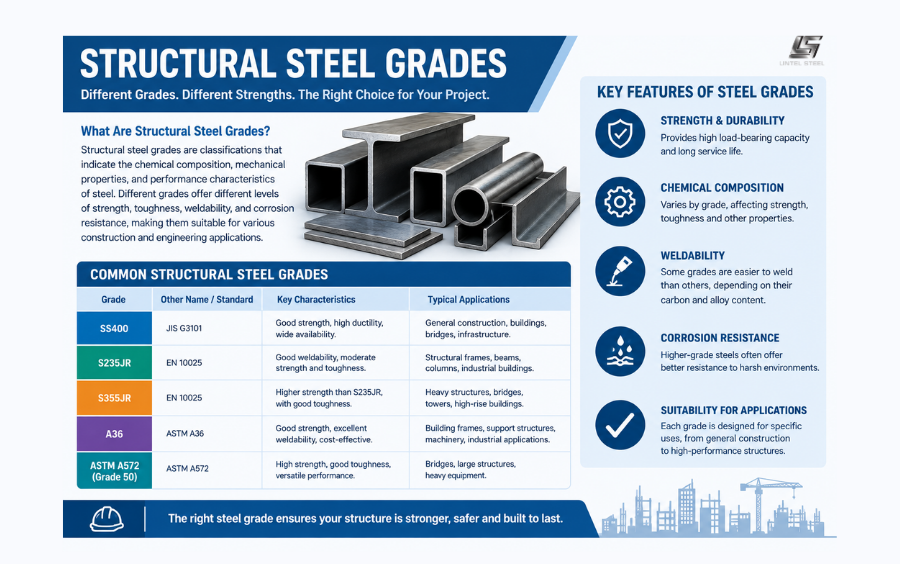
Structural steel grades are standardized classifications that describe the required properties of steel used in buildings, bridges, industrial facilities, and other load-bearing structures. A grade is not simply a product name. It refers to a set of requirements established by a recognized standards organization, such as ASTM International in the United States or the European Committee for Standardization under EN standards.
Depending on the standard, a grade may define minimum yield strength, tensile strength, chemical limits, impact toughness, elongation, and other characteristics. Manufacturers must produce and test the steel to confirm that it meets those requirements.
The grade works alongside the product type. A wide-flange beam, hollow structural section, plate, angle, and reinforcing bar may be governed by different specifications even when their strength levels appear similar. For that reason, engineers specify both the relevant material standard and the grade rather than selecting steel by strength alone.
Why Steel Grade Selection Matters
Choosing the correct grade directly affects safety, fabrication, service life, and project cost. Yield strength determines how much stress steel can resist before it begins to deform permanently. Tensile strength describes the maximum stress it can withstand before fracture. Toughness indicates how well the material can absorb energy and resist brittle failure, especially at low temperatures or under impact loading.
Weldability also matters. Steel with a suitable chemical composition and carbon equivalent is generally easier to weld without cracking or requiring complex procedures. In some projects, corrosion resistance is a priority, while in others, fatigue performance, fire design, ductility, or availability may influence the selection.
A higher-strength grade is not automatically the best option. Stronger steel may allow smaller or lighter members, but stiffness, buckling, deflection, connection design, weldability, and local supply can still control the final choice. The best grade is the one that satisfies the entire design and construction process, not simply the one with the largest strength number.
How Structural Steel Grades Are Named
Steel grade names make more sense once you know which standard created them. In ASTM designations, the letter “A” is followed by a specification number, such as ASTM A36, ASTM A572, or ASTM A992. Some specifications contain multiple grades, so a full description may read ASTM A572 Grade 50. The number 50 in that name generally refers to a minimum yield strength of 50 ksi, or approximately 345 MPa, for the applicable product and thickness range.
European grade names usually communicate strength more directly. In a designation such as S355, the “S” identifies structural steel and “355” indicates a nominal minimum yield strength of 355 MPa for the stated thickness range. Additional letters and numbers describe qualities such as impact toughness, delivery condition, or suitability for particular applications.
For example, S355JR, S355J0, and S355J2 share the same basic nominal strength level, but their toughness requirements are tested at different temperatures. These suffixes are important where a structure may experience cold weather, dynamic loading, or a risk of brittle fracture.
The number in a grade name should never be interpreted without checking the governing standard. Minimum yield strength can change with material thickness, product form, and specification edition. Under EN 10025, for example, the stated number commonly relates to material up to a defined thickness, and the required minimum yield strength may decrease as the steel becomes thicker.
Common Grades in ASTM Standards
ASTM A36 is one of the best-known carbon structural steels. It has a minimum yield strength of 36 ksi, or about 250 MPa, for commonly covered thicknesses and shapes. It is widely associated with plates, bars, angles, channels, and general structural work. Its broad availability, familiar fabrication characteristics, and straightforward use have made it a long-standing choice for many applications.
ASTM A572 is a high-strength, low-alloy specification available in several strength grades. Grade 50, with a minimum yield strength of 50 ksi or roughly 345 MPa for applicable thicknesses, is especially common. It can provide more strength than A36 without requiring a proportionate increase in steel weight, although the engineer must still evaluate member stability, deflection, connections, and fabrication requirements.
ASTM A992 is commonly specified for wide-flange shapes used in building frames in the United States. It has a minimum yield strength of 50 ksi and includes tighter controls on important mechanical and chemical characteristics than older general-purpose options. The American Institute of Steel Construction states that ASTM A992/A992M should be specified for W-shapes used today.
ASTM A500 covers cold-formed welded and seamless carbon steel structural tubing in round and shaped forms. It is commonly associated with hollow structural sections, or HSS. Because HSS products and open shapes are not governed by the same material specification, it is important not to assume that a grade used for a wide-flange beam also applies to a square, rectangular, or round tube.
ASTM A588 is a high-strength, low-alloy structural steel designed for improved atmospheric corrosion resistance. Often described as weathering steel, it can develop a protective oxide layer when used in a suitable environment and detailed correctly. However, it is not maintenance-free in every location. Persistent moisture, salt exposure, poor drainage, and unsuitable detailing can prevent the protective patina from performing as intended.
Other ASTM specifications are used for specialized products and performance requirements, including bridge steels, high-strength plates, and steels intended for particular temperature or toughness conditions. The project drawings and specifications should always identify the exact standard, grade, product form, and any supplementary requirements.
Common Grades in European Standards
S235, S275, S355, and S460 are widely recognized European structural steel strength grades. Their numbers indicate nominal minimum yield strength in megapascals for the relevant product and thickness range. S235 is commonly used for lighter-duty structural applications, while S275 and S355 are frequent choices for general building and infrastructure work. S460 offers higher strength where weight reduction or higher resistance is valuable.
S355 is particularly common because it provides a useful balance of strength, availability, and fabrication practicality. According to SteelConstruction.info, S355 has a specified minimum yield strength of 355 N/mm² for material up to 16 mm thick, with lower specified values applying to greater thicknesses.
The letters following the strength number are just as important as the number itself. JR, J0, and J2 refer to Charpy impact toughness requirements at progressively lower test temperatures. Other designations can indicate normalized or normalized-rolled delivery, thermomechanical rolling, weather resistance, or suitability for hollow sections.
An engineer therefore would not treat S355JR and S355J2 as interchangeable merely because both begin with S355. The required subgrade depends on factors such as service temperature, member thickness, stress level, loading rate, fabrication details, and the risk of brittle fracture.
ASTM and EN Grades Are Not Direct Equivalents
It is tempting to compare grades only by yield strength. For example, ASTM A572 Grade 50 and S355 appear close because their minimum yield strengths are around 345 MPa and 355 MPa, respectively. However, that does not make them automatically interchangeable.
Each specification can set different requirements for chemistry, tensile strength, elongation, toughness, dimensional tolerances, testing, manufacturing route, and certification. Product coverage also differs. A valid substitution requires a technical review of the complete standards, the design code, the project specification, and the intended product form.
This is especially important on international projects, where design drawings may use one standards system while local suppliers stock another. Any proposed substitution should be reviewed and approved by the responsible structural engineer before material is ordered or fabricated.
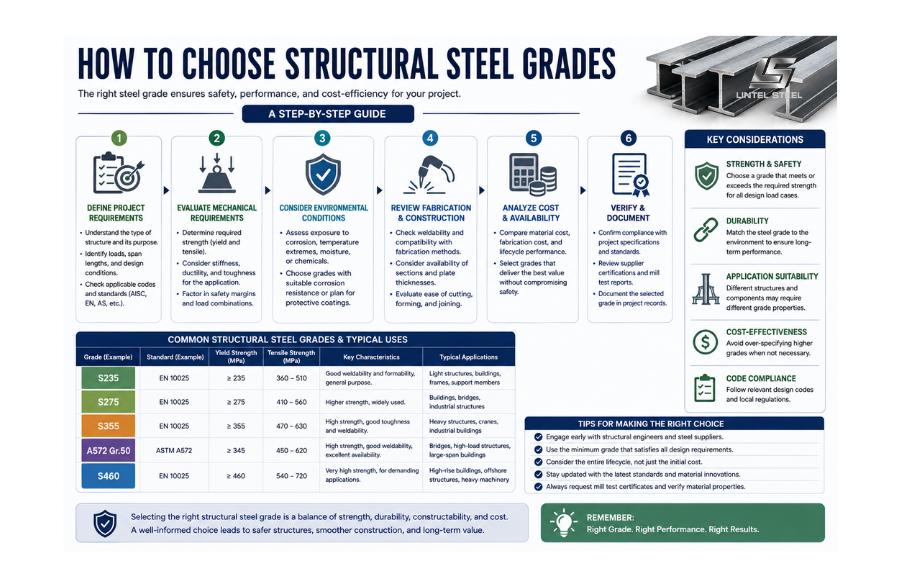
How to Choose Structural Steel Grades
Selection starts with the structural design. The engineer assesses loads, member geometry, stability, deflection, fatigue, fire requirements, and connection behavior. The required yield and tensile strengths are only part of that process.
The operating environment comes next. Structures exposed to low temperatures, impact, repeated loading, marine conditions, chemicals, or heavy weathering may need enhanced toughness or corrosion protection. Weathering steel may work well in some atmospheric conditions, while coated carbon steel or another material system may be more reliable in areas with salt, constant dampness, or poor ventilation.
Fabrication requirements must also be considered early. Welding processes, plate thickness, heat input, preheat, forming, cutting, and post-weld inspection can affect the most practical grade choice. Using a familiar, readily weldable grade may reduce risk and production time compared with selecting a higher-strength material that needs more demanding controls.
Availability is another practical factor. A grade that looks ideal on paper may cause delays or higher costs if it is not regularly stocked in the required shape, size, and thickness. Early communication among the engineer, fabricator, and supplier can identify readily available materials and prevent late substitutions.
Finally, confirm the documentation. Mill test reports or material test certificates should match the purchase order and project specification. They normally provide the heat number, chemical analysis, mechanical test results, grade, standard, and product information needed for traceability. The markings on the steel and the certificates should remain linked throughout fabrication when the project requires material identification.
Understanding Material Certification
Material certification provides evidence that the supplied steel meets the specified requirements. It is especially important because visual inspection alone cannot confirm a grade. Two plates can have the same dimensions and appearance while possessing different strength, toughness, or chemical properties.
Project quality procedures may require certificates to be checked before fabrication begins. The review should confirm the correct standard and grade, dimensions or thickness, heat identification, test values, and any required supplementary testing. If a certificate is incomplete or does not match the material markings, the discrepancy should be resolved before the steel is incorporated into the structure.
Certification does not replace engineering judgment, and a familiar grade name does not guarantee suitability for every use. The current edition of the governing standard, applicable building or bridge code, contract documents, and engineer’s specifications remain the controlling references.
Frequently Asked Questions About Structural Steel Grades
What is the most common structural steel grade?
The answer depends on the country and product. ASTM A992 is commonly specified for wide-flange building shapes in the United States, while ASTM A36 and ASTM A572 Grade 50 remain familiar for various structural products. In many projects designed to European standards, S275 and S355 are common choices. Availability and standard practice vary by market.
Does a higher grade always mean better steel?
No. A higher strength can reduce member weight in some cases, but it may not improve stiffness, fatigue performance, weldability, cost, or availability. “Better” means better suited to the complete set of project requirements.
Can ASTM A36 be replaced with S275?
Not without review. Their strength levels may appear similar, but ASTM and EN standards have different requirements and product coverage. The responsible engineer should compare the complete specifications and approve any substitution.
What is the difference between yield strength and tensile strength?
Yield strength is the stress at which steel begins to deform permanently. Tensile strength is the maximum stress it can resist before fracture during a tensile test. Structural design uses both properties, along with ductility, toughness, and other factors.
Does steel thickness affect the grade’s strength?
It can affect the minimum specified strength. Some standards assign lower minimum yield values as thickness increases. Always check the correct table in the current material standard instead of relying only on the grade number.
Final Thoughts
Structural steel grades provide a common language for designers, fabricators, contractors, and suppliers. They describe essential material properties, but they must be read together with the relevant standard, product type, thickness, subgrade, and project requirements.
The safest approach is to avoid choosing steel from a grade name alone. Consider strength, toughness, weldability, corrosion exposure, fabrication, availability, and certification as one connected decision. When substitutions or unusual conditions arise, consult the responsible structural engineer and verify the current governing standards before proceeding.
With those principles in mind, grade names such as ASTM A36, ASTM A572 Grade 50, ASTM A992, S275, and S355 become much easier to understand, and much more useful when selecting steel for a reliable, efficient structure.
Choose Lintel Steel – where precision meets performance in every structure we build.
Click here to get a quote and quantity takeoff for free.
You can find out more about us at our Fanpage Lintel Steel.


