
Why Accurate Steel Cutting Matters in Construction

Steel can carry substantial loads, span wide spaces and form the dependable framework behind homes, warehouses, workshops and commercial buildings. However, even a well-designed member can create problems when it is cut to the wrong length, angle or profile. Accurate steel cutting turns standard stock into components that fit the drawings, connect correctly and arrive ready for efficient assembly.
For builders, fabricators and project owners in Western Australia, accuracy can influence the whole construction program. A small error made in the workshop may become a large delay on site, especially when cranes, installers and other trades are waiting. Careful steel cutting helps reduce rework, protect budgets and produce a cleaner finished structure.
This guide explains why precision matters, how common cutting methods differ and what customers should provide when ordering processed steel. It offers general purchasing information rather than engineering or fabrication instructions. Structural dimensions, tolerances, connections and compliance requirements must always follow the approved documentation for the project.
What Does Steel Cutting Involve?
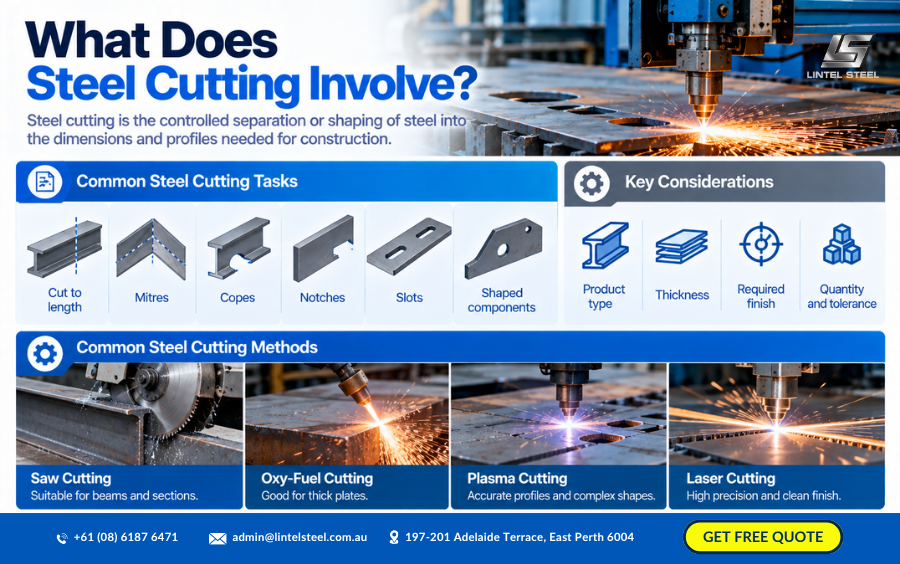
Steel cutting is the controlled separation or shaping of steel into the dimensions and profiles needed for construction. The work may be as simple as shortening a beam to a specified length, or it may involve mitres, copes, notches, slots and shaped plate components. Holes are generally drilled or profiled as a separate operation, but their position must coordinate precisely with every cut edge and connection detail.
The best process depends on the product, thickness, required finish, quantity and allowable tolerance. A structural beam may be sawn, a thick plate may be cut with oxy-fuel equipment, and a detailed plate profile may be produced by plasma or laser. No single method is automatically best for every job. Good steel cutting starts by matching the process to the drawing and the intended use of the component.
Why Accurate Steel Cutting Is Essential
A steel frame works as an interconnected system. Beams meet columns, plates align with holes, braces connect at designed angles and bearing surfaces transfer forces into supports. If one component is too long, too short or out of square, the error can affect several adjoining parts.
Accurate steel cutting supports correct fit-up and helps the completed frame reflect the engineer’s design. It also makes fabrication more predictable. Weld preparations can be formed in the right location, connection plates can sit as intended and installers are less likely to need unplanned modification. Accuracy does not replace structural design or inspection, but it helps turn those requirements into a buildable result.
Accurate Steel Cutting Improves Connection Fit
Connections are among the most important areas of a steel structure. Bolted end plates, cleats, splice plates, base plates and welded joints all rely on components meeting in the correct position. An incorrect end cut can create a gap, shift a bolt group or prevent a member from seating properly.
Trying to force a poorly fitting component into place is not an acceptable substitute for correct fabrication. It may introduce unintended stresses, damage finishes or require a design review. Precise steel cutting gives fabricators a reliable starting point for drilling, welding and trial assembly. On site, it allows connection details to come together with fewer surprises.
Steel Cutting and Dimensional Tolerances
Construction drawings contain nominal dimensions, but fabrication must also consider the permitted variation around those dimensions. This is known as tolerance. The acceptable tolerance depends on the component, connection, execution requirements and relevant project specification. A decorative item and a primary structural connection will not necessarily have the same requirements.
Professional steel cutting accounts for blade width or cutting kerf, equipment capability, heat effects and the sequence of fabrication. Operators measure the finished component rather than assuming that a machine setting alone guarantees the result. Where tighter tolerances are needed, that requirement should be identified before processing begins so the supplier can confirm an appropriate method.
Common Steel Cutting Methods for Construction
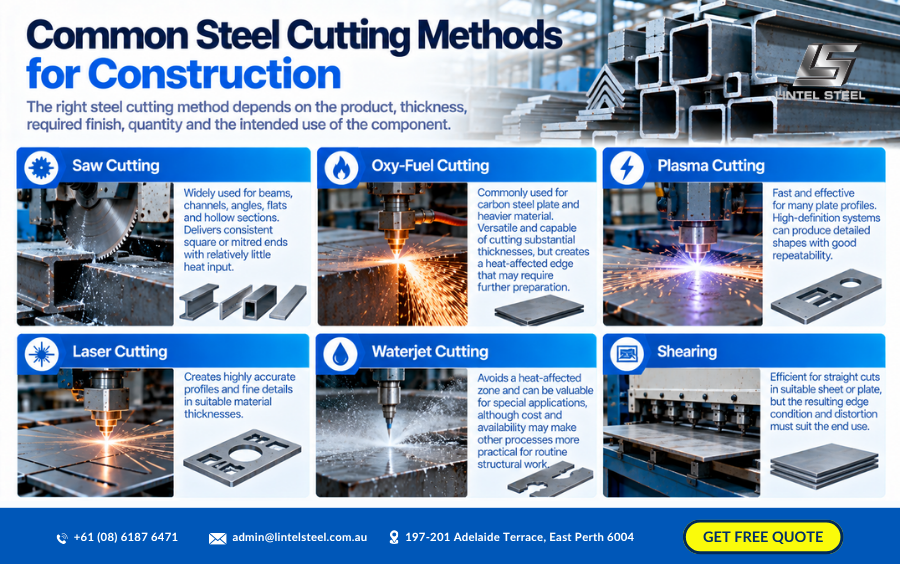
Saw cutting is widely used for beams, channels, angles, flats and hollow sections. Band saws can deliver consistent square or mitred ends with relatively little heat input. Cold saws are useful where a clean, controlled cut is required for suitable sizes and sections.
Oxy-fuel cutting is commonly associated with carbon steel plate and heavier material. It is versatile and capable of cutting substantial thicknesses, although it creates a heat-affected edge that may require cleaning or further preparation. Plasma cutting is fast and effective for many plate profiles, while high-definition systems can produce detailed shapes with good repeatability.
Laser cutting can create highly accurate profiles and fine details in suitable material thicknesses. Waterjet cutting avoids a heat-affected zone and can be valuable for special applications, although cost and availability may make other processes more practical for routine structural work. Shearing is efficient for straight cuts in suitable sheet or plate, but the resulting edge condition and distortion must suit the end use.
The right steel cutting method is therefore a project decision, not a marketing label. Section shape, grade, thickness, edge quality, quantity and downstream work should all be considered.
Steel Cutting for Beams, Columns and Channels
Universal beams, universal columns and parallel flange channels often need square ends, mitres, copes or notches to fit around adjoining members. Length is only one part of the requirement. The relationship between the web, flanges and connection geometry also matters.
A clean, accurately located cut can simplify the attachment of end plates, stiffeners and cleats. It can also improve bearing where a member is intended to sit on a plate or support. Because structural sections may have mill tolerances and slight variations, experienced processors consider the actual material as well as the drawing. Correct steel cutting helps these large members reach site ready for the planned erection sequence.
Steel Cutting for RHS, SHS and Other Hollow Sections
Rectangular hollow sections and square hollow sections are common in columns, frames, trusses, verandahs and architectural features. Their closed shape makes orientation important. A mitre that is correct on one face but inaccurate through the depth can leave an uneven joint and complicate welding.
Accurate steel cutting helps adjoining hollow sections meet with controlled gaps and consistent alignment. It also reduces the temptation to fill excessive gaps with weld metal. When a hollow section requires slots, access openings or special end shaping, the details should be coordinated with drainage, venting, corrosion protection and any later galvanising process.
Read more: Hollow Steel Tube: Common Sizes and 6 Essential Buying Guides
Steel Cutting for Plates and Connection Components
Base plates, gussets, cleats, brackets and stiffeners may be small compared with the main beams, but they play a major role in transferring loads. Their external profile, hole locations and edge distances must work together. An error at the edge of a plate can affect clearances or reduce the space available around a fastener.
Digital profiling equipment can produce repeated components efficiently when the input data is correct. However, automation does not remove the need for checking. Approved drawings, material identity, scale, units and revisions still need to be controlled. Quality steel cutting combines capable machinery with clear documentation and inspection.
How Steel Cutting Affects Welding
Welding quality begins before an arc is struck. Joint geometry, root gaps, bevel angles and edge condition can influence access, penetration and the amount of weld metal required. An inconsistent cut may increase preparation time or make it difficult to achieve the specified joint.
Thermal steel cutting can leave scale, dross or a heat-affected area that needs attention before welding, depending on the material and procedure. Saw-cut surfaces may still require deburring or bevel preparation. Fabrication should follow the applicable drawings, welding procedure specifications and relevant standards, including the appropriate part of the AS/NZS 1554 series where specified.
Accurate cuts do not guarantee a compliant weld, but they create better conditions for qualified personnel to perform and inspect the work.
Accurate Steel Cutting Reduces Site Rework
Construction sites are generally a poor place to discover a fabrication error. Access may be limited, weather can interfere and suitable cutting equipment may not be available. A member that needs modification can hold up a crane lift, installation crew and following trades. It may also need to return to the workshop.
Workshop steel cutting allows equipment, extraction, measurement and inspection to be managed in a controlled environment. Completing as much verified processing as practical before delivery can reduce hot work and material handling on site. This supports a smoother installation program, although site conditions and final measurements still need to be managed carefully.
Accurate Steel Cutting Supports Safer Work
Accuracy contributes to safer construction by helping components fit through the intended assembly process. Installers are less likely to struggle with misaligned parts or improvise modifications while a member is suspended. Clean, deburred edges can also reduce handling hazards.
Safety depends on much more than dimensions. Cutting equipment, hot work, fumes, fire prevention, lifting and installation all require competent people and suitable controls. Accurate steel cutting should be part of a broader quality and safety system, not treated as a stand-alone safeguard.
Steel Cutting Can Protect the Project Schedule
Steelwork is often on the critical path. Footings, frames, roofing, cladding and services may depend on fabricated members being available in the correct sequence. One missing or incorrect piece can interrupt work well beyond the steel package.
Reliable steel cutting helps suppliers produce repeatable components, label them clearly and group them for delivery. When the cutting list is coordinated with shop drawings and the erection sequence, the right steel can arrive when it is needed. Early confirmation of lead times, quantities and revisions is especially valuable for regional WA projects, where replacement material may have to travel a considerable distance.
Accurate Steel Cutting Helps Control Costs
The cheapest cut is not always the lowest-cost outcome. A slightly lower processing price offers little value if parts need grinding, re-cutting, extra welding or replacement. Project cost includes workshop labour, transport, crane time, site labour and the impact of delays.
Accurate steel cutting improves first-time fit and makes those wider costs easier to control. It can also support efficient nesting of plate profiles and planned use of stock lengths. Customers should compare quotes on the full scope: material grade, cutting method, tolerances, edge preparation, holes, identification, coating and delivery can all affect the real value of an order.
Steel Cutting Reduces Material Waste
Good planning can extract more usable components from each plate or stock length. Digital nesting arranges profiles to reduce offcuts, while an organised cutting list can combine project requirements around available lengths. Less waste can mean lower material cost and fewer movements through the workshop.
Some offcut is unavoidable, and the smallest possible remnant is not always the only goal. Grain direction where relevant, heat spacing, handling room and cut quality must still be considered. Responsible steel cutting balances material utilisation with safe, compliant production. Usable remnants can sometimes be retained for future work, while other scrap can enter established steel recycling streams.
Steel Cutting and Corrosion Protection in WA
Western Australia includes coastal, industrial, inland and remote environments, so corrosion exposure varies widely. Cut edges may need to be prepared as part of the specified protective coating system. Burrs, sharp corners, slag and surface contamination can prevent a coating from achieving consistent coverage.
For painted steel, the required surface preparation and coating build should follow the project specification. If components will be hot-dip galvanised after fabrication, cuts, holes, welds, venting and drainage need to be considered before the material reaches the galvaniser. If pre-galvanised or already coated steel is cut, the damaged protection may require an approved repair system.
The correct treatment is project-specific. A supplier should know the intended environment and coating process before steel cutting begins, particularly for sites near the WA coast.
Steel Cutting Quality Checks and Traceability
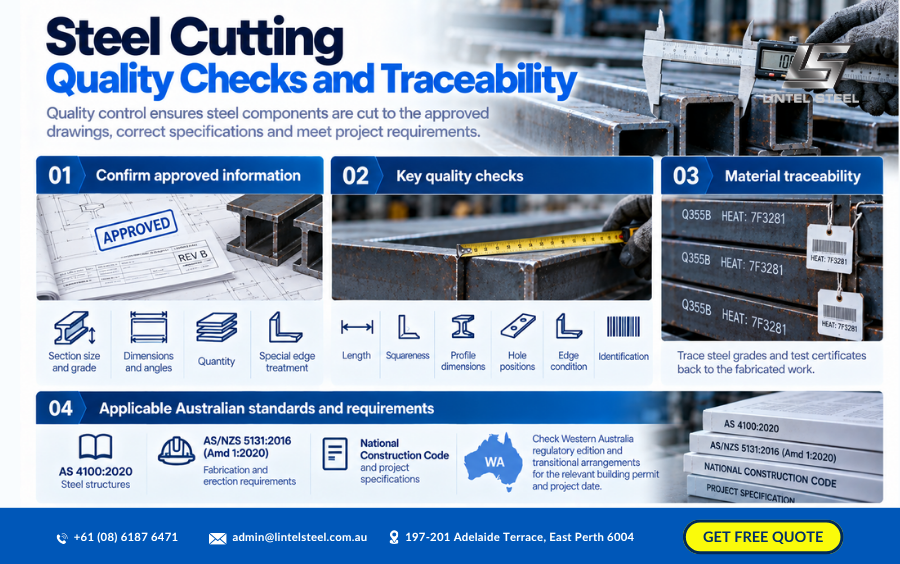
Quality control starts with the latest approved information. The processor should confirm section size, grade, quantity, dimensions, angles and any special edge treatment. Revision control is vital because a perfectly made component can still be wrong if it was produced from an outdated drawing.
Checks may include length, squareness, profile dimensions, hole positions, edge condition and identification. The inspection level should reflect the project specification and the importance of the component. Material traceability may also be required so steel grades and test certificates can be connected to the fabricated work.
Under Australia’s structural steel framework, AS 4100:2020 addresses steel structures, while AS/NZS 5131:2016, including Amendment 1:2020, covers fabrication and erection requirements. The applicable National Construction Code, contract documents and engineering specifications must also be followed. In Western Australia, the regulatory edition and transitional arrangements should be checked for the particular building permit and project date.
Information Needed for an Accurate Steel Cutting Order
A useful order begins with unambiguous documentation. Customers should provide the product type, section size, steel grade, quantity and finished dimensions. Drawings should identify square or mitred ends, orientation, copes, notches, bevels, holes and any areas that must not be marked. Units and tolerances should be stated rather than assumed.
It is also helpful to explain what happens next. The processor may need to know whether the component will be welded, bolted, galvanised, painted or left visible. Delivery sequence, piece marks and certification requirements should be agreed before production. Where dimensions depend on site conditions, they should be verified by the responsible party before steel cutting is authorised.
For structural components, the supplier should receive approved fabrication information. A steel retailer or processor can help clarify product availability and cutting capability, but changes to engineered details must go back to the appropriate designer.
Common Steel Cutting Problems to Avoid
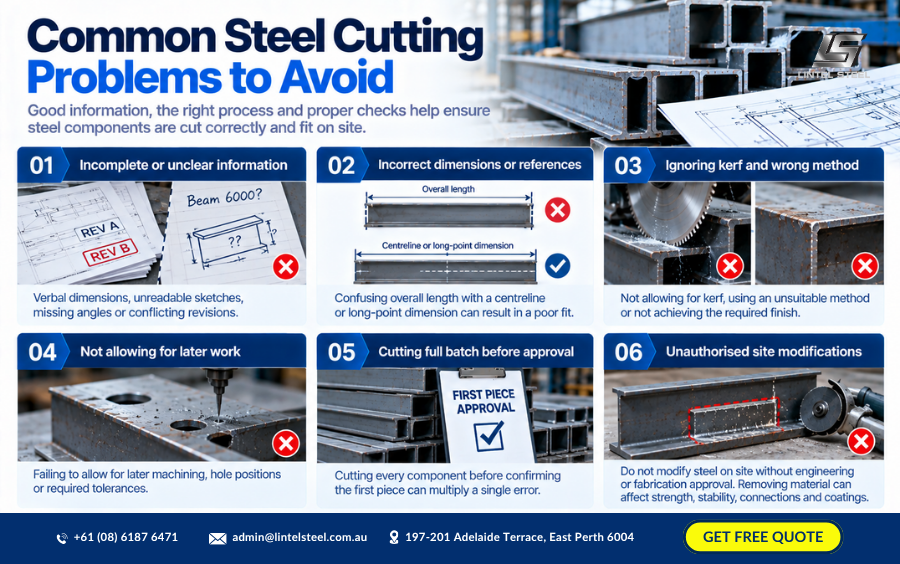
Many problems begin with incomplete information rather than the machine itself. Verbal dimensions, unreadable sketches, missing angles and conflicting drawing revisions create unnecessary risk. Confusing overall length with a centreline or long-point dimension can also produce a component that does not fit.
Other problems include ignoring kerf, using an unsuitable method for the required finish, failing to allow for later machining and overlooking coating repairs. Cutting every component before confirming the first piece can multiply a single error across the whole batch. Clear approvals and first-off checks can prevent that outcome.
Site modification without engineering or fabrication approval is another concern. Removing material can affect strength, stability, connections and protective coatings. When a mismatch is found, the correct response is to identify the cause and obtain authorised instructions rather than make an improvised change.
Choosing a Steel Cutting Supplier in Western Australia
A capable supplier should do more than operate cutting machinery. Look for clear communication, suitable equipment, reliable measurement, material identification and an understanding of downstream fabrication. The supplier should be willing to confirm what is included in the quote and flag unclear information before production starts.
Local stock access and processing can simplify procurement for Perth and regional WA projects. Ask whether the business can supply the required sections and grades, manage repeat components, provide relevant documentation and coordinate delivery. If your job includes fabrication, welding, drilling or coating, confirm which services are completed in-house and which are arranged through other providers.
Get free quote and quantity take-off here
Steel cutting on-site around Perth and WA
Frequently Asked Questions About Steel Cutting
What is the most accurate way to cut structural steel?
There is no universal answer. Laser, saw, plasma, oxy-fuel and waterjet processes each suit different materials, thicknesses, shapes and tolerances. The most appropriate steel cutting method is the one that achieves the documented requirement efficiently without creating unacceptable edge conditions or distortion.
Does cut steel always need further finishing?
Not always. Some saw-cut ends may only need deburring, while thermally cut edges can require removal of slag, scale or irregularities. Welding, painting, galvanising, visible finishes and specified edge quality may create additional preparation requirements.
Can a supplier determine structural dimensions for me?
A supplier can discuss available products and processing capability, but structural dimensions and connection details should come from the project’s approved drawings and responsible design professionals. Do not ask a cutter to substitute assumptions for engineering documentation.
Why is site cutting sometimes more expensive?
Site work can involve mobilisation, permits, restricted access, fire controls, weather and disruption to other trades. Workshop processing is often more controlled and repeatable. Site steel cutting may still be necessary for authorised adjustments, but accurate measurement and prefabrication can reduce it.
How early should cut steel be ordered?
Timing depends on stock, quantity, processing complexity, coating and delivery location. Ordering early allows time for drawing review, material procurement and quality checks. Confirming lead times is particularly important for large packages and regional Western Australian deliveries.
Get Reliable Steel Cutting for Your WA Project
Accurate steel cutting connects good design with efficient construction. It helps beams, columns, hollow sections and plates fit as intended; supports welding and coating; reduces waste; and limits expensive surprises during erection. The result is not simply a neater edge—it is a more predictable steel package.
If you are ordering structural steel in Western Australia, provide clear drawings, confirmed dimensions and the intended finish as early as possible. A knowledgeable steel supplier can help match the material and processing method to your order, coordinate practical lead times and deliver components ready for the next stage of work.
Contact our team to discuss steel products, cutting requirements and delivery for your Perth or regional WA construction project. All structural work should be selected, detailed, fabricated and installed in accordance with the approved design, current regulations and applicable standards.
Authoritative Resources
- Standards Australia, “Revised steel standards to support industry”: https://www.standards.org.au/news/revised-steel-standards-to-support-industry
- Australian Building Codes Board, National Construction Code: https://ncc.abcb.gov.au/
- Western Australian Government, Building and Energy: https://www.wa.gov.au/organisation/building-and-energy
- Safe Work Australia, welding processes guidance: https://www.safeworkaustralia.gov.au/


