
Structural Steel Welding: Methods and Best Practices

Welded connections are found throughout residential, commercial and industrial construction. They join end plates to beams, stiffeners to columns, brackets to hollow sections and individual plates into custom structural members. When the work is properly designed, prepared, completed and inspected, welding creates strong and efficient connections that are well suited to modern steel construction.
Good results do not come from the welding machine alone. Structural steel welding depends on correct materials, approved procedures, qualified personnel, suitable consumables, accurate fit-up, controlled heat input, inspection and reliable documentation. A weld can appear smooth while still failing to meet the engineering or quality requirements of the project.
This guide explains structural steel welding methods and best practices in friendly language for customers buying steel products in Western Australia. It is intended to help builders, developers and buyers understand the fabrication process. It is not a welding procedure, design guide or substitute for qualified engineering, fabrication and workplace safety advice.
What Is Structural Steel Welding?
Structural steel welding is a controlled process that joins steel components by using heat, pressure or a combination of both to create a permanent connection. In building fabrication, an electric arc commonly melts the edges of the parent steel and a consumable electrode or wire. The molten material cools and solidifies into a weld that transfers forces between the connected parts.
Typical welded components include beam end plates, column base plates, cleats, stiffeners, splice plates, trusses, brackets, lintels, stairs and fabricated girders. Welding may take place in a workshop, on site or in both locations, depending on transport limits and the connection strategy.
Structural steel welding is different from a cosmetic weld. The joint must achieve specified capacity, geometry and quality. The engineer defines the connection requirements, while the fabricator develops and follows the appropriate welding procedures and quality controls.
Why Structural Steel Welding Quality Matters
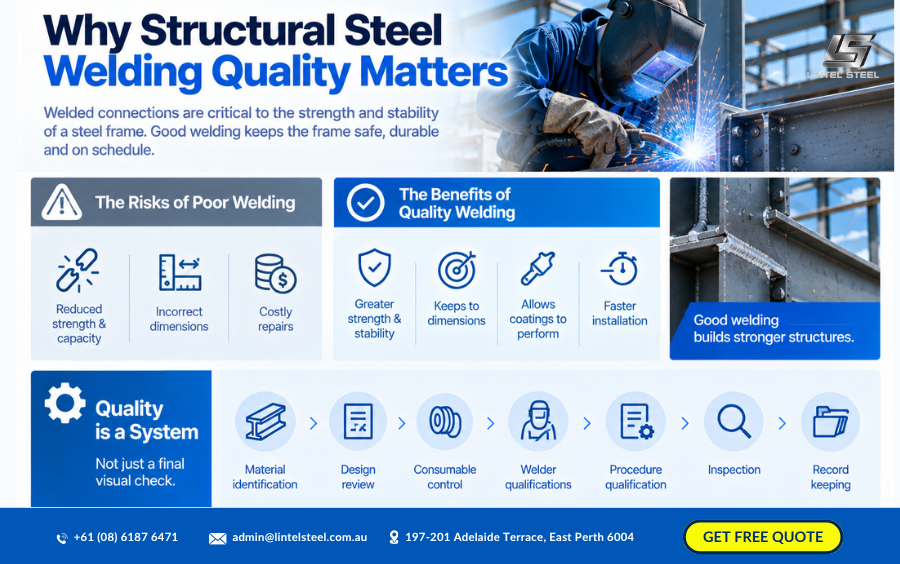
Welded connections can be critical to the strength and stability of a steel frame. Defects, incorrect dimensions or unsuitable procedures may reduce the capacity of a joint and affect how loads move through the building. Repairs can also become expensive once steel has been coated or delivered to site.
Quality structural steel welding improves more than strength. Controlled work helps members remain within dimensional tolerances, allows coatings to perform properly and supports faster installation. Accurate workshop welding can reduce the amount of hot work required on a busy construction site.
Quality is achieved through a system, not a final visual check. Material identification, design review, consumable control, welder qualifications, procedure qualification, inspection and record keeping all contribute to a dependable result.
Structural Steel Welding Design Comes First
Before welding begins, the connection must be designed and detailed. The engineer determines the forces to be transferred and specifies the joint arrangement, weld type, size, length and any special requirements. The detailer converts that information into workshop drawings.
Good design considers access for the welder, electrode angle, inspection, coating and erection. A weld that is theoretically adequate but impossible to reach consistently is not a practical detail. Crowded joints can also trap moisture or make surface preparation difficult.
Structural steel welding should not be increased by guesswork. Adding weld metal may introduce more heat, distortion, labour and residual stress without improving the intended connection. Any proposed change to an engineered weld requires the appropriate design review and approval.
Common Structural Steel Welding Methods
Several arc-welding processes are used in Australian structural fabrication. The right method depends on steel type, thickness, joint position, required productivity, workshop conditions, site exposure and the approved welding procedure.
Gas metal arc welding and flux-cored arc welding are common in workshops because continuous wire feeding supports efficient production. Manual metal arc welding remains useful for site work, repairs and situations where portability or access matters. Submerged arc welding can provide high deposition rates for long, repeatable welds on suitable fabricated members.
The process name alone does not determine quality. Structural steel welding performance depends on matching the process, wire or electrode, shielding, power settings, preparation and operator technique to the joint and material.
Structural Steel Welding with Gas Metal Arc Welding
Gas metal arc welding, often known as GMAW or MIG welding, uses a continuously fed wire electrode and shielding gas. It can provide good productivity, relatively low slag and a clean finish in controlled workshop conditions.
The shielding gas protects the molten weld pool from atmospheric contamination. Wind can disturb this shield, which is one reason the process needs careful control outdoors. Wire type, gas composition, transfer mode, voltage and feed speed must match the approved procedure.
For structural steel welding, GMAW is useful where production is repetitive and joints are accessible. It does not remove the need for clean surfaces, sound fit-up, qualified welders or inspection. Incorrect settings can produce lack of fusion, excessive spatter or other discontinuities.
Structural Steel Welding with Flux-Cored Arc Welding
Flux-cored arc welding, or FCAW, uses a tubular wire containing flux ingredients. Gas-shielded varieties are widely used for structural fabrication because they can achieve strong deposition rates and work in several positions. Self-shielded products are available for applications where external shielding gas is not used.
The flux creates slag and helps protect the weld pool. Slag must be removed between passes and before inspection or coating. Entrapped slag, poor cleaning or unsuitable technique can create defects within a multi-pass weld.
FCAW can be productive for fillet welds, groove welds and heavier steelwork. The correct consumable classification and procedure are essential because “flux-cored wire” describes a family of products rather than one interchangeable material.
Structural Steel Welding with Manual Metal Arc Welding
Manual metal arc welding, also called MMAW or stick welding, uses flux-coated electrodes held by the welder. The equipment is portable and versatile, making the process valuable for construction sites, repairs and short welds where moving wire-feeding equipment would be impractical.
Each electrode is consumed and replaced, and the slag is removed after every run. Electrode storage and handling are important, particularly for low-hydrogen consumables that may require controlled drying and exposure times.
Manual structural steel welding is sensitive to technique and can be slower for long production welds. In skilled hands and under an approved procedure, however, it remains a practical and widely recognised method.
Structural Steel Welding with Submerged Arc Welding
Submerged arc welding, or SAW, feeds wire beneath a blanket of granular flux. The arc is hidden below the flux, and the process can deliver high deposition rates with deep penetration and consistent quality on suitable joints.
SAW is commonly associated with long, straight welds on fabricated beams, girders, columns and plate assemblies. It is generally mechanised or automated and works best in favourable positions where equipment can travel along the joint.
Because the process is less suited to small, irregular or out-of-position connections, it complements rather than replaces other structural steel welding methods. Joint preparation, flux condition, parameters and run sequence still require control.
Structural Steel Welding Joint Types
Structural connections use several joint arrangements. Fillet welds join surfaces that meet at an angle and are common for end plates, cleats and stiffeners. Butt or groove welds join parts along prepared edges and can transfer forces through the full or partial thickness of the material, depending on design.
Lap joints, T-joints, corner joints and splices can use different weld configurations. Weld symbols on the drawings communicate the intended type, size, length, location and other requirements. Fabricators and inspectors must interpret those symbols consistently.
The chosen structural steel welding joint should provide the required force path while allowing access, inspection and corrosion protection. The connection detail must come from the engineering documents rather than workshop preference alone.
Fillet Welds in Structural Steel Welding
Fillet welds are among the most familiar welds in steel fabrication. Their triangular cross-section joins two surfaces, such as a plate placed against the flange or web of a beam. Drawings nominate the required size and length.
More weld is not automatically better. An undersized fillet may lack capacity, while an oversized fillet consumes additional time and consumables, introduces extra heat and can increase distortion. The throat dimension and effective length are central to structural performance.
Consistent fit-up helps produce reliable fillets. Large gaps, contamination, poor access or irregular edges can change the result. Structural steel welding procedures should address joint condition and permitted tolerances before production begins.
Butt Welds in Structural Steel Welding
Butt welds connect components placed edge to edge. The edges may be square or prepared with bevels, grooves or backing arrangements so the arc can reach the required depth. Complete penetration and partial penetration welds serve different design purposes and should not be confused.
Preparation accuracy is important. Root opening, bevel angle, alignment and backing affect penetration and fusion. Multi-pass welds require cleaning and inspection between layers, while welding sequence influences shrinkage and distortion.
Some critical butt welds require non-destructive testing beyond visual inspection. The specified inspection level should be known before structural steel welding begins so access and hold points can be planned.
Structural Steel Welding Procedures
A welding procedure specification, commonly called a WPS, tells the production team how a weld is to be made. It can define the process, parent material, consumable, joint preparation, position, electrical range, travel conditions, preheat and other essential variables.
The procedure must be supported in the manner required by the applicable standard and project. Qualification demonstrates that the proposed combination can produce an acceptable weld when followed correctly. Changing an essential variable outside the qualified range may require a different or newly qualified procedure.
For structural steel welding buyers, the practical lesson is simple: a fabricator should not choose settings by feel for every joint. Qualified procedures create repeatability, guide welders and give inspectors a clear basis for verification.
Welder Qualifications for Structural Steel Welding
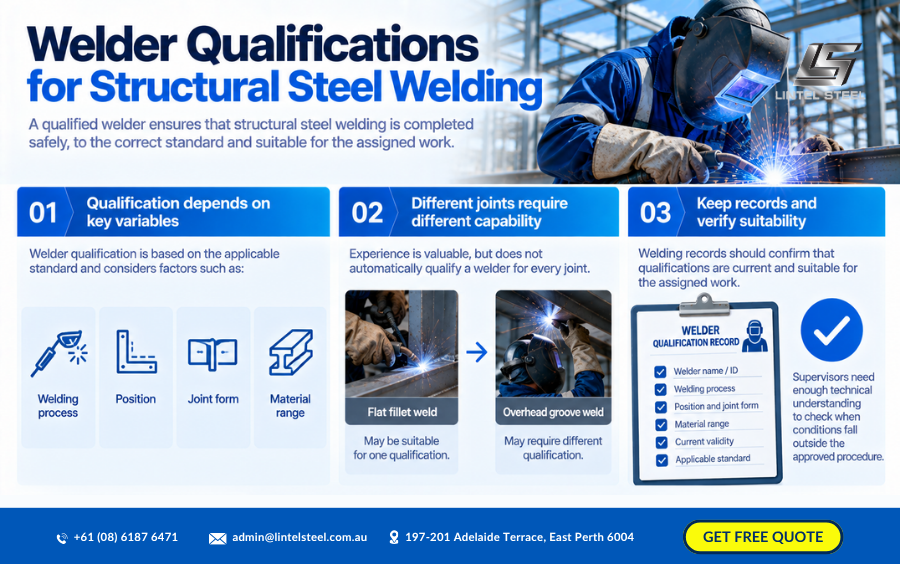
Even a good procedure needs a welder who is qualified for the relevant process and work. Qualification typically considers variables such as welding process, position, joint form and material range under the applicable standard.
A person’s general experience is valuable but does not automatically prove qualification for every joint. A welder competent on a flat fillet weld may need different capability for an overhead groove weld or tubular connection.
Structural steel welding records should show that qualifications are current and suitable for the assigned work. Supervisors also need enough technical understanding to recognise when site or workshop conditions fall outside the approved procedure.
Material Identification in Structural Steel Welding
Steel grade and product type influence weldability. Material strength, chemical composition, thickness and manufacturing route can affect consumable selection, preheat and procedure requirements. Two members with the same external dimensions may not have the same properties.
Fabricators preserve material identity through tags, marks, certificates or digital systems. If an offcut loses its grade identification, it should not be used for a structural component based on appearance alone.
Reliable traceability supports structural steel welding and final documentation. It helps the workshop confirm that parent materials match the drawings and that the procedure is suitable for the actual steel being joined.
Structural Steel Welding Surface Preparation
Joint surfaces need to be clean enough for the approved process. Oil, paint, heavy rust, moisture, scale, zinc and other contaminants can affect arc stability, introduce defects or create hazardous fumes. The required preparation depends on the procedure and material.
Thermally cut edges may need dressing or examination, particularly where cutting has produced notches, hardened areas or irregular profiles. Burrs and poor fit-up should be corrected before welding rather than hidden beneath deposited metal.
Surface preparation is also important after structural steel welding. Slag, spatter and sharp defects can interfere with paint or galvanising. The final condition should meet both welding and corrosion-protection requirements.
Structural Steel Welding Fit-Up
Fit-up positions components before final welding. Assemblers use drawings, jigs, clamps and measuring equipment to set alignment, root gaps and joint geometry. Tack welds hold parts during handling and production.
Tacks are not casual temporary marks. If they become part of the finished weld, they need suitable quality and compatible consumables. Cracked or defective tacks must be removed according to the procedure rather than welded over.
Accurate fit-up makes structural steel welding easier and reduces the temptation to fill excessive gaps. It also helps finished beams, columns and frames remain within the dimensional tolerances needed for site installation.
Preheat in Structural Steel Welding
Preheat raises the temperature of steel around the joint before welding. Where required, it slows cooling, assists hydrogen control and can reduce the risk of cracking. The necessary temperature depends on factors such as material composition, thickness, restraint, consumable and heat input.
Preheat is not determined by touching the steel or following one temperature for every job. The procedure defines how it is measured, the area to be heated and any interpass temperature limits. Suitable instruments confirm compliance.
Structural steel welding in cold, windy or damp conditions needs particular attention to moisture and temperature. Heating should be controlled and uniform; uncontrolled flame heating can create its own problems.
Hydrogen Control in Structural Steel Welding
Hydrogen-assisted cracking can occur when susceptible steel, tensile stress and diffusible hydrogen combine. Cracks may appear after the weld has cooled, making prevention essential. Low-hydrogen consumables, clean dry joints, preheat and controlled storage can help manage the risk.
Electrodes and fluxes should be stored, conditioned and issued according to manufacturer instructions and the welding procedure. Leaving moisture-sensitive consumables exposed in the workshop or on site can compromise their performance.
Hydrogen control is one reason structural steel welding cannot be reduced to bead appearance. A weld that looks acceptable immediately may still contain conditions that contribute to delayed cracking.
Read more: How Structural Steel Is Installed on a Construction Site
Structural Steel Welding Heat Input
Heat input influences penetration, cooling rate, microstructure and distortion. Too little heat can contribute to lack of fusion, while excessive heat can enlarge the heat-affected zone, reduce productivity through distortion and affect material properties.
Voltage, current and travel speed work together, so changing one setting changes the thermal cycle. Welders should remain within the qualified procedure range rather than adjusting parameters purely for convenience.
Controlled heat input allows structural steel welding to deliver the required fusion without unnecessarily heating the entire assembly. Production records may be required for particular joints or project categories.
Structural Steel Welding Distortion Control
Weld metal shrinks as it cools, pulling connected parts and potentially causing bow, twist or angular distortion. Large weld volumes, poor sequence and heavily restrained joints can make movement more difficult to control.
Fabricators may use balanced welding sequences, back-step methods, jigs, clamps, presetting and strategically placed tacks. The best method depends on the member and must not introduce harmful restraint or unapproved heat treatment.
Dimensional checks during structural steel welding catch movement before it accumulates. Correcting a small change between weld stages is generally easier than straightening a completed and coated frame.
Structural Steel Welding Positions
Welding position describes how the joint and weld pool are oriented. Flat and horizontal positions are often more productive and easier to control, while vertical and overhead welding demand different technique and may have different procedure limits.
Workshop layout can rotate members so important welds are made in favourable positions. Positioners, rotators and manipulators improve access and consistency. Large assemblies or site connections may not offer that flexibility.
The assigned welder and WPS must cover the required position. Structural steel welding planning should consider orientation during detailing and assembly rather than leaving access decisions until the joint is ready.
Workshop and Site Structural Steel Welding
Workshop welding offers controlled access, lighting, ventilation, equipment and weather protection. Members can be positioned for efficient work, and inspection is easier to schedule. For these reasons, projects often maximise shop welding and use bolted site connections.
Site welding remains necessary for some splices, alterations and continuity details. Wind, rain, working height, restricted access and nearby combustible materials create additional controls. Temporary stability must also be maintained while a connection is incomplete.
Structural steel welding on site should follow the same approved technical requirements as workshop work, with extra attention to environmental conditions, fume control, fire prevention, access and coating repair.
Structural Steel Welding Inspection
Inspection begins before welding. The inspector can review drawings, procedures, welder qualifications, material identity, consumables, joint preparation and fit-up. During welding, checks may cover cleaning, preheat, parameters and sequence.
Completed welds receive visual inspection for size, length, profile and visible discontinuities. Depending on the joint and specification, non-destructive testing may also be required. Inspection findings are assessed against the applicable acceptance criteria rather than personal preference.
Good structural steel welding inspection is independent of production pressure. Hold points should be respected, and inaccessible welds should be inspected before plates, coatings or later components cover them.
Non-Destructive Testing for Structural Steel Welding
Non-destructive testing examines welds without damaging the completed connection. Magnetic particle testing can find certain surface and near-surface discontinuities in ferromagnetic steel. Ultrasonic testing can assess internal features, while radiography, penetrant testing or other methods may suit particular situations.
No single test finds every possible defect. The engineer or specification defines the method, extent and acceptance requirements according to joint type, risk and applicable standard. Personnel performing the work need appropriate qualifications.
NDT supports structural steel welding quality but does not replace controlled procedures and competent welders. Testing every completed weld would not correct poor material control, unsuitable design or defective fit-up.
Structural Steel Welding Defects and Repairs
Common weld discontinuities can include cracks, lack of fusion, incomplete penetration, porosity, slag inclusions, undercut and incorrect profile. Whether a discontinuity is acceptable depends on its type, size, location and the applicable criteria.
Nonconforming areas should be documented and evaluated. An approved repair may involve controlled removal of the defect, preparation, rewelding and reinspection. Repeated repair adds heat and can affect the component, so the cause should be investigated rather than simply repeating the same technique.
Structural steel welding repairs must remain traceable. Grinding a defect away or covering it with extra weld metal without assessment can hide the problem rather than resolve it.
Structural Steel Welding and Corrosion Protection
Welding affects protective coatings. Shop primer, paint or zinc near a joint may need removal before welding, followed by suitable preparation and reinstatement. Welding through coatings can cause defects, fumes or contamination unless a specifically approved system and procedure allow it.
For hot-dip galvanised assemblies, most fabrication is completed before immersion. If site welding damages the zinc coating, the affected area requires an approved galvanising repair method. Weld details should also avoid water traps and allow coating access.
Western Australian coastal environments make these details especially important. Structural steel welding and corrosion protection should be coordinated as one system, not treated as unrelated trades.
Structural Steel Welding Safety and Fume Control
Welding hazards include electric shock, radiation, hot metal, fire, compressed gases, noise and hazardous fumes. Australian workplaces must manage these risks using the applicable work health and safety framework and site-specific controls.
Welding fumes are a complex mixture whose composition depends on the process, parent metal, consumables, coatings and contaminants. Safe Work Australia states a workplace exposure standard of 1 mg/m³ as an eight-hour time-weighted average for total welding fumes, with additional exposure standards applying to individual components where relevant. Jurisdictional implementation and current requirements should be confirmed with WorkSafe WA.
Effective controls can include process selection, removal of coatings, local exhaust ventilation, general ventilation, isolation and suitable respiratory protection where required. Personal protective equipment is important, but structural steel welding safety begins by eliminating or reducing exposure at the source so far as reasonably practicable.
Structural Steel Welding Under Australian Standards
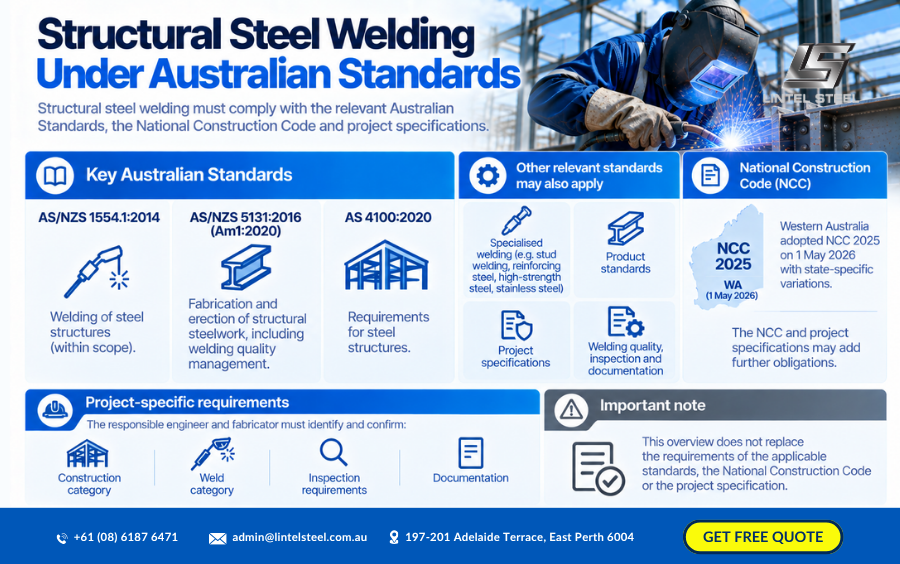
AS/NZS 1554.1:2014 covers welding of steel structures for the materials and applications within its scope. Other parts of the AS/NZS 1554 series apply to specialised work such as stud welding, reinforcing steel, high-strength quenched and tempered steel or stainless steel.
AS/NZS 5131:2016, including Amendment 1:2020, establishes requirements for fabrication and erection of structural steelwork, including welding quality management. AS 4100:2020 provides requirements for steel structures. Product standards, the National Construction Code and project specifications may add further obligations.
Western Australia adopted NCC 2025 on 1 May 2026 with state variations. The responsible engineer and fabricator must identify the standards, construction category, weld category, inspection and documentation relevant to the project. This structural steel welding overview does not replace those requirements.
Structural Steel Welding Documentation
Documentation demonstrates that production followed the approved quality system. A project file may contain material certificates, welding procedure specifications, procedure qualification records, welder qualifications, consumable records, inspection reports, NDT results, nonconformance reports and repair records.
The required package depends on the construction category and contract. It should be agreed before pricing because additional traceability, testing and reporting require time and resources.
Creating records during structural steel welding is more reliable than rebuilding them at handover. Digital systems can connect member marks with material, welder and inspection information for easier retrieval.
Structural Steel Welding Best Practices
The strongest practice is to coordinate design, detailing, materials, welding and inspection from the beginning. Use approved drawings, preserve material identification and confirm that the joint can be accessed and welded in a qualified position.
Keep joint surfaces clean and dry, control consumables, verify fit-up and follow the WPS. Monitor preheat and heat input where required, use a planned sequence to manage distortion and inspect work before it becomes inaccessible.
For structural steel welding in WA, also plan for coastal coatings, hot weather, site wind and fume extraction. Quality and safety should be built into the workflow rather than checked only after a member is complete.
Common Structural Steel Welding Mistakes
One frequent mistake is assuming that an experienced welder can work without a suitable procedure. Another is using an electrode or wire because it is available rather than because it matches the joint, steel and WPS.
Poor fit-up, contaminated edges, damp consumables, missing preheat and uncontrolled sequence can create defects or distortion. Overwelding wastes time and heat, while unapproved site welding can damage coatings and alter engineered connections.
Late inspection is another avoidable problem. Structural steel welding should include planned hold points so defects can be corrected before further assembly, coating or delivery makes access difficult.
Choosing a Structural Steel Welding Supplier in WA
Buyers should look beyond a workshop’s ability to produce a visually neat bead. Ask whether the fabricator works to the required construction category, maintains suitable procedures and welder qualifications, controls materials and consumables, and can provide the specified inspection records.
Workshop equipment, lifting capability, coating partners and experience with similar members also affect delivery. A fabricator accustomed to small residential beams may need different resources for heavy trusses or complex commercial frames.
When requesting a structural steel welding quotation, provide current engineering drawings, specifications, steel grades, coating requirements, inspection scope and delivery details. Clear information produces a price that is easier to compare and less vulnerable to later variation.
Structural Steel Welding Cost Factors
Welding cost depends on joint type, weld volume, preparation, position, accessibility, consumable, procedure, fit-up, inspection and distortion control. A connection with many short welds can require more handling and starts than one long, accessible joint.
Testing, traceability and documentation also affect cost. Site welding generally adds access, weather and mobilisation considerations, while workshop welding can benefit from jigs, positioning equipment and controlled conditions.
Efficient structural steel welding does not mean reducing required welds or inspection. It means designing practical connections, standardising details where appropriate and completing quality work without preventable repair.
Get free quote and quantity take-off here
Frequently Asked Questions About Structural Steel Welding
Which welding method is best for structural steel?
There is no single best method. GMAW and FCAW are productive in workshops, MMAW is portable and useful on site, and SAW suits long mechanised welds. The procedure, material, position and project requirements determine the appropriate process.
Can any welder complete structural steel connections?
No. Welders need qualifications appropriate to the process and work under the applicable standard and project specification. A general trade background does not automatically cover every structural joint, position or material.
Is a larger weld always stronger?
Not necessarily. The engineered weld size is selected to transfer the required forces. Oversized welding can add heat, distortion and cost without increasing useful connection capacity.
Can painted or galvanised steel be welded?
It can be welded under controlled procedures, but coatings near the joint may need removal, and fumes, contamination and coating repair must be managed. The approved project details should be followed.
Why is preheat used?
Where required, preheat slows cooling and helps control hydrogen-related cracking. The temperature depends on the steel, thickness, restraint, consumable and procedure; it is not the same for every weld.
How are structural welds inspected?
All specified welds receive the required visual inspection, and selected joints may need magnetic particle, ultrasonic, radiographic or other non-destructive testing. The method and extent come from the applicable specification.
Better Structural Steel Welding for WA Projects
Reliable welded steelwork begins with an engineered connection and continues through every workshop decision. Correct steel, qualified procedures, competent welders, controlled consumables, accurate fit-up and timely inspection all support the final result.
For builders and developers, early coordination is the easiest way to avoid welding delays. Finalise member sizes, connection details, coating systems and inspection requirements before fabrication starts. If site welding is unavoidable, plan access, temporary stability, weather protection and coating repair at the same time.
If you need beams, columns, channels, angles, plates or hollow sections supplied and processed for a Western Australian project, send current drawings and specifications to an experienced steel supplier. A clear scope will support accurate pricing, efficient fabrication and structural steel welding that matches the project requirements.
Authoritative Resources
For current requirements, consult Standards Australia, the Australian Steel Institute, Safe Work Australia’s welding guidance, WorkSafe Western Australia and the National Construction Code. Project documents may reference AS/NZS 1554.1:2014, AS/NZS 5131:2016 including Amendment 1:2020, AS 4100:2020 and other standards relevant to the materials and welding application.
This article provides general information only.


