
Universal Beams vs Universal Columns: What’s the Difference?

Universal beams and universal columns are two of the most widely used hot-rolled steel sections in Australian construction. At first glance, they look almost identical because both have an H- or I-shaped cross-section with two flanges connected by a central web. Their proportions, however, are designed for different structural jobs.
The short explanation is that universal beams are usually deeper and are commonly selected to resist bending across a span. Universal columns are more compact, with flange widths closer to their overall depth, which makes them well suited to carrying compression and bending in more than one direction.
Understanding universal beams vs universal columns helps builders read structural schedules, order the right sections, plan connections, and identify potential mistakes before steel is fabricated or erected. This guide explains their main differences in friendly, practical language, with terminology relevant to Australian projects.
Universal Beams vs Columns: The Short Answer
In the universal beams vs universal columns comparison, the most obvious difference is proportion. A universal beam, usually abbreviated as UB, tends to be deeper than it is wide. A universal column, or UC, generally has a squatter profile with wider flanges relative to its depth.
That geometry reflects the member’s typical role. A beam spans horizontally between supports and carries loads that create bending and shear. Increasing the distance between the top and bottom flanges helps the section resist bending efficiently. A column usually stands vertically and carries compression, often combined with bending, so balanced properties and resistance to buckling about both main axes become more important.
This does not mean every UB must be horizontal or every UC must be vertical. Engineers may use a universal beam as a column or a universal column as a beam when its calculated capacity, stability, connections, availability, and geometry suit the project. The section name describes its product family and usual application, not an absolute rule about orientation.
The safest way to approach universal beams vs universal columns is to follow the full designation on the approved drawings. Visual similarity is not enough to identify a section, and neither weight nor depth alone confirms that one member can replace another.
What Is a Universal Beam?
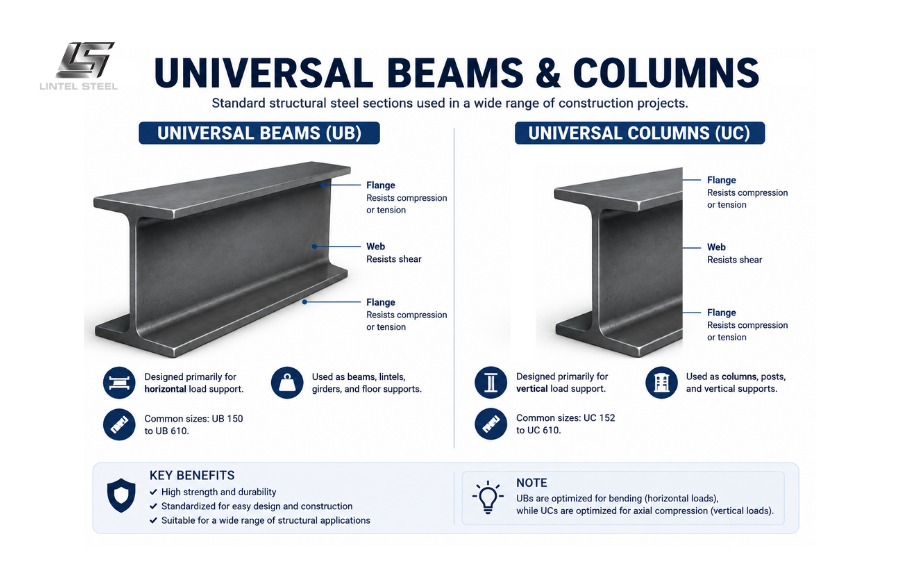
In the universal beams vs columns comparison, a universal beam is the deeper hot-rolled section with two parallel flanges connected by a vertical web. Its cross-section resembles a capital I when viewed from the end. Australian schedules normally identify it with the abbreviation UB.
The flanges resist much of the tension and compression caused by bending, while the web carries much of the shear and keeps the flanges apart. This distribution places material where it works efficiently, allowing UBs to carry significant loads without the weight of a solid rectangular section of similar depth.
In the discussion of universal beams vs universal columns, the beam’s greater depth is its main advantage. Depth increases the separation between the flanges, which generally improves bending stiffness and resistance about the strong axis. That is why UBs are common in floor systems, roof framing, transfer structures, platforms, bridges, lintels, and industrial buildings.
Australian universal beams in a range of serial sizes manufactured to exceed the minimum requirements of AS/NZS 3679.1. The product designation and published table provide the information needed to confirm actual dimensions, mass per metre, and availability.
What Is a Universal Column?
Within universal beams vs columns, a universal column is the more compact hot-rolled H- or I-shaped section, with flanges that are relatively wide compared with its overall depth. Australian structural drawings usually use the abbreviation UC.
Columns primarily transfer vertical loads from beams and floors toward the foundations. They must resist compression and remain stable against buckling. Depending on the framing system and connection arrangement, they may also carry bending from one or both directions.
The compact proportions central to universal beams vs universal columns give UCs useful properties around both principal axes. They are not equally strong in every direction, but the difference between their major- and minor-axis behaviour is generally less extreme than it is for a deep, narrow UB.
Universal columns are common in multi-storey frames, portal frames, transfer structures, industrial buildings, mezzanines, supports for heavy equipment, and residential projects requiring compact steel posts. Australian universal columns manufactured from structural steel complying with the relevant hot-rolled section standard.
Universal Beams vs Columns in Shape and Proportions
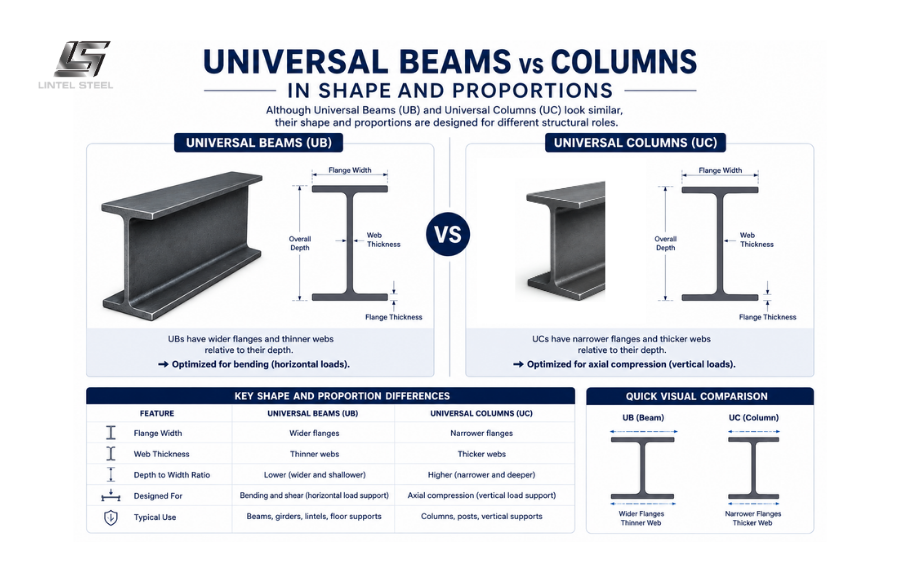
Looking at universal beams vs universal columns from the end is the easiest way to understand their geometry. Both have a web running between two parallel flanges, but a UB usually has a noticeably greater overall depth. A UC appears broader and more compact because its flange width is closer to its depth.
The deeper UB profile is efficient when bending occurs mainly about one strong axis. Material in the flanges sits farther from the centre of the section, increasing the member’s resistance and stiffness for that direction of bending.
The UC’s compact shape gives it a larger radius of gyration about its weaker axis than a comparably deep, narrow beam might provide. That characteristic can improve buckling performance where a member carries compression, although actual capacity still depends on section size, grade, length, restraints, imperfections, and applied moments.
Another difference in universal beams vs universal columns is the connection surface. Wide UC flanges provide convenient faces for beams approaching from different sides. They can also allow a relatively compact column to sit within wall zones or architectural layouts. UB flanges are often narrower relative to depth but remain practical for many bolted and welded beam connections.
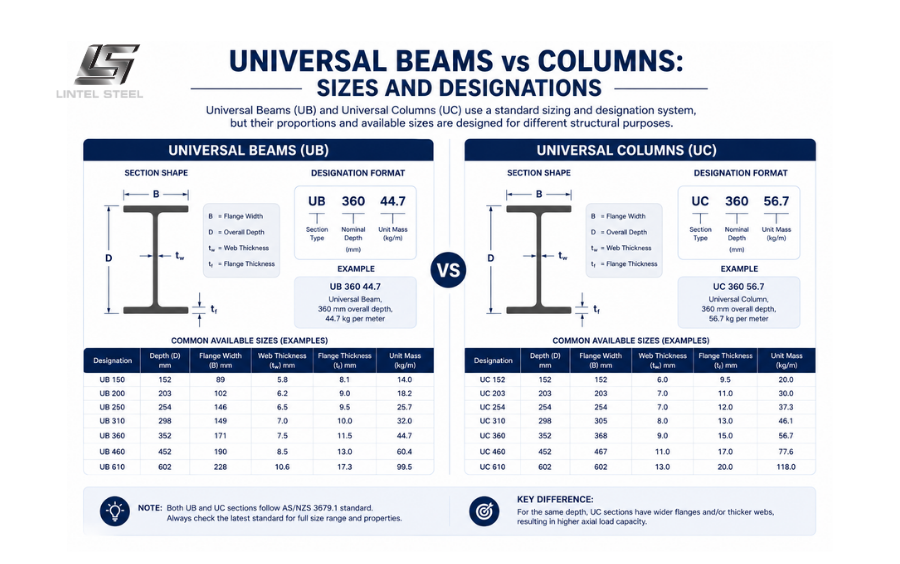
Actual dimensions must come from the correct section table. The serial name uses nominal information and should not be treated as a precise measurement of depth or width. Several members in the same serial group can have different flange thicknesses, web thicknesses, widths, depths, and mass.
Universal Beams vs Universal Columns in Structural Behaviour
The structural difference between universal beams vs columns begins with the dominant force. Beams are typically governed by bending, shear, deflection, vibration, and lateral-torsional buckling. Columns are commonly governed by compression, flexural buckling, combined compression and bending, and overall frame stability.
When a simply supported UB carries downward loading, its upper flange generally goes into compression while its lower flange goes into tension. The web carries shear, which is often greatest near the supports. If the compression flange is not restrained, the beam can move sideways and twist before the steel reaches its full bending resistance.
A UC carrying compression behaves differently. Small initial imperfections and unavoidable load eccentricities cause real columns to bend slightly. As the member becomes more slender, buckling can control capacity before the cross-section reaches its full squash load. Restraint at floors, beams, braces, and connections affects the effective buckling length.
Comparing universal beams vs universal columns only by cross-sectional area is therefore misleading. Two members with similar mass per metre can have very different moments of inertia, section moduli, radii of gyration, torsional properties, and local slenderness. The correct choice depends on the entire load and restraint condition.
Serviceability matters as well. A UB may be strong enough but too flexible for a floor’s deflection or vibration limits. A UC may have adequate compressive resistance but create unwanted frame movement if connections and lateral stability are not properly considered.
Universal Beams vs Columns: Sizes and Designations
Australian UB and UC designations normally include a serial size followed by mass in kilograms per metre. A designation such as 310UB40.4 identifies a universal beam in the nominal 310 series with a mass of 40.4 kilograms per metre. A UC designation follows the same general idea but includes UC to identify the column family.
The numbers do not provide every exact dimension. When comparing universal beams vs universal columns, builders should check overall depth, flange width, web thickness, flange thickness, root radii, and mass in the current product table. These values affect fit, connection details, fire protection, surface area, lifting weight, and structural properties.
It is also important to read the full steel grade and product standard. A section designation identifies geometry, while the grade identifies material properties such as yield strength. Universal beams vs columns cannot be compared safely from the section name alone if their specified grades or certification requirements differ.
International notation may look different. British schedules also use UB and UC, but available ranges and grades should be checked against the relevant project standard. North American drawings commonly use W-shapes rather than separate UB and UC product labels; designers select appropriate wide-flange proportions for beam or column behaviour.
Avoid converting one designation into another by rounding metric or imperial dimensions. Similar nominal depths do not guarantee equal capacity, stiffness, weight, or connection geometry. Any international substitution requires an engineering comparison of the complete properties and standards.
Universal Beams vs Universal Columns: Typical Applications
The usual applications of universal beams vs universal columns follow their geometry. UBs commonly span between columns or walls to support floors, roofs, cladding, equipment, and other beams. They are also used for lintels, bridge elements, transfer beams, crane-support members, and horizontal framing in residential and commercial buildings.
UCs normally support beams and carry loads vertically through one or more storeys. Their compact dimensions suit internal and perimeter columns, portal-frame legs, mezzanine supports, residential posts, industrial frames, and members carrying compression with bending.
Multi-storey steel frames demonstrate the relationship clearly. Guidance from SteelConstruction.info notes that columns in braced multi-storey frames are commonly hot-rolled UC sections, while floor beams span between them. The beam reactions enter the columns and continue downward through splices and base plates.
In residential work, universal beams vs columns often appear together when a load-bearing wall is removed. A UB may span over the new opening, while a UC or another engineered post supports one or both ends. The floor and foundation below must then be checked for the concentrated reactions.
Industrial projects may use UBs for crane beams, platforms, rafters, and equipment support, while UCs act as frame columns. However, large axial forces, dynamic loading, fatigue, temperature, or connection demands may lead engineers to choose welded sections, hollow sections, or built-up members instead.
Can Universal Beams Be Used as Columns?
Yes. The universal beams vs universal columns naming convention does not prevent a universal beam from being used as a column when an engineer confirms adequate compression resistance, buckling capacity, bending resistance, and connection performance. Product names describe typical use, not an absolute restriction on structural role.
The universal beams vs universal columns decision may favour a UB where its depth aligns with a wall, where availability is better, or where bending about one axis is significant. A UB might also match an existing structure or simplify a particular connection.
The main limitation is usually weak-axis behaviour. Deep, relatively narrow UBs may have less buckling resistance about their minor axis than a UC of similar mass. Additional bracing, a shorter unrestrained length, a heavier section, or a different orientation may be required.
Builders should not stand a spare beam vertically and assume it is a suitable post. Universal beams vs columns must be assessed using actual loads, member length, restraint, steel grade, section properties, base details, and connection forces.
Can Universal Columns Be Used as Beams?
Yes. The universal beams vs universal columns distinction does not prevent a UC from acting as a beam. It may be selected for a transfer member, short heavily loaded span, moment-frame element, shallow-depth zone, or connection arrangement that benefits from wide flanges.
In a universal beams vs columns comparison for bending, a UB will often provide greater strong-axis efficiency because it is deeper. A UC of similar mass may need more steel to achieve the same stiffness or bending resistance over a long span. However, depth restrictions and connection requirements can make a UC the more practical choice.
Wide UC flanges can be useful where loads arrive from both sides or where large connection plates need space. The compact section may also fit beneath a ceiling or within an architectural zone where a deeper UB would clash with services.
Using a UC as a beam remains an engineering decision. The member must be checked for bending, shear, deflection, lateral stability, local effects, web bearing, connection forces, and any combined axial load.
Universal Beams vs Columns in Connections
Connections are a major practical factor in universal beams vs universal columns. A typical simple beam-to-column connection transfers the beam’s vertical reaction into the column while allowing some end rotation. Fin plates, end plates, cleats, or seated details may be used depending on the design and regional practice.
Moment connections transfer substantial bending as well as shear. They can involve flange plates, end plates, direct welding, haunches, stiffeners, continuity plates, or other details. UC flange width and thickness may help accommodate these forces, but every connection requires calculation and detailing.
At a column base, a UC usually connects to a base plate that spreads compression into concrete and works with holding-down bolts to resist shear, uplift, or moment where required. Grout, stiffeners, welds, concrete strength, edge distances, and foundation reinforcement all influence performance.
The universal beams vs columns choice can change connection geometry even if the two candidate members have similar mass. Flange width affects bolt layout, web depth affects plate length, and thickness influences welding and local capacity. A substitution that fits structurally may still require new shop drawings and redesigned connections.
Access during fabrication and erection should also be considered. Bolts need installation and tightening space, welds need suitable preparation and inspection, and temporary stability must be maintained until the frame is complete.
Universal Beams vs Universal Columns in Fabrication and Erection
Both section families can be cut, drilled, coped, welded, cambered, coated, and fitted with plates in a fabrication workshop. The operations are similar, but the proportions of universal beams vs universal columns influence handling, connection layout, and distortion control.
UBs often require web copes or notches where they frame into other members. UCs may receive connection plates on several faces, column splices, base plates, stiffeners, and temporary erection fittings. Accurate orientation is essential because connection holes and plates may not be symmetrical.
During erection, long UBs may be more prone to lateral movement or twisting until connected and braced. UCs need stable bases, temporary support, and accurate vertical alignment. The erection sequence must keep the incomplete frame stable under construction loads and weather.
Comparing universal beams vs columns by weight alone does not capture lifting behaviour. Member length, centre of gravity, lifting points, attachments, and orientation affect crane planning. A long, slender beam may require more controlled lifting than a shorter column with a similar total mass.
Field cutting, hole enlargement, flange removal, or unapproved welding can change capacity. Any mismatch should be recorded and referred to the fabricator and engineer rather than corrected informally on site.
Universal Beams vs Columns: Cost and Availability
The material cost of universal beams vs universal columns depends on mass, length, grade, supplier, market conditions, and availability. Fabrication, coatings, transport, fire protection, connections, and erection can be just as important as the price per tonne.
Standard stocked sections are generally faster and more economical to source than uncommon sizes requiring a special order. Australian suppliers carry ranges of UBs and UCs, but stock varies by location. Early consultation can identify practical alternatives before the drawings are finalised.
A lighter beam is not always the lowest-cost solution. A slightly heavier UB might remove the need for web stiffeners, reduce deflection, or simplify connections. A compact UC might save architectural space or improve connection access even if its material weight is higher than another option.
Any value-engineering review of universal beams vs universal columns should consider total installed cost and programme. Proposed changes need approval because they can affect reactions, stiffness distribution, connection design, base plates, fireproofing, cladding, and adjoining trades.
How to Identify Universal Beams vs Columns on Site
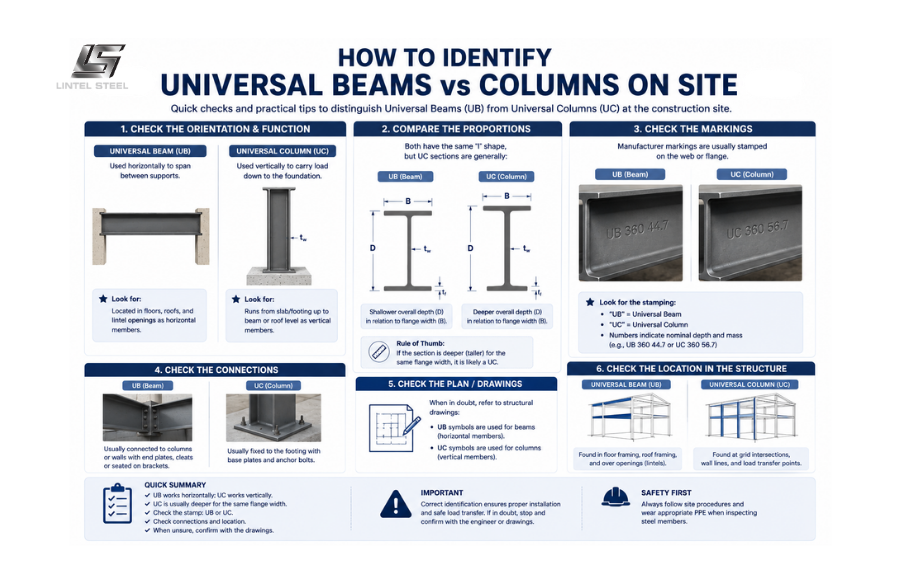
Start with the member mark and the current approved shop drawing. The mark connects the physical steel to its section designation, grade, length, orientation, and connection details. Paint marks, tags, stamps, or barcodes may support the fabricator’s tracking system.
The visible shape gives an initial clue in the universal beams vs universal columns check. A UB generally looks deeper and narrower, while a UC looks squatter and wider. This visual check is useful, but it is not proof because sizes overlap and perspective can be misleading.
When checking universal beams vs universal columns, measure more than overall depth if a discrepancy is suspected. Flange width, flange thickness, web thickness, and mass can help distinguish closely related sections. Product tolerances apply, so measurements should be evaluated against the correct standard and method.
Do not install a member simply because it fits the opening. If universal beams vs columns have been mixed up, the wrong piece may create inadequate capacity, incorrect connections, level problems, or an unstable erection condition. Quarantine the item and obtain clarification before proceeding.
Material certificates should match the specified product and grade where traceability is required. The section size and steel grade are separate pieces of information, and both must comply with the project documents.
Common Mistakes When Comparing Universal Beams vs Columns
A common mistake is assuming that a UC is stronger than a UB because the word “column” sounds heavier. Strength depends on the exact section, direction of loading, member length, restraint, grade, and failure mode. There is no universal ranking that makes one family stronger in every situation.
Another mistake is comparing only nominal depth. Universal beams vs universal columns with similar depths can have very different flange widths, thicknesses, weights, and properties. The full designation and section table are necessary.
Builders may also assume that a heavier replacement is automatically acceptable. Additional weight does not guarantee equal bending efficiency or buckling resistance, and different dimensions may conflict with connections or finishes. Every substitution requires design approval.
Confusing orientation is another risk. Turning a UB or UC through 90 degrees dramatically changes which axis resists bending. Fabricated plates, holes, copes, and camber can also make one end or face different from another.
Finally, universal beams vs universal columns should not be selected from informal span charts or visual experience alone. Load combinations, deflection, vibration, lateral restraint, fire, corrosion, and connection forces all require project-specific consideration.
How Engineers Choose Universal Beams vs Columns
Engineers begin with the member’s structural role, loads, span or height, support conditions, and restraint. They calculate forces and compare candidate sections using the applicable design standard and verified section properties.
For a beam, strong-axis bending efficiency, shear capacity, deflection, vibration, and lateral stability often lead to a UB. For a column, axial resistance, buckling about both axes, combined bending, and connection geometry often make a UC more efficient.
The universal beams vs universal columns choice also considers architecture and building services. A deep UB may reduce steel weight but increase floor depth, while a compact UC used as a beam might fit beneath ducts or within a tight ceiling zone. A wide UC may suit multi-directional connections but occupy more wall width.
Availability, fabrication, transport, erection, coatings, and fire protection are also reviewed. The best section is the one that meets all design and construction requirements efficiently, not simply the member with the lowest theoretical mass.
Builders and fabricators can improve the decision by providing early information about stock, processing capacity, crane access, delivery limits, and preferred connection practices. The engineer remains responsible for approving the final selection.
Frequently Asked Questions About Universal Beams vs Columns
What is the main difference between a UB and a UC?
In simple universal beams vs universal columns terms, a UB is generally deeper and narrower, making it efficient for strong-axis bending across a span. A UC is more compact with relatively wide flanges, making it well suited to compression and bending about more than one axis.
Is a universal column stronger than a universal beam?
Not automatically. The answer depends on the exact sizes, steel grades, loading direction, length, restraint, and failure mode. A UB may be more efficient for strong-axis bending, while a UC may perform better as a compression member.
Can a UB be installed vertically?
Yes, if the engineer has designed or approved it as a column. Its weak-axis buckling resistance and restraints require careful checking. Orientation alone does not determine whether the section is suitable.
Can a UC be installed horizontally?
Yes. UCs can be used as beams where their bending, shear, deflection, stability, and connections are adequate. They are sometimes chosen for short heavy spans, transfer members, or restricted-depth areas.
How are Australian UB and UC sizes written?
The designation generally includes a nominal serial size, the letters UB or UC, and mass in kilograms per metre. Always use the current product table for exact dimensions and section properties.
Can a builder substitute a UB for a UC?
Only after engineering review and documented approval. The substitution can change buckling resistance, bending stiffness, connection geometry, reactions, member weight, fire protection, and fit with other building elements.
Final Thoughts
The universal beams vs universal columns distinction is mainly about proportion and typical structural role. UBs are usually deeper and commonly used to resist bending across spans. UCs are more compact and commonly used to carry compression with possible bending from one or more directions.
Their similar appearance does not make them interchangeable. Exact section properties, grade, length, restraint, orientation, connections, fabrication, and serviceability all affect performance. A UB can serve as a column and a UC can serve as a beam, but only when the engineer verifies the application.
Understanding universal beams vs universal columns gives builders a better foundation for reading drawings, checking deliveries, coordinating connections, and raising questions early. The final rule is simple: use the complete approved designation and never substitute structural steel based on appearance alone.
Choose Lintel Steel – where precision meets performance in every structure we build.
Click here to get a quote and quantity takeoff for free.
You can find out more about us at our Fanpage Lintel Steel.


