
Steel Angles: Equal vs Unequal Angles Explained

Steel angle is one of the simplest structural sections, but choosing the correct type can make a major difference to fabrication, fit and structural performance. With an L-shaped cross-section, steel angles are used throughout residential construction, commercial buildings, mining projects, workshops and general fabrication across Western Australia.
The two main forms are equal angles and unequal angles. They may look similar at first glance, yet their proportions suit different loads, connection details and space constraints. This guide explains how each type works, where it is commonly used and what to check before ordering material for a WA project.
What Are Steel Angles?
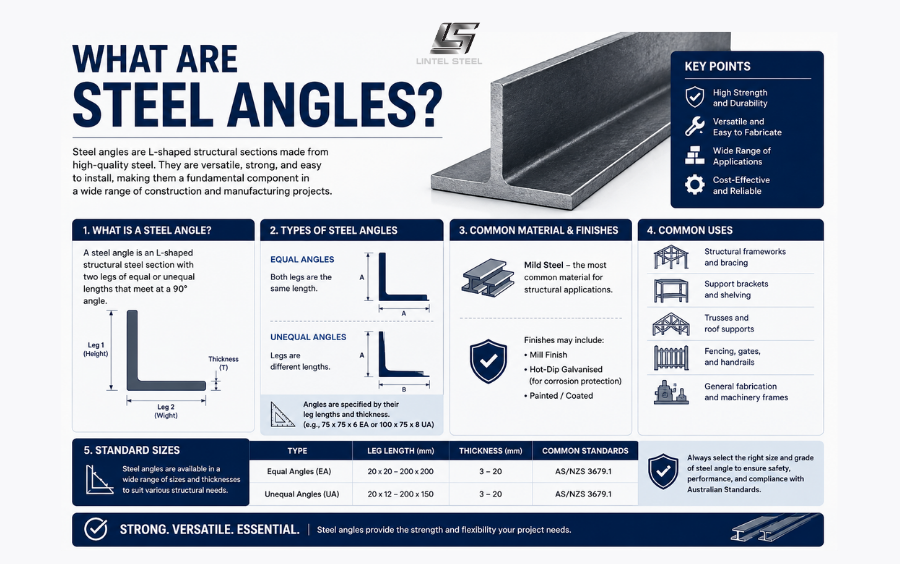
Steel angles are hot-rolled or cold-formed sections shaped like the letter L. Each side of the L is called a leg, while the inside meeting point is the heel and the outer edges are the toes. The shape places material in two perpendicular planes, making an angle useful for bracing, framing, edge support and connections between structural components.
In Australian structural work, hot-rolled equal and unequal angles are commonly specified to AS/NZS 3679.1, the standard covering structural steel hot-rolled bars and sections. Grade 300 is widely used for general structural applications, although the grade, dimensions and finish must always match the engineer’s drawings and project specification.
A typical designation records the leg widths and thickness in millimetres. An equal angle described as 75 × 75 × 6 has two 75 mm legs and is 6 mm thick. An unequal angle described as 100 × 75 × 8 has a 100 mm long leg, a 75 mm short leg and an 8 mm thickness. Length is normally stated separately when placing an order.
That naming system makes steel angles easy to identify, but size alone does not confirm their structural capacity. The steel grade, length, orientation, connection, effective length and type of loading also affect performance. Any load-bearing selection should therefore be made or confirmed by a suitably qualified structural engineer.
Equal Steel Angles Explained
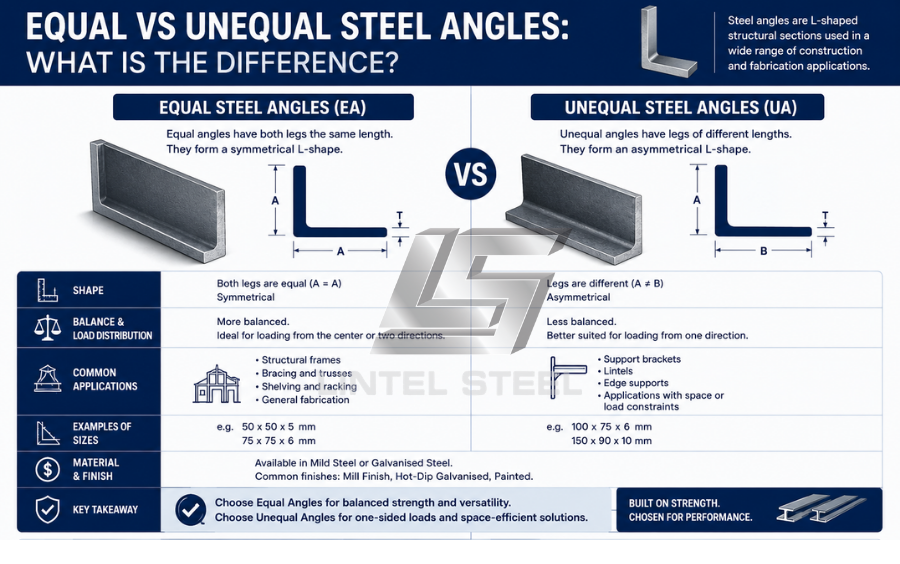
Equal steel angles have legs of identical width. When viewed from the end, the section has a balanced L shape, such as 50 × 50 × 5 or 100 × 100 × 10. This symmetry makes equal angles convenient for details where either leg can be placed against the connected component.
Their straightforward geometry is useful in repetitive fabrication. A fabricator has less chance of rotating the member incorrectly, and connection holes can often be detailed consistently. Equal angles are commonly found in roof trusses, wall bracing, small frames, cleats, lintel components, supports, racks and fabricated brackets.
Equal steel angles are also popular when loads and connection demands are reasonably balanced between both legs. In back-to-back arrangements, two sections can be joined to create a built-up member for trusses, bracing or other engineered applications. They can also be welded to plate, beams, columns or other sections to form practical connection details.
However, equal legs do not mean the section behaves identically in every loading direction. An L section is not doubly symmetrical like some beam sections, and loads applied away from its centroid can introduce bending and twisting. The engineer must consider the actual orientation and connection rather than selecting an equal angle simply because it looks balanced.
Unequal Steel Angles Explained
Unequal steel angles have one leg longer than the other. Common descriptions include proportions such as 75 × 50 or 150 × 90, with the thickness shown as the third dimension. The long leg provides more surface area for a connection or places additional steel where the design requires it.
This shape can be valuable when one side of a bracket must carry more load, when a wider face is needed for bolts or welds, or when the available space restricts the other leg. Unequal angles are often used in equipment frames, shelf supports, lintels, trailer and transport fabrication, industrial platforms, connection cleats and structural details around openings.
The orientation of unequal steel angles matters. Turning the long leg from one plane to another changes the geometry relative to the load and connected members. Drawings should clearly show which leg is vertical, horizontal or fixed to the supporting structure. Fabricators should confirm this detail before drilling, notching or welding.
Unequal sections can also help achieve an efficient detail without moving to a larger equal angle. That does not automatically make them lighter or stronger in every case. Their suitability depends on the required section properties, connection eccentricity, buckling behaviour and available stock sizes.
Equal vs Unequal Steel Angles: What Is the Difference?
The visible difference is the leg length. Equal steel angles use two matching legs, while unequal angles combine a long leg and a short leg. In practice, this affects how the member fits, connects and responds to forces.
Equal angles are often the simpler option for general-purpose frames, symmetrical bracing layouts and repeated brackets. They are easy to orient and are available in a broad range of common sizes. When both connection faces need similar width, the equal profile usually provides a clean and economical solution.
Unequal angles are better suited to asymmetric details. The long leg can provide room for multiple bolt lines, a longer weld or greater bearing area, while the short leg reduces projection into a restricted space. This can be particularly useful where structural steel meets masonry, timber, concrete, cladding or mechanical equipment.
The correct choice is not based on appearance alone. Two steel angles with similar mass per metre can have different section properties because their material is distributed differently. An engineer may choose an unequal angle to place more steel in the critical direction, manage a connection or work around geometric limitations.
Common Applications for Steel Angles in Western Australia
Western Australian construction uses steel angles in projects ranging from suburban homes to major industrial facilities. In residential building, they may form lintels, brackets, supports, frames and connection cleats. They are also used in patios, carports, sheds and renovations where compact steel components can support or connect other materials.
In commercial construction, angles can support masonry, façade elements, services, platforms and secondary framing. Their flat legs are easy to bolt or weld to other components, which makes them useful wherever a simple change of plane is required.
Mining, agriculture and infrastructure projects use steel angles for equipment frames, conveyor supports, walkways, guards, racks and maintenance platforms. These environments often require heavier sections, documented steel grades, traceability and carefully selected protective coatings.
General fabricators use angles for benches, gates, trailers, storage systems and machinery supports. Not every fabricated item is structural, but material thickness, welding method and corrosion exposure still deserve attention. Selecting a suitable section at the start usually produces a neater result with less cutting and reinforcement later.
Understanding Steel Angles Sizes and Grades
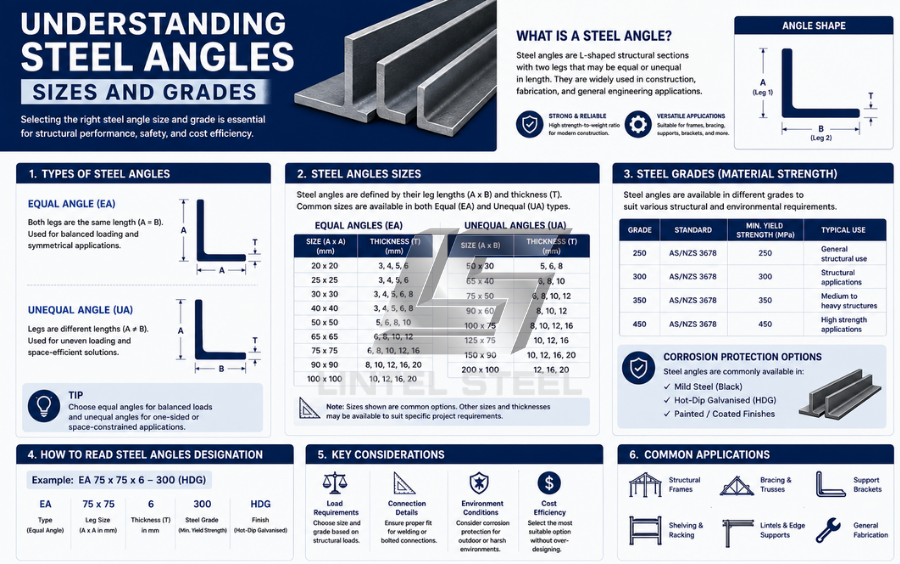
Angle size is normally written as leg × leg × thickness for an equal section, or long leg × short leg × thickness for an unequal section. All dimensions should be read in millimetres unless the documentation states otherwise. For example, 65 × 65 × 6 describes an equal angle, while 125 × 75 × 10 describes an unequal angle.
As the legs and thickness increase, the mass per metre generally increases as well. This affects material cost, handling, transport and the total dead load added to the structure. Suppliers may stock standard mill lengths and offer cutting to suit, but available lengths and section ranges can vary by location.
The project specification should identify the required grade and manufacturing standard. AS/NZS 3679.1 covers hot-rolled structural bars and sections, including EA and UA products. Australian Steel Institute guidance lists Grade 300 equal angles and unequal angles as products specified to this standard. Grade designations relate to strength, but the applicable design value can also depend on section thickness.
When ordering structural steel angles, do not substitute a different grade, thickness or leg size simply because it appears close. Even a small dimensional change can affect bolt edge distances, weld length, alignment and design capacity. Ask the engineer or detailer to approve any proposed alternative before fabrication begins.
Fabricating and Connecting Steel Angles
One reason steel angles are so widely used is that they are relatively simple to process. Depending on the section and project, they can be cut to length, drilled, punched, slotted, welded or incorporated into larger fabricated assemblies. Accurate shop drawings remain essential because angle connections are often sensitive to orientation and hole position.
Bolted connections need suitable hole sizes, edge distances, bolt spacing and access for installation. A connection that fits comfortably on the long leg of an unequal angle may be too crowded on its short leg. Welded details must consider the specified welding standard, steel grade, member thickness and access for a sound weld.
The inside corner of a hot-rolled angle has a root radius rather than a perfectly sharp 90-degree corner. Plates, washers or adjacent sections placed too close to the heel may not sit flat. Good detailing allows for this radius and for normal manufacturing tolerances.
Cut edges, holes and weld areas also need attention when a protective coating is specified. If the completed assembly will be hot-dip galvanised, drainage, venting and fabrication details should be coordinated before it reaches the galvaniser. AS/NZS 4680:2025 sets general properties and test methods for hot-dip galvanised coatings on fabricated iron and steel articles.
Choosing a Finish for Steel Angles in WA
The right finish depends on the service environment and the expected design life. Black steel may be suitable for protected indoor fabrication or where a separate coating system will be applied. Primed, painted or hot-dip galvanised steel angles may be specified for exposed conditions.
Western Australia includes coastal, tropical, industrial and inland environments, so corrosion risk varies considerably. A detail used inside a dry Perth warehouse will face different exposure from steel installed near the coast or at a remote processing facility. Salt, moisture, chemicals, temperature and maintenance access should all be considered.
Protective treatment should be selected as part of the design rather than after fabrication. Welding or drilling through a finished coating can damage the protection and require approved repair. Areas that trap water or debris can also corrode sooner, even when the overall member is coated.
For structural work, follow the coating system shown in the drawings and specification. If the required finish is unclear, confirm it before ordering. A local supplier can explain available finishes and processing services, but the project designer remains responsible for the exposure classification and required protection system.
How to Choose Between Equal and Unequal Steel Angles
Begin with the drawings. If a structural engineer has nominated an EA or UA section, use that exact designation unless an alternative is formally approved. The member has usually been selected to satisfy both structural capacity and connection geometry.
For non-structural fabrication, consider which leg needs the greatest connection area, how the angle will be oriented and how much space is available. Equal steel angles are often the most convenient for balanced frames and general bracing. Unequal angles are useful when one face needs to be wider or the other needs to remain compact.
Also consider the complete supply requirement: steel grade, standard, finish, stock length, cut length, quantity and processing. Supplying this information in one request helps the steel supplier quote accurately and reduces delays caused by follow-up questions.
Weight and transport should not be overlooked. Ordering full lengths can be economical for repeated fabrication, while cut-to-length supply may reduce site handling and waste. For regional WA projects, consolidating materials and confirming delivery access can make the overall order more efficient.
Ordering Steel Angles From a Western Australian Supplier
An accurate order should state whether the section is equal or unequal, followed by its full dimensions, grade, finish, length and quantity. Where relevant, include cutting, drilling, punching or other processing requirements and provide approved drawings.
Check stock availability before finalising a fabrication schedule. Common equal sizes may be readily available, while some unequal steel angles, heavy sections or special lengths may need additional lead time. Early coordination is especially important for regional deliveries and projects with galvanising or extensive processing.
A reliable WA construction-material supplier can help interpret the product designation, calculate the required total length and identify practical supply options. However, the supplier should not be expected to redesign a structural member. Any change that affects size, grade, connection or intended use should return to the project engineer for approval.
Whether you need a small quantity for a residential job or a larger order for commercial, industrial or mining work, send our team your steel schedule or drawings for a quote. Lintel Steel can help you source the right steel angles, organise suitable processing and plan delivery across Western Australia.
Get free quote and quantity take-off for your order here.
Frequently Asked Questions About Steel Angles
Are equal angles stronger than unequal angles?
Not automatically. Strength depends on the section dimensions, thickness, grade, orientation, effective length, connection and applied loads. The correct section should be selected from engineering calculations rather than leg proportions alone.
What do EA and UA mean on structural drawings?
EA means equal angle, and UA means unequal angle. The letters are normally followed by the section dimensions and may also be accompanied by grade, length or connection information elsewhere in the schedule.
Can steel angles be welded?
Yes, suitable structural angles can be welded when the steel grade, welding procedure, consumables and workmanship comply with the project requirements and relevant standards. Structural welding should be completed by appropriately qualified personnel.
Should outdoor angles be galvanised?
Galvanising is a common option for outdoor steel, but it is not the only protective system. The correct coating depends on the exposure environment, design life, fabrication details and maintenance plan.
Can an unequal angle replace an equal angle?
Only when the substitution is suitable for the load, orientation, connection and geometry. For structural work, obtain written approval from the engineer before changing the nominated section.
This article provides general information only. Structural members, connections and corrosion-protection systems should be specified and verified by suitably qualified professionals for the individual project.


