
RHS vs SHS Steel: Which One Should You Use?

Rectangular and square hollow sections are used everywhere in Western Australian construction. You will find them in house frames, patios, commercial buildings, equipment supports, trailers, farm structures and mining projects. Their clean shape, enclosed profile and range of sizes make them practical for both structural work and general fabrication. However, when a project can use either profile, the RHS vs SHS decision is not always obvious.
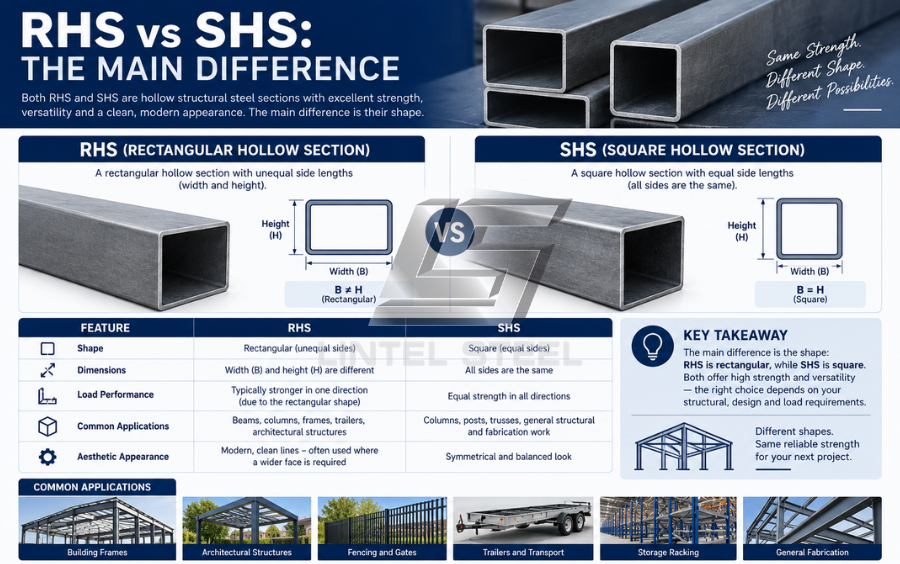
RHS stands for rectangular hollow section, while SHS stands for square hollow section. Both are strong, versatile steel products, but their different proportions influence how they carry loads, fit into a design and connect to other materials. This guide explains the RHS vs SHS comparison in clear language so builders, fabricators and property owners can order with greater confidence.
What Do RHS and SHS Mean?
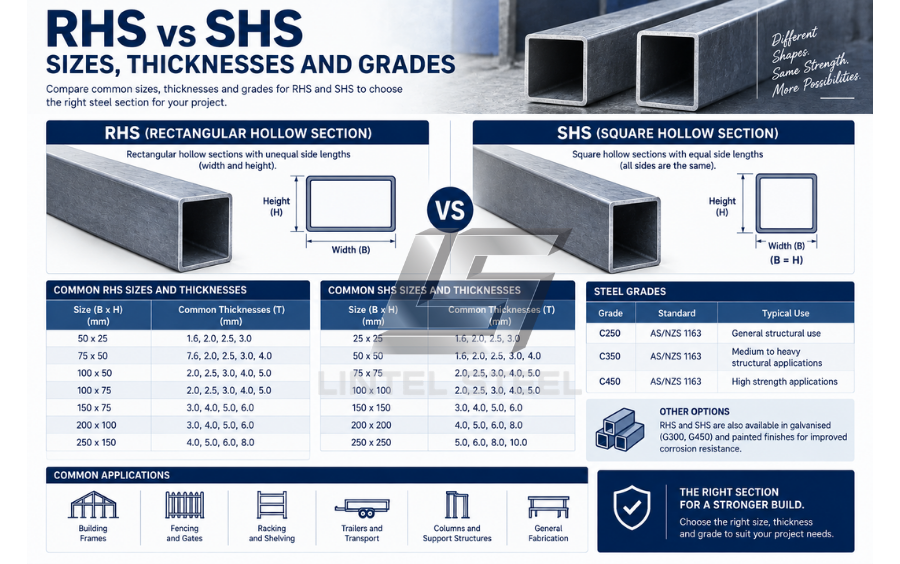
RHS is a steel tube with a rectangular cross-section. Its width and depth are different, as seen in sizes such as 100 × 50 mm or 150 × 100 mm. SHS has four sides of equal width, with common examples including 50 × 50 mm, 75 × 75 mm and 100 × 100 mm. The wall thickness is stated separately, so a complete description might read 100 × 50 × 4 RHS or 75 × 75 × 3 SHS.
Both profiles have flat external faces and rounded corners. They are usually manufactured by forming steel strip into a closed section and welding the longitudinal seam. In either RHS vs SHS selection, structural products in Australia are commonly specified to AS/NZS 1163, which covers cold-formed structural steel hollow sections. Common grades include C250L0, C350L0 and C450L0, although availability varies by profile, size and finish.
In everyday conversation, people sometimes use “RHS” as a general term for both rectangular and square tube. That shorthand can create confusion when ordering. For a clear RHS vs SHS specification, state the full external dimensions, wall thickness, steel grade, finish, length and quantity.
RHS vs SHS: The Main Difference
The main difference in RHS vs SHS is the relationship between width and depth. RHS has a long side and a short side, while SHS has equal sides. That simple geometric change affects section properties, orientation and connection options.
Because an SHS profile is square, its geometric properties are the same about its two principal axes. This makes it convenient for columns, posts and frames where forces may act from more than one direction. It is also easier to orient during fabrication because rotating the section by 90 degrees does not change its overall depth or width.
RHS has a major axis and a minor axis. When the deeper dimension is placed in the direction of bending, it can provide an efficient beam or bearer. Turn the same section by 90 degrees and its bending behaviour changes. This ability to position more depth where it is useful is one of the main reasons designers choose RHS.
Neither option is automatically stronger in every situation. The true RHS vs SHS result depends on the external dimensions, thickness, grade, member length, restraints, connection and applied loads. A structural engineer should select load-bearing members using the relevant design properties rather than relying on shape alone.
RHS vs SHS Strength and Load Capacity
When comparing RHS vs SHS strength, it helps to separate compression, bending and torsion. A post mainly carrying compression behaves differently from a beam carrying a floor or roof load. Slenderness, end restraint and buckling can be just as important as the amount of steel in the cross-section.
In an RHS vs SHS assessment for columns, SHS is often a practical choice because its equal dimensions provide balanced stiffness about both principal axes. If a post may receive loads from different directions, this symmetry simplifies orientation and can support a clean structural layout. Square faces also make it easy to attach beams or plates on any side.
RHS is frequently used as a beam, lintel, joist or bearer because its deeper dimension can be positioned vertically. Increasing structural depth generally improves resistance to bending about that axis. This can make an appropriately selected RHS efficient where the direction of the main load is known.
Closed hollow sections also have useful torsional behaviour compared with many open sections. Even so, an off-centre load or poorly detailed connection can introduce twisting. In a structural RHS vs SHS decision, the engineer considers section properties such as area, second moment of area, section modulus, radius of gyration and torsion constant.
It is therefore misleading to compare two members only by outside size. A 100 × 50 × 3 RHS and a 75 × 75 × 3 SHS distribute material differently and have different masses and design properties. Always check the exact section shown on the engineering drawings.
RHS vs SHS for Columns and Posts
SHS is often preferred for free-standing posts, building columns, fence supports and architectural frames. Its square appearance looks balanced from all directions, and the equal faces make connection layouts more flexible. Where a post supports beams on two perpendicular sides, SHS can also simplify detailing.
RHS can be the better RHS vs SHS choice when a post has a clear strong direction, needs to fit inside a narrow wall or must provide a wider face for a connection. For example, an RHS column may sit neatly within a wall cavity while its longer face provides room for brackets or cladding support.
The RHS vs SHS choice for a column should still consider buckling in both directions. A rectangular member may be strong about its major axis but less stiff about its minor axis. Bracing, connection restraint and unsupported length can control the final selection.
For visible work, appearance may also influence the choice. SHS produces a uniform square line, while RHS can create a slimmer elevation when viewed from its narrow side. Architects and builders often coordinate the structural requirement with cladding thickness, sight lines and finishing details.
RHS vs SHS for Beams, Joists and Bearers
For the RHS vs SHS decision on horizontal members, RHS is commonly selected because its deeper side can be placed vertically. This orientation uses the rectangular geometry efficiently for bending in the expected load direction. Typical uses include floor bearers, roof members, lintels, awning frames and equipment supports.
SHS can also function as a beam, particularly over shorter spans or where equal depth and width help with connections. It may be preferred for exposed frames that need a consistent visual proportion or for modular fabrication where members connect from several directions.
The best RHS vs SHS profile for a beam is not necessarily the one with the largest outside dimension. Deflection, vibration, local capacity, lateral restraint, connection design and service openings all matter. A heavier section may still perform poorly if it is installed in the wrong orientation or inadequately restrained.
Builders should never rotate a nominated RHS on site without approval. If the drawings show the deeper dimension vertical, turning it flat changes the design properties about the loaded axis. Even when the section fits more easily, the substitution can reduce capacity or increase deflection.
RHS vs SHS for Fabrication
Both profiles are popular with fabricators because their flat faces are easier to mark, clamp, cut and connect than curved tube. They can be welded, bolted to plates, drilled and incorporated into prefabricated frames. The enclosed form also creates a neat appearance with fewer exposed edges than many open sections.
SHS can simplify the RHS vs SHS fabrication decision for repetitive frames because all sides are the same width. Mitred corners can produce clean square frames, and matching faces make jigs easier to set up. This is useful for gates, benches, racks, balustrade frames, signs and small structures.
RHS offers a wider face for long welds, plates or brackets while keeping the other dimension compact. It is useful for trailer rails, machinery bases, wall frames and rectangular assemblies. In the RHS vs SHS fabrication comparison, RHS often gives more flexibility when the finished item has a clear width and height.
Connection design can have a large effect on cost. End plates, cleats, through-bolts, welded brackets and slotted connections all require suitable wall thickness and access. Thin-walled hollow sections can distort or fail locally if loads are introduced through an unsuitable detail. Structural connections should be designed and welded in accordance with the project requirements and applicable standards.
The internal space also needs attention. Moisture can enter through open ends, holes or incomplete welds and may be difficult to detect later. End caps, drain holes, vent holes and coating access should be planned before fabrication, especially for outdoor or galvanised work.
RHS vs SHS Sizes, Thicknesses and Grades
RHS is described as outside depth × outside width × wall thickness, while SHS uses side × side × wall thickness. The order used on drawings and supplier schedules should remain consistent. If there is any doubt, confirm which RHS dimension must be vertical before material is cut.
Common structural hollow-section grades in Australia include C250L0, C350L0 and C450L0. In this designation, “C” identifies cold-formed structural hollow section, the number relates to the nominal minimum yield strength in megapascals, and “L0” indicates specified impact properties at 0°C. The exact properties and permitted applications should be confirmed from compliant product documentation.
AS/NZS 1163:2016, including its current amendment, is the relevant Australian/New Zealand product standard for cold-formed structural steel hollow sections. This standard is an important part of any structural RHS vs SHS comparison. Products that look dimensionally similar are not necessarily equivalent if they have different grades, tolerances, testing or certification.
For a reliable RHS vs SHS comparison, check mass per metre as well as external size and thickness. Mass affects material cost, transport, lifting and the total dead load of the structure. Section tables also provide the geometric properties engineers need for design.
Stock ranges vary between suppliers. Some sizes are readily available in painted or galvanised finishes, while less common combinations may require additional lead time. Confirm availability before completing shop drawings or promising a fabrication date.
RHS vs SHS Finishes for Western Australian Conditions
Western Australia contains very different exposure environments. Steel used inside a dry workshop faces different conditions from material installed near the coast, on a farm, in the Pilbara or around industrial chemicals. The RHS vs SHS shape alone does not determine corrosion resistance; the chosen coating and fabrication details are more important.
Painted or black hollow sections may be suitable for protected environments or where a project-specific paint system will be applied. Pre-galvanised structural tube provides zinc protection on the interior and exterior surfaces, subject to the relevant product and coating specification. The chosen finish applies independently of the RHS vs SHS shape decision. Fully fabricated assemblies may also be hot-dip galvanised after fabrication when properly designed for the process.
Continuously or specialised-process galvanised hollow sections are commonly referenced to AS/NZS 4792. This should not be confused with coatings applied to a completed fabricated article under a different galvanising process. Always check the drawing, product certificate and coating designation rather than assuming all “galvanised” products provide the same coating.
Coastal exposure deserves particular care. Cut ends, welds and drilled areas may need an approved repair system, and hollow members should not trap water. A suitable corrosion-protection specification should consider environment, design life and maintenance access.
Common RHS and SHS Applications in WA
Residential builders use RHS and SHS for patios, carports, verandahs, floor systems, posts, lintels, gates and renovation work. In a typical residential RHS vs SHS comparison, SHS is common for posts and exposed square frames, while RHS is frequently used for beams, bearers and members that need greater depth in one direction.
Commercial projects use hollow sections in façades, awnings, stairs, screens, roof framing, equipment platforms and architectural steelwork. Their flat surfaces and clean lines make them useful where the steel remains visible.
Agricultural and regional projects rely on these sections for sheds, machinery supports, yards, trailers and storage frames. Mining and industrial projects use larger or heavier hollow sections for equipment structures, walkways, guards, platforms and transport systems.
In every sector, the RHS vs SHS selection should reflect the actual job. A shape that works well for a decorative frame may not be suitable for a load-bearing column, even when the outside dimensions look substantial.
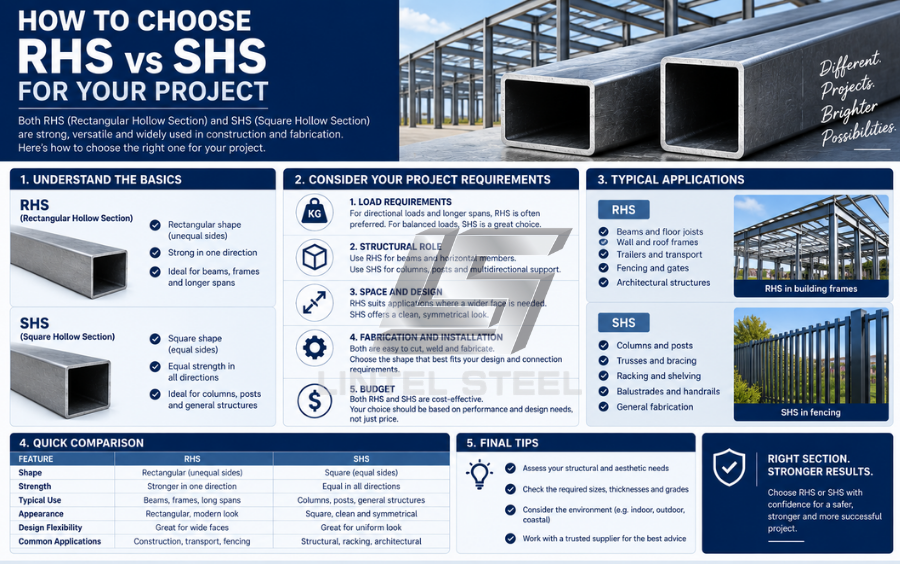
How to Choose RHS vs SHS for Your Project
Start with the approved structural drawings. If the engineer has nominated a specific section, grade, orientation and finish, order it exactly as documented. Do not replace RHS with SHS, change wall thickness or rotate a member without written approval.
For non-structural fabrication, think about the direction of the load and the shape of the finished item. SHS is often convenient when loads, connections or appearance are similar on every side. RHS can be more efficient when one direction needs greater depth, one face needs extra connection area or the assembly must remain narrow in the other direction.
The RHS vs SHS choice should also include fabrication. Consider how the member will be cut, welded, bolted, capped and coated. A theoretically efficient section can become expensive if it requires complicated plates, difficult weld access or extensive coating repair.
Availability is another practical RHS vs SHS factor. A common stocked size may reduce cost and lead time, but availability should never override structural compliance. If the specified product is unavailable, ask the supplier for possible alternatives and return them to the engineer for assessment.
Finally, compare the complete installed cost rather than the price of one length. Processing, waste, transport, lifting, coating, connections and labour can change which option is most economical.
Ordering RHS vs SHS From a WA Steel Supplier
An accurate request should state the profile, external dimensions, wall thickness, grade, finish, length and quantity. Include cutting, drilling or other processing requirements and attach the relevant drawings or steel schedule where possible.
For RHS, make the orientation clear if holes, slots or welded components are required. A drawing should identify the long and short faces so fabrication does not proceed on the wrong side. For SHS, confirm whether the weld seam or face orientation matters to the finished appearance or connection.
When comparing RHS vs SHS prices, make sure the quoted products have equivalent grades, finishes and processing. A lower price may reflect a different wall thickness, product standard or coating. Request appropriate product documentation for structural work and keep it with the project records.
Lintel Steel – a Western Australian steel supplier can help confirm stock, standard lengths, mass, processing options and delivery. For residential, commercial, agricultural, industrial or mining projects, send our team your material schedule for a quote. We can help you source the required hollow sections and arrange practical supply across WA.
Get free quote and quantity take-off for your order here.
RHS vs SHS: Frequently Asked Questions
Is RHS stronger than SHS?
Not in every situation. RHS can be efficient in bending when its deeper dimension is aligned with the main load, while SHS has balanced properties about both principal axes. Strength depends on the complete section, grade, span, restraints, load and connection.
Is SHS better for columns?
SHS is commonly used for columns because it has equal dimensions and balanced geometric properties in two directions. However, RHS may be more suitable where space, connection width or directional loading controls the design.
Can RHS be installed flat?
Only if that orientation is allowed by the design. Rotating RHS changes its bending properties about the loaded axis. Follow the engineering drawings and obtain approval before changing orientation.
Can RHS and SHS be welded?
Yes. Structural hollow sections are commonly welded, but the steel grade, wall thickness, preparation, welding procedure and welder qualifications must meet the project and relevant standard requirements. Coated steel also requires appropriate safety precautions and coating repair.
What information is needed to order hollow sections?
Provide the profile type, outside dimensions, wall thickness, grade, finish, length and quantity. Add any cutting, drilling, welding or delivery requirements and include approved drawings for processed material.
What is the simplest RHS vs SHS rule?
Use SHS when balanced geometry and easy orientation are valuable. Consider RHS when greater depth is needed in one main load direction or when a wider connection face is useful. For structural work, the engineer’s specification always takes priority.
This article provides general information only. Structural members, connections and corrosion-protection systems must be selected and verified by suitably qualified professionals for each project.


