
Structural Steel Connections: Bolted vs Welded Connections

A steel frame is only as dependable as the joints holding its members together. Beams, columns, braces and plates may be designed to carry substantial loads, but they need carefully detailed connections to transfer those forces through the structure. This is why choosing between bolted and welded structural steel connections is an important part of almost every steel construction project.
Both connection types are widely used in residential, commercial and industrial construction across Western Australia. Bolts make it practical to assemble prefabricated components on site, while welding can form compact and continuous joints in the workshop or, where appropriate, in the field. Many projects use both methods because each solves a different construction challenge.
This guide explains how the two options work, where they are commonly used and what builders and buyers should consider when ordering steel. It provides general information rather than structural design advice. The project engineer must specify the connection type, loads, bolts, welds, plates and inspection requirements for the particular building.
What Are Structural Steel Connections?
Structural steel connections are the details that join individual steel members so they can work together as one structural system. Common examples include a beam connected to a column, a brace joined to a gusset plate, two beam sections spliced together and a column fixed to a concrete footing through a base plate and anchors.
Connections do more than keep components in position. They transfer actions such as shear, tension, compression and bending moment from one member to another. They may also need to accommodate erection tolerances, movement, vibration, fatigue, fire exposure and environmental conditions.
A connection can be relatively simple in appearance while still performing a critical role. Its capacity depends on the complete detail, including the member thickness, steel grade, plate geometry, bolt arrangement, weld category and surrounding material. That is why structural steel connections should always be fabricated from approved drawings rather than improvised on site.
Why Structural Steel Connections Matter
The main members in a frame often receive the most attention, but poorly planned connections can make an otherwise efficient design difficult or expensive to build. A detail that is strong on paper may still create access problems for tools, require excessive site welding or conflict with cladding and services.
Well-designed structural steel connections support a clear load path and practical assembly. They help fabricators position plates and holes accurately, allow installers to bring members together safely and give inspectors access to the finished work. Good detailing can also reduce unnecessary steel, workshop time and site delays.
The best results usually come from early coordination between the structural engineer, detailer, fabricator, builder and steel supplier. Connection decisions affect member lengths, plate sizes, hole positions, protective coatings and delivery sequence, so they should not be left until the frame reaches site.
Bolted Structural Steel Connections Explained
Bolted structural steel connections use mechanical fasteners passing through aligned holes in the connected components. A typical detail may include bolts, nuts, washers, plates, cleats and the flanges or webs of the main members. The engineer selects the bolt arrangement and connection geometry for the forces that must be transferred.
Some bolted joints transfer load through bolt shear and bearing against the sides of the holes. Other applications may require pretensioned or slip-resistant behaviour. These categories are not interchangeable, and the installation method must match the design documents and applicable standard.
Bolted components are often prepared in a fabrication workshop and assembled on site. This approach can minimise field welding, make erection more predictable and allow members to be transported as manageable pieces. However, accurate drilling, clear identification and correct installation remain essential for reliable structural steel connections.
Advantages of Bolted Structural Steel Connections
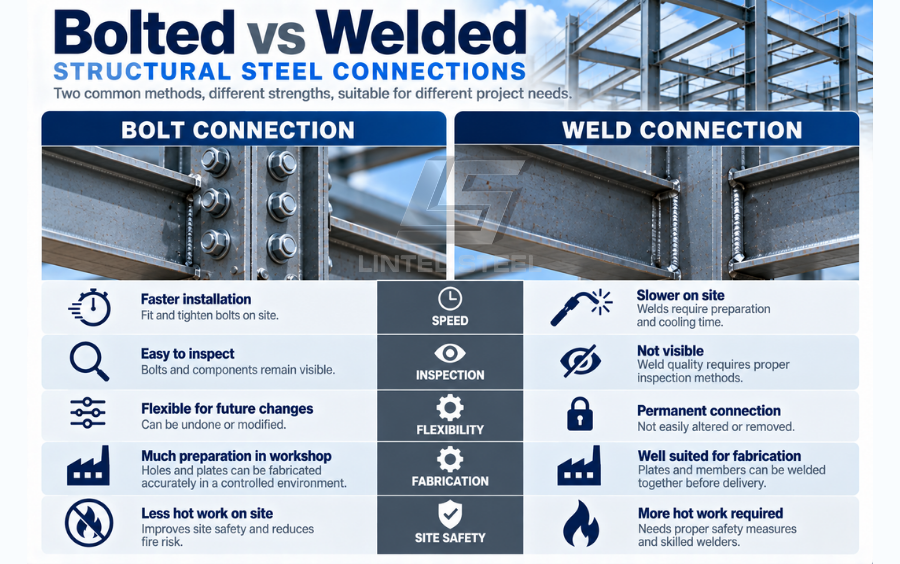
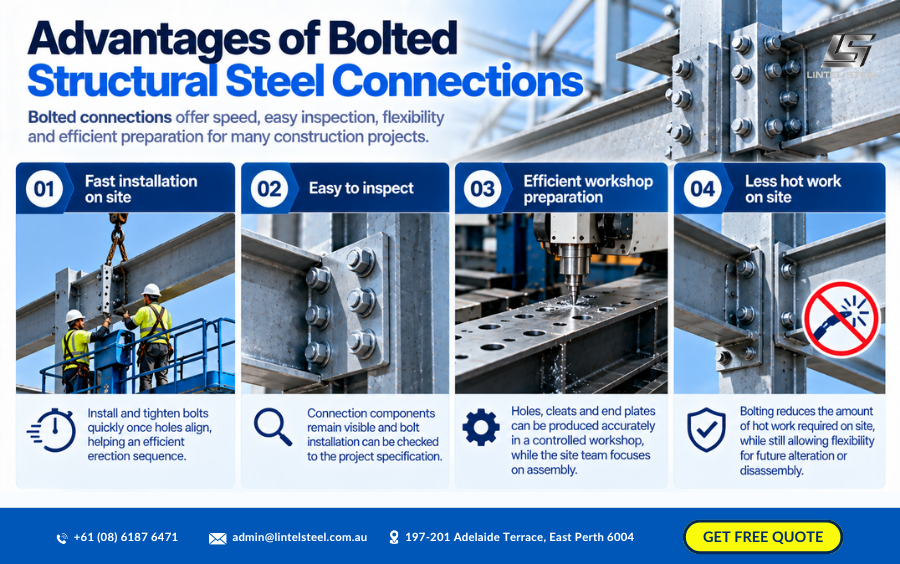
Speed on site is one of the main benefits of bolting. Once members are lifted into position and the holes align, installers can fit and tighten the specified fasteners without waiting for welded joints to cool. This can support an efficient erection sequence for warehouses, workshops, commercial buildings and residential steelwork.
Bolted structural steel connections are also comparatively easy to inspect visually. The connection components remain identifiable, and bolt installation can be checked using the method required by the project specification. Where a building is designed for future alteration or disassembly, bolts may offer more flexibility than a permanent welded joint.
Another advantage is that much of the preparation can happen in a controlled workshop. Holes, cleats and end plates can be produced using accurate equipment, while the site team focuses on assembly. Bolting can also reduce the amount of hot work required at the construction site, although lifting, temporary stability and tool safety still need careful management.
Limitations of Bolted Structural Steel Connections
Bolted details require physical space for bolt heads, nuts, washers and installation tools. A tight architectural junction or congested connection may not provide enough access. Plates can also make a joint larger or more visible than a welded alternative.
Hole alignment is another practical consideration. Small fabrication or erection errors can prevent a bolt from passing through the assembled parts. Holes must not be enlarged or modified without authorisation, because an unapproved change can affect edge distances, bearing behaviour and connection capacity.
The fasteners themselves need the correct grade, diameter, length and finish. Substituting a bolt that appears similar is unsafe. Threads, washers, installation condition and tightening requirements all matter. Bolted structural steel connections therefore require disciplined procurement and clear documentation, not simply a box of general-purpose bolts.
Welded Structural Steel Connections Explained
Welded structural steel connections join components by fusing metal at a prepared joint, normally with added filler material. Welding can connect plates directly to beams and columns, form built-up sections and produce joints that would be difficult to achieve with bolts alone.
Common weld forms include fillet welds and butt welds, but the finished detail may vary greatly. Size, length, preparation, access, welding position, consumables and quality level must follow the engineer’s drawings and an approved welding procedure. Qualified personnel are essential because the finished weld cannot be assessed reliably from appearance alone.
Workshop welding is generally easier to control than field welding. Fabricators can manage member position, weather protection, consumables, equipment and inspection within an established quality system. Site-welded structural steel connections may still be appropriate, but access, wind, moisture, fire risk and surrounding work can make them more demanding.
Advantages of Welded Structural Steel Connections
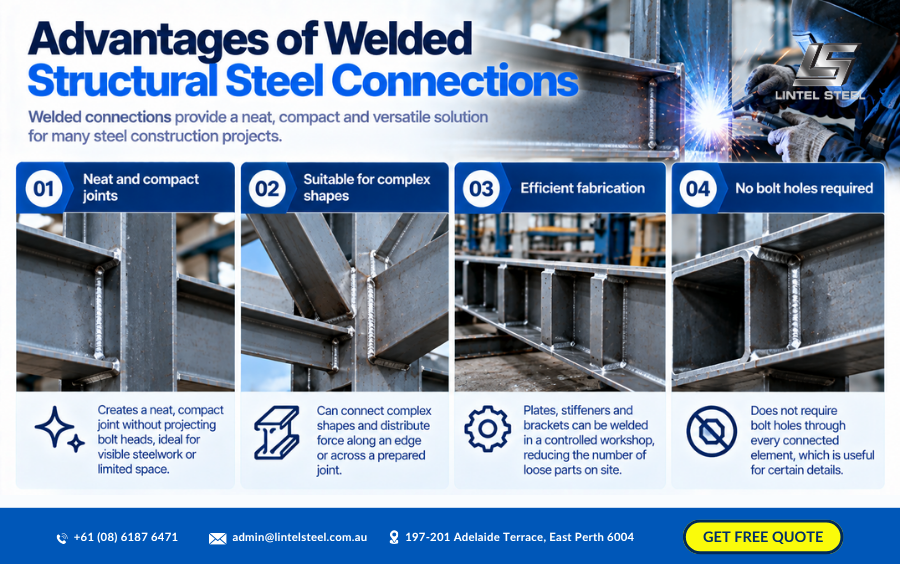
Welding can create a neat, compact joint without projecting bolt heads or large external cleats. This is useful where steel remains visible or where surrounding finishes leave limited space. A welded detail can also connect complex shapes and distribute force along an edge or across a prepared joint.
Welded structural steel connections work well in controlled fabrication. Plates, stiffeners and brackets can be attached before delivery, reducing the number of loose parts required on site. Welding is also central to the production of custom members, trusses, frames and fabricated beams.
Because welding does not require bolt holes through every connected element, it can suit details where hole placement would be impractical. That does not automatically make the joint stronger or more efficient. The benefit depends on the specific design, workmanship, inspection and service conditions.
Limitations of Welded Structural Steel Connections
Welding introduces heat into the steel. If the work is not planned and sequenced correctly, heating and cooling can cause distortion, residual stress or changes around the weld area. Joint preparation and fit-up must therefore be controlled before welding begins.
Quality depends heavily on the approved procedure and the competence of the people completing the work. Contamination, poor access, incorrect consumables or unsuitable conditions can lead to defects. Some welds require non-destructive examination in addition to visual inspection, depending on the connection category and project specification.
Field welding can affect the construction program because it may require weather protection, work permits, fire controls and access platforms. It can also damage existing paint or galvanising near the joint, creating a need for specified coating repairs. Welded structural steel connections should be chosen with the whole fabrication and installation process in mind.
Structural Steel Connections: Bolted vs Welded Strength
It is misleading to say that one connection method is always stronger. Properly engineered bolted and welded structural steel connections can both transfer substantial loads. Capacity comes from the complete detail rather than the simple choice of bolts or welds.
A bolted joint may be governed by bolt shear, plate bearing, tension, slip, block shear or failure of the connected member. A welded joint may be governed by weld capacity, base metal strength, geometry or local effects in the supporting component. Engineers check the relevant limit states and design the connection for the actions identified in the structural analysis.
The correct question is not “Which method is strongest?” but “Which connection meets the design requirements and can be fabricated, protected, inspected and erected reliably?” In some locations, a combined detail with workshop welds and site bolts offers the most practical answer.
Structural Steel Connections and Construction Speed
Bolted joints often allow faster site assembly because much of the fabrication is completed before delivery. A crane can position the member, temporary bolts can stabilise it as permitted by the erection plan, and the connection can then be completed. This helps projects progress from frame to roofing and cladding efficiently.
Welded structural steel connections may take longer on site because joint preparation, welding, cooling and inspection happen in sequence. In the workshop, however, welding can be highly efficient and may simplify site work by arriving as part of a prefabricated assembly.
Construction speed therefore depends on where the work takes place. A sensible strategy is often to complete repeatable welding in the workshop and use bolted structural steel connections for primary site assembly. The exact approach must follow the engineered design and erection methodology.
Structural Steel Connections and Project Cost
Connection cost includes more than the price of bolts or welding consumables. It covers detailing, plates, holes, edge preparation, workshop labour, inspection, protective treatment, transport, lifting and installation. A detail that saves material may demand more fabrication time, while a slightly heavier standardised connection may be faster to produce.
Bolted structural steel connections can reduce site labour but may need additional plates and accurately positioned holes. Welded options can produce cleaner geometry but may require skilled labour, joint preparation and more extensive inspection. Regional travel and site access can also influence the balance on Western Australian projects.
Repetition usually improves value. Using a smaller range of standardised details can simplify fabrication and installation, provided the connections remain suitable for the loads. Early collaboration helps the design team compare whole-project cost rather than focusing on a single component.
Structural Steel Connections for Residential Construction
Residential steelwork commonly includes beams supporting upper floors, columns around open-plan areas, lintels, roof frames, balcony members and connections between extensions and existing structures. Both bolts and welds may appear in the same house.
For example, a fabricator might weld end plates and cleats to a beam in the workshop, then bolt the beam into place on site. This reduces field welding and helps installers work around existing walls and finishes. Custom welded brackets may be used where architecture creates an unusual shape or restricted space.
Residential structural steel connections still require engineering. Removing a wall, opening a living area or adding a second storey changes load paths and temporary stability. The connection details must account for the existing building, construction sequence and practical access, not just the final appearance.
Structural Steel Connections for Commercial and Industrial Buildings
Warehouses, offices, retail buildings and industrial facilities often contain large numbers of repeated connections. Bolted end plates, fin plates, cleats, splice plates and bracing connections can support rapid site erection. Workshop welding is commonly used to attach these plates to primary members before coating and delivery.
Industrial structures may also experience vibration, fatigue, heavy equipment loads or aggressive environments. These conditions can change the connection design, inspection and maintenance requirements. Crane-supporting structures and plant platforms, for example, cannot be detailed solely by copying an ordinary building connection.
Efficient structural steel connections should suit both the design actions and the operating environment. Access for future inspection, maintenance or equipment replacement may be as important as initial installation speed.
Structural Steel Connections in Coastal Western Australia
WA has a long coastline, and steelwork near marine environments can face significant corrosion exposure. Connection geometry matters because overlapping plates, crevices, water traps and inaccessible surfaces can be difficult to protect and maintain.
Both bolted and welded structural steel connections need a coating system appropriate to the environment and expected service life. Fasteners must be compatible with the connected steel and specified protection. Welds, sharp edges and heat-affected coating areas may need preparation before painting or galvanising.
If steel will be hot-dip galvanised after fabrication, the detail must include suitable venting and drainage. Site welding on galvanised components can damage the coating and requires an approved repair process. Corrosion protection should be coordinated before fabrication rather than treated as a final cosmetic step.
Structural Steel Connections, Fire and Building Performance
Connections form part of the structural system considered in fire design. Where fire resistance is required, protective materials may need to cover bolts, plates and welded areas as well as the main members. Connection geometry can influence whether spray-applied protection, boards or other systems can be installed continuously.
The National Construction Code sets performance requirements for buildings in Australia, while project documents identify the applicable fire-resistance and structural provisions. The required outcome depends on building classification, use, size and approved design pathway.
Fire protection products should not be selected by assumption. Structural steel connections, member temperatures, load levels and the tested or assessed protection system must be coordinated by the relevant professionals.
Read more: Structural Steel Welding: Methods and Best Practices
Fabrication Quality for Structural Steel Connections
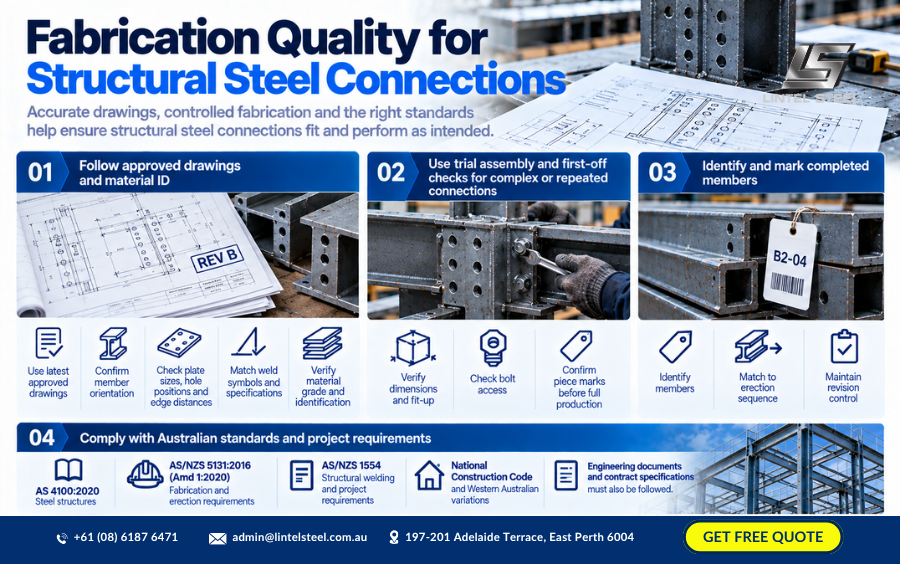
Connection accuracy starts with controlled drawings and material identification. Plate dimensions, hole positions, edge distances, weld symbols and member orientation must match the approved fabrication information. Revision control is vital because a precisely fabricated connection is still wrong if it comes from an outdated drawing.
Trial assembly or first-off checks can be valuable for repeated or complex structural steel connections. Fabricators may verify dimensions, bolt access, fit-up and piece marks before producing the full batch. Completed members should be identified so the erection team can match them to the installation sequence.
In Australia, AS 4100:2020 addresses steel structures, while AS/NZS 5131:2016, including Amendment 1:2020, covers fabrication and erection. Structural welding is addressed through the applicable AS/NZS 1554 standard and project welding requirements. The current National Construction Code, Western Australian variations, engineering documents and contract specifications must also be checked for each project.
Inspection of Structural Steel Connections
Inspection requirements should be defined before fabrication begins. For bolted joints, checks may cover fastener identification, hole condition, washers, installation method and access. A connection that looks tight is not necessarily installed in accordance with the specified bolt category.
For welded structural steel connections, inspection begins before welding with material, preparation, fit-up and procedure checks. Visual examination continues during and after the work. Additional non-destructive examination may be specified based on the weld category, execution requirements and importance of the joint.
Records provide evidence that the planned controls occurred. Depending on the project, these may include material certificates, welder qualifications, welding procedure documents, inspection reports and bolt installation records. The required level of documentation should be agreed when obtaining prices, not requested after delivery.
Installation of Structural Steel Connections on Site
Safe erection requires a planned sequence. A partly completed frame may behave differently from the finished structure, so temporary bracing and connection stages must follow the erection documentation. Members should not be released from lifting equipment until the required stability has been established.
Bolted structural steel connections need adequate access for fitting and tightening fasteners. Welded joints need safe platforms, weather control and hot-work arrangements. Any mismatch should be reported rather than forced into place or modified without approval.
Site teams should also protect finished coatings during handling and assembly. Damage around bolts, welds or lifting points needs repair using the specified system. Good installation preserves both structural performance and long-term durability.
Can Bolted and Welded Structural Steel Connections Be Combined?
Yes. Combining the methods is common and often efficient. A connection plate can be welded to a beam in the workshop and bolted to a column on site. A truss may contain welded internal joints but use bolted end connections for transport and erection. Column splices may use bolts even when base plates and stiffeners are workshop welded.
This hybrid approach uses controlled welding where workshop conditions are favourable and convenient bolting where components meet on site. However, the combination must be intentional. Bolts and welds do not automatically share load in the way someone might expect, so an engineer must design the detail and define the installation sequence.
Combined structural steel connections can offer excellent value when design, fabrication, coating and erection are coordinated from the beginning.
Choosing Between Bolted and Welded Structural Steel Connections
The decision starts with structural performance. The engineer assesses the loads, stiffness, movement, fatigue exposure and behaviour required at the joint. From there, the project team can consider fabrication capability, site access, transport limits, architectural appearance and future alteration.
Bolting is often attractive where rapid erection, straightforward inspection or later disassembly is important. Welding may suit compact details, complex fabricated assemblies and joints completed under controlled workshop conditions. Neither option should be chosen only because it appears cheaper on a preliminary sketch.
For Western Australian projects, also consider distance from the workshop, availability of skilled site labour, wind and weather, fire restrictions, coating repairs and delivery sequencing. A connection that reduces site operations can be particularly valuable in regional locations.
Ordering Steel for Structural Steel Connections
Send your steel supplier the latest approved drawings and schedules. The information should identify member sizes, grades, finished lengths, plate details, holes, bolt requirements, weld symbols, coatings and piece marks. Clearly state whether the order is supply-only, cut and drilled, or fully fabricated.
Avoid relying on a verbal description for structural steel connections. Terms such as “standard bolts” or “fully welded” do not provide enough information to manufacture a compliant detail. If dimensions conflict or a required value is missing, obtain clarification from the responsible designer before production.
Discuss documentation, inspection, coating and delivery needs when requesting the quote. This allows the supplier to price the actual scope and plan the correct production route. Last-minute changes after fabrication begins can affect both cost and lead time.
Common Mistakes with Structural Steel Connections
One common mistake is selecting a connection based only on appearance. A neat welded joint may be difficult to access and inspect, while a bolted detail may conflict with finishes or services. Practical construction considerations need to be resolved alongside structural capacity.
Another mistake is making unauthorised site changes. Enlarging holes, replacing bolts, cutting plates or adding welds can alter the designed behaviour. Even a small modification may affect coating protection or introduce unintended restraint. Changes should be documented and approved by the relevant professional.
Poor coordination is also costly. If hole locations, member orientation and coating systems are not confirmed early, the problem often appears during erection. Clear drawings, revision control and communication between the engineer, detailer, fabricator and installer help structural steel connections fit correctly the first time.
Frequently Asked Questions About Structural Steel Connections
Are bolted connections better than welded connections?
Not in every situation. Bolts can simplify site erection and future removal, while welds can create compact, continuous details in a workshop. The better choice is the engineered connection that suits the loads, fabrication process, site conditions and maintenance needs.
Are welded connections stronger than bolts?
Either method can provide high capacity when correctly designed and completed. Strength depends on the entire detail, including member thickness, plate geometry, bolt group, weld size, base metal and load direction. It cannot be judged from the connection type alone.
Can structural bolts be reused?
Reuse depends on the fastener type, installation history, applicable standard and project specification. Do not assume removed bolts can be installed again. The responsible engineer or specified procedure should determine whether replacement is required.
Is site welding allowed in Western Australia?
Site welding can be used when it forms part of the approved design and is completed under appropriate procedures, qualifications, inspection and safety controls. Weather, access, fire precautions and coating repair must also be managed.
Who designs structural steel connections?
Connections should be designed or verified by an appropriately qualified structural professional under the project’s agreed responsibilities. The shop detailer and fabricator develop production information, but unresolved design decisions must be referred to the responsible engineer.
What information should I send a steel supplier?
Provide approved drawings, steel grades, member sizes, quantities, connection details, coating requirements, documentation needs and delivery information. The clearer the scope, the more accurately a supplier can quote and schedule the work.
Reliable Structural Steel Connections Start with the Right Supply Partner
Bolted and welded connections both have an important place in modern construction. Bolts can accelerate assembly and provide practical access for inspection, while welding can form efficient fabricated components and clean architectural details. Many of the best steel frames combine workshop welding with site bolting.
Successful structural steel connections depend on engineering, accurate processing, suitable materials, qualified workmanship and clear quality requirements. When these elements are coordinated early, the frame is easier to fabricate, deliver, erect and protect for its intended service life.
If you are sourcing structural steel in Perth or regional Western Australia, contact our team with your approved drawings or material schedule. We can help with steel availability, processing, fabrication scope and delivery planning so your project receives the right products at the right time.
Authoritative Resources
- Standards Australia, Construction sector: https://www.standards.org.au/sectors/construction
- Standards Australia, Structural steel standards update: https://www.standards.org.au/news/revised-steel-standards-to-support-industry
- Australian Building Codes Board, National Construction Code: https://ncc.abcb.gov.au/
- Western Australian Government, Building and Energy: https://www.wa.gov.au/organisation/building-and-energy
- Safe Work Australia, Welding processes code of practice: https://www.safeworkaustralia.gov.au/doc/model-code-practice-welding-processes
This article contains general information only. Structural steel connections, fabrication, welding, bolting, inspection, corrosion protection and erection must follow the approved project design, current legislation, applicable standards and instructions from suitably qualified professionals.


