
PFC Steel: What It Is and Where It Is Used

PFC steel is a familiar product on Australian construction sites, fabrication drawings, and material schedules. Its C-shaped profile makes it easy to recognise, but the section does much more than provide a convenient edge or support. When selected and detailed correctly, it can carry bending, shear, tension, or compression in a wide range of structures.
The letters PFC stand for parallel flange channel. Unlike an I-shaped beam, which has flanges extending to both sides of the web, a PFC has one web with two flanges projecting from the same side. That open geometry provides easy access for bolts and welds, but it also creates behaviour that designers must consider carefully, particularly when loads can make the member twist.
This guide explains what PFC steel is, how it is sized, where it is used, and how it compares with other common sections. The information is written for builders, clients, students, estimators, and new construction professionals. Final member sizes, connections, grades, and substitutions must always be approved by the responsible structural engineer.
What Is PFC Steel?
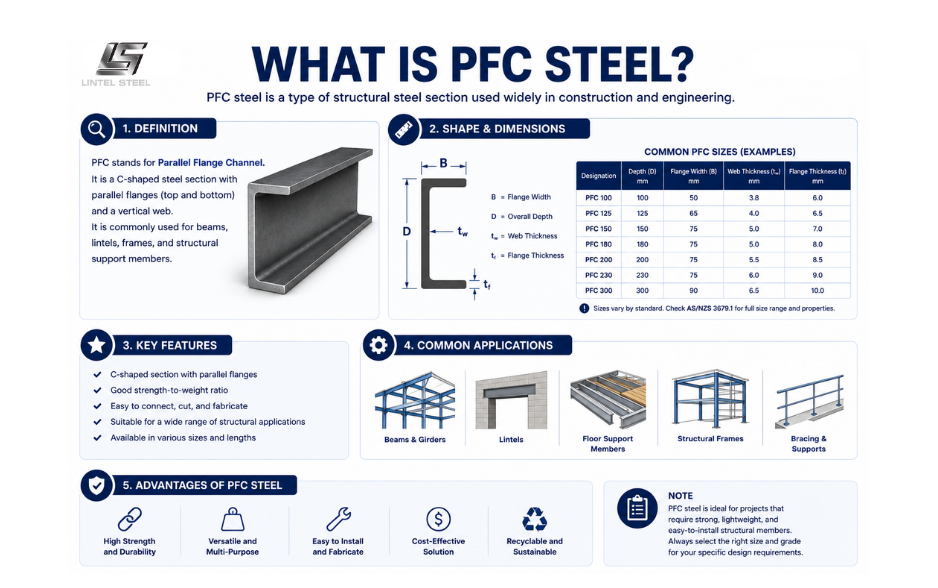
PFC steel is a hot-rolled structural section with a C-shaped cross-section and parallel flange surfaces. It consists of a vertical web and two horizontal flanges projecting from one side. The web and flanges are formed together during rolling, creating a standard product with defined dimensions, mass, tolerances, and structural properties.
The term “parallel flange” distinguishes the profile from older channel shapes that may have tapered internal flange faces. Parallel faces simplify detailing and make it easier to connect plates, bolts, brackets, and adjoining members.
In Australia, PFC steel is manufactured and supplied in recognised metric sizes.
A PFC can work as a beam, lintel, stringer, edge member, frame component, or part of a built-up section. Its suitability depends on the direction and position of loading, span, restraint, connection details, steel grade, and applicable design standard.
Why the Channel Has a C-Shaped Profile
The C shape of PFC steel provides a useful balance between structural efficiency, access, and compact dimensions. The flanges sit away from the section’s centre and contribute strongly to bending resistance, while the web carries much of the shear.
Because both flanges project to the same side, one face of the web remains relatively open and accessible. Fabricators can connect plates, cleats, brackets, bolts, and welds without the enclosed interior found in hollow sections. This makes channels practical for edge details, stair construction, equipment supports, and members attached to existing structures.
The open shape is not symmetrical about both principal axes. If a load does not pass through the correct position, PFC steel can experience bending combined with twisting. This is why load eccentricity, torsional restraint, flange restraint, and connection geometry are important.
The section’s behaviour should not be judged only by its depth. Web thickness, flange width, flange thickness, root radii, mass per metre, section modulus, moment of inertia, and torsional properties all affect performance.
PFC Steel Sizes and Designations
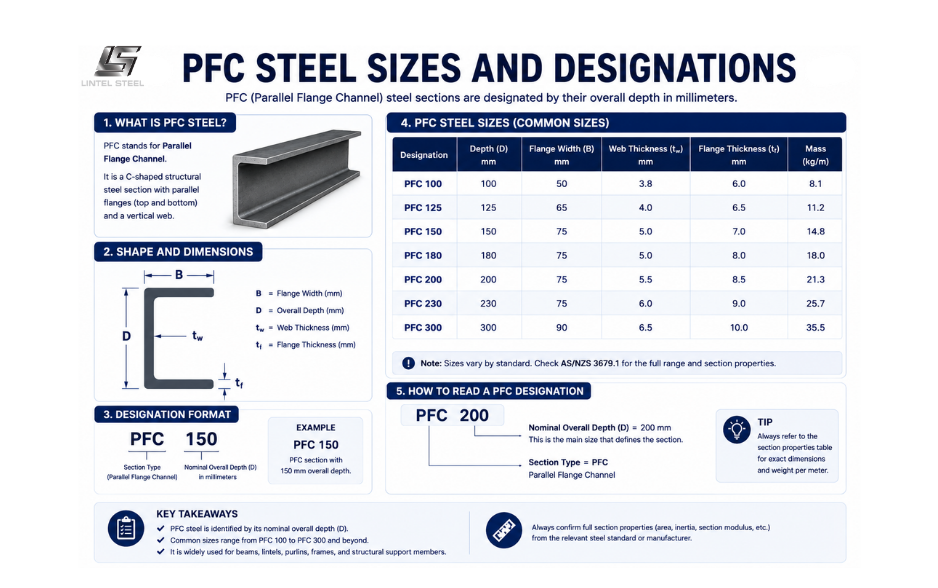
Australian PFC steel is normally identified by a nominal depth followed by the letters PFC. A designation such as 150 PFC refers to the recognised 150-millimetre serial size, but the product table should be used to confirm actual depth, flange width, web thickness, flange thickness, mass per metre, and section properties.
The nominal number is an identifier rather than a complete measurement. Manufacturing standards also allow tolerances, so a delivered channel should be assessed against the correct product standard rather than an assumed perfect dimension.
When reading a drawing, check the complete PFC steel designation together with the steel grade, length, orientation, member mark, finish, and fabrication notes. A size alone does not describe holes, end plates, cleats, stiffeners, mitres, welds, or protective coatings.
Size ranges and stock lengths vary by supplier and location. Commonly available sections are generally more economical than unusual or imported alternatives, but availability should never drive an unapproved substitution. The engineer must confirm that any proposed change provides suitable strength, stiffness, stability, and connection geometry.
International projects may use different channel naming systems. British schedules also use PFC, while North American drawings commonly use C or MC designations for channel families. Similar nominal depths do not make sections from different standards equivalent.
How Parallel Flange Channels Carry Loads
PFC steel can resist bending and shear when used as a beam. Under ordinary downward loading, one flange generally carries compression while the other carries tension. The web transfers shear between them and helps maintain their separation.
The channel is most efficient when bending occurs about its strong axis and the member is adequately restrained. If the compression flange is free to move sideways, lateral-torsional buckling may reduce capacity before the cross-section reaches its full bending resistance.
Torsion is especially relevant because the shear centre of an open channel does not generally coincide with the centre of the web. A load applied through a convenient surface may be eccentric to the shear centre and cause the PFC steel member to twist as it bends.
Engineers manage this behaviour through load placement, restraints, connections, paired channels, bracing, or the selection of another profile. A channel fixed continuously to a wall, slab, or other structural element can behave differently from the same section standing alone.
PFC steel can also carry axial tension or compression. When used as a brace or column-like member, eccentricity and buckling about the principal axes must be checked. Built-up arrangements may create more balanced behaviour, but the connectors joining the components are part of the structural system.
Residential Construction Applications
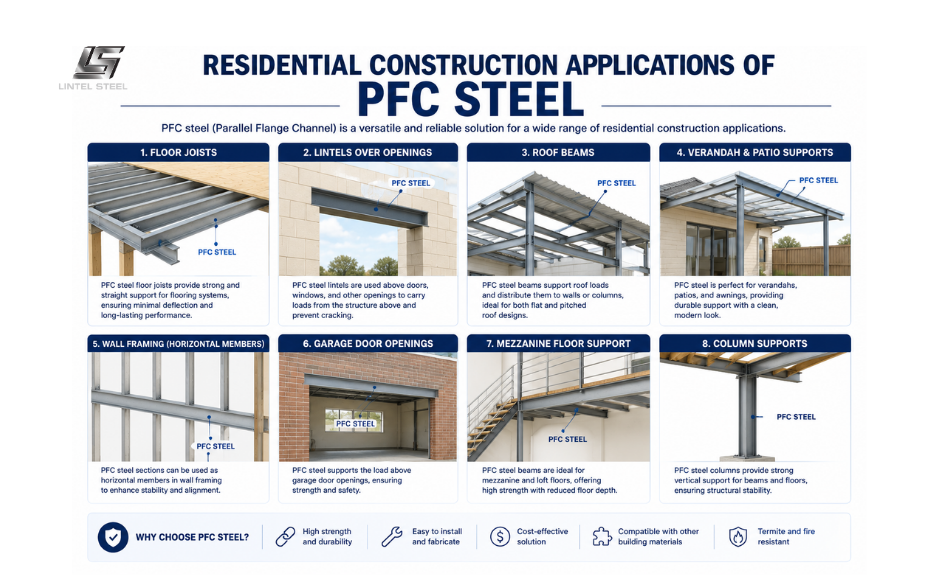
In residential construction, parallel flange channels are often used for lintels over doors, windows, and garage openings. Their open side can make it easier to fit around masonry, timber framing, light-gauge steel framing, or architectural finishes, depending on the detail.
Channels also serve as stair stringers, balcony edge members, deck supports, verandah beams, retaining components, and trimming around floor or roof openings. In renovation work, PFC steel may be fixed to an existing beam, wall, or member to support a new opening or altered load path.
The profile’s flat web provides a convenient surface for attaching brackets and plates. However, masonry support, bearing length, end reactions, corrosion exposure, and movement must be resolved. A channel installed with the open side facing upward can collect water or debris unless the detail provides drainage and protection.
Residential loads can still be substantial, especially where a member supports upper floors, masonry, roof reactions, or large openings. Builders should not select PFC steel from an informal span chart unless that chart is approved for the exact loading, grade, restraint, and construction system.
Commercial Construction Applications
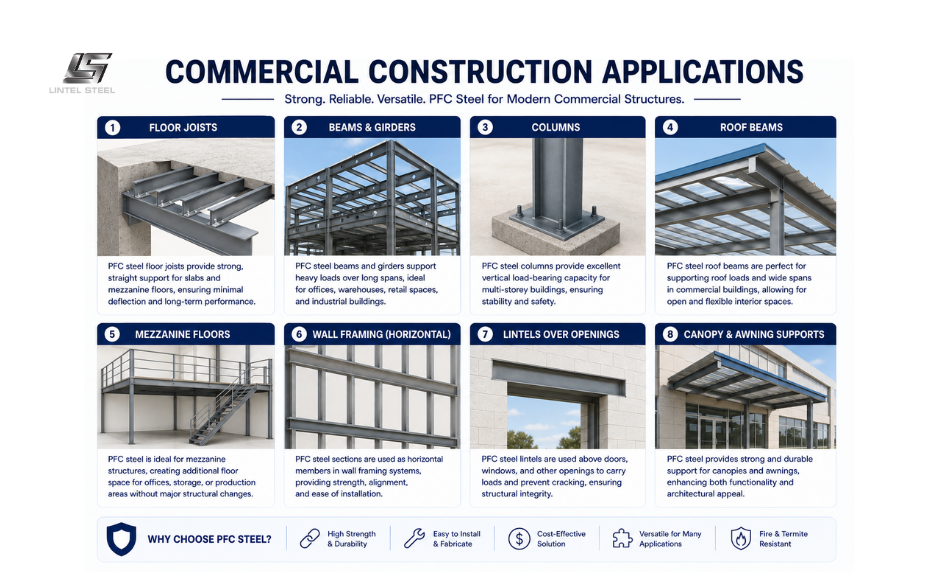
Commercial buildings use parallel flange channels for edge beams, façade supports, secondary framing, plant platforms, stair structures, service openings, lintels, canopies, parapets, and supports around floor penetrations.
An edge channel can provide a clean outer face for cladding or slab-edge details while keeping the open side accessible for connections. PFC steel can also trim lift openings, stairs, escalators, risers, and mechanical penetrations where standard floor beams need additional support.
In façade work, channels may support glazing, precast panels, screens, awnings, or secondary steelwork. Deflection and connection tolerances can be critical because brittle finishes and glass may not accommodate the movement allowed for an ordinary structural member.
Commercial projects often contain congested services. The channel’s open profile can simplify some connections, but pipes and ducts should not be supported from PFC steel without confirming loads and approved attachment points. Drilling or welding new fittings can affect the member and its protective coating.
Industrial and Mining Applications
Industrial facilities use these channels in equipment frames, platforms, walkways, conveyor supports, pipe racks, guarding structures, maintenance access, wall framing, and secondary building members.
The section is practical where brackets, handrails, grating, machinery, or service supports need to attach to an accessible web. Back-to-back channels can form built-up beams or columns, while toe-to-toe or spaced arrangements may suit particular connection and load requirements.
Mining and processing environments introduce demanding conditions. PFC steel may experience vibration, impact, dust, chemicals, moisture, heat, or repeated loading. Connection fatigue, corrosion protection, inspection access, drainage, and replacement planning can be as important as initial strength.
Industrial modifications should be controlled carefully. Adding equipment to an existing channel or cutting access holes through its web changes the load path. The existing grade, size, condition, restraint, and original design should be verified before new loads are introduced.
Modular and Light Construction Applications
Parallel flange channels are well suited to modular frames because their open face makes bolted assembly and connection to corner posts relatively straightforward. They can form longitudinal edge beams, roof edges, floor edges, and supports around open sides.
SteelConstruction.info describes the use of PFC edge beams in modular construction, including modules framed with hollow-section posts and parallel flange channel edge members. The exact arrangement depends on whether modules have four closed sides or need large open sides for combined internal spaces.
In light construction, hot-rolled PFC steel should not be confused with thin cold-formed C-sections. Both profiles may look similar from a distance, but their thickness, manufacturing method, design rules, connections, local buckling behaviour, and typical uses differ significantly.
A hot-rolled channel may support heavier concentrated loads, while cold-formed sections are often used as purlins, girts, studs, or joists within proprietary systems. The approved drawings should state the full section designation and material standard.
Civil and Infrastructure Applications
Civil projects use these sections for bridge components, barriers, sign structures, drainage supports, access platforms, temporary works, retaining details, utility frames, and equipment supports.
Channels can act as edge members or stiff framing elements where an open section is useful for attachment and inspection. Paired channels may form built-up members in older bridges, towers, gantries, and temporary structures.
Exterior PFC steel needs detailing that manages water, debris, and corrosion. The open side can create ledges or pockets depending on orientation. Drainage holes, sealed details, coatings, galvanising, inspection access, and maintenance intervals should match the environment and design life.
Temporary use does not remove the need for engineering. Falsework, shoring, work platforms, and temporary bridges can experience changing loads and support conditions during construction. Connections and bracing must be adequate for every stage, not only the final arrangement.
Comparing PFCs With Universal Beams
PFC steel and universal beams are both hot-rolled open sections, but their geometry and typical behaviour differ. A universal beam has flanges extending to both sides of the web, creating a doubly symmetric I-shaped profile. A PFC has both flanges on the same side of the web.
Universal beams are generally more efficient for major strong-axis bending over longer spans. Their symmetry helps them carry vertical loads without the same inherent eccentricity concerns that can affect a single channel.
PFC steel offers easier access to one face, a compact edge profile, and useful connection surfaces. It can be a better choice for stair stringers, lintels, wall attachments, edge framing, and secondary members where a full I-section is unnecessary or difficult to detail.
The correct comparison is not based on depth alone. Two sections with similar nominal depths can have very different weight, stiffness, bending resistance, torsional behaviour, and flange dimensions. An engineer should compare the actual section properties and structural system.
Comparing PFCs With Cold-Formed C-Sections
PFC steel is typically a hot-rolled section with relatively thick webs and flanges. Cold-formed C-sections are made by bending thinner steel sheets at room temperature, often with lips or additional folds to improve local stability.
Hot-rolled channels and cold-formed sections follow different standards and design methods. Cold-formed members can be highly efficient for light loads, but their thin elements are sensitive to local buckling, distortional buckling, screw connections, and handling damage.
PFC steel normally uses bolts and welds common to structural fabrication, while cold-formed systems frequently rely on screws, bolts, rivets, or proprietary connectors. Coating types and corrosion protection can differ as well.
The word “channel” is therefore not a complete specification. Builders should verify whether drawings call for a PFC, a hot-rolled channel from another series, or a cold-formed C-section before ordering material.
Comparing Channels With RHS and SHS
Rectangular and square hollow sections are closed profiles, while PFC steel is open. The closed shape gives RHS and SHS useful torsional resistance and balanced appearance, but it can make internal access for bolts, plates, drainage, and corrosion protection more difficult.
PFC steel provides an exposed web and flange edges that are easy to reach during fabrication. This can simplify brackets, cleats, stiffeners, and connections to walls or existing members.
Hollow sections may be preferred for exposed columns, trusses, frames, and members loaded from multiple directions. Channels may be better for edge details, stringers, lintels, and built-up arrangements. The selection depends on loads, connection cost, architecture, maintenance, and availability.
Weight alone does not determine which profile is stronger. Cross-sectional geometry, axis of bending, wall or plate thickness, member length, restraint, and connection details control performance.
PFC Steel Connections and Fabrication
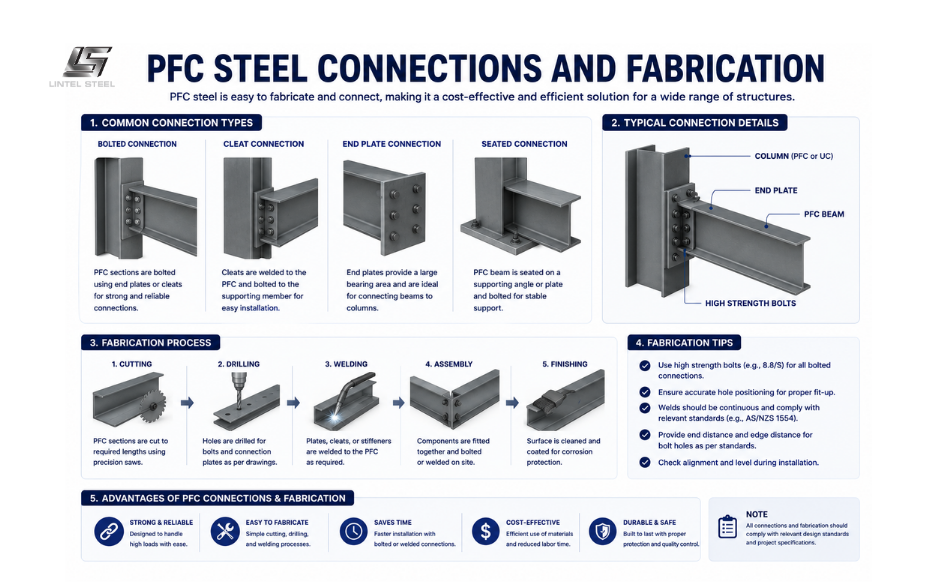
PFC steel can be cut to length, drilled, punched where permitted, mitred, coped, welded, curved, stiffened, and fitted with plates or cleats. The accessible open section makes many operations straightforward in a fabrication workshop.
Common connection concepts include end plates, fin plates, angle cleats, seated details, welded brackets, splice plates, and direct attachment through the web. The engineer selects bolt sizes, hole positions, plate thicknesses, welds, and edge distances to transfer the required forces.
Load eccentricity deserves attention. A bracket fixed to the outer face of a web may apply force away from the section’s shear centre, causing torsion. Connections can be detailed to provide restraint, share force with another member, or place load more favourably.
Back-to-back PFC steel can create a built-up section with more balanced properties. The channels may touch or be separated by plates or spacers. Bolts or welds between them must transfer forces and ensure the components act as intended.
Unapproved site modifications can be dangerous. Enlarging holes, cutting flanges, removing web material, or welding new attachments may reduce strength, stability, or fatigue performance. Any change should be reviewed and documented before work proceeds.
How Engineers Select a Channel
Engineers begin with the member’s loads, span, support conditions, and structural role. They check bending, shear, deflection, vibration, torsion, lateral stability, bearing, and combined actions as required.
The orientation of PFC steel is part of the design. Turning a channel around can move its flanges, change connection access, alter load eccentricity, and affect architectural interfaces even though the basic section properties remain the same.
Restraint can strongly influence capacity. A channel connected continuously to a slab, wall, or bracing system may have better stability than an isolated member. The assumed restraint must be reliable, sufficiently strong, and detailed in the drawings.
Engineers also consider fire resistance, corrosion exposure, fabrication, transport, erection, and availability. A theoretically light channel may be less economical if it requires complex stiffeners or torsional restraints. A slightly heavier stock section may simplify the complete assembly.
The final PFC steel selection must fit the connections and adjoining materials. Flange width, web depth, thickness, root radius, bolt access, weld access, edge distance, and clearances can be just as important as calculated member resistance.
Benefits of Parallel Flange Channels
PFC steel combines structural capacity with an accessible open profile. It can provide a compact edge member, a convenient web for attaching plates, and parallel flange surfaces that simplify many connections.
Standard Australian sizes are widely recognised by engineers, detailers, fabricators, and suppliers. This supports efficient design communication, workshop processing, estimating, and procurement.
The product is versatile enough for beams, lintels, stringers, trimmers, frames, equipment supports, and built-up members. It can also be cut and welded into specialised components where standard details do not suit the project.
These advantages do not make PFC steel ideal for every job. Open-section torsion, weak-axis behaviour, exposure pockets, and the need for restraint can lead to another profile being more efficient. Selection should be based on the complete design rather than convenience alone.
Fire and Corrosion Protection
Like other carbon structural steel, PFC steel can corrode when exposed to moisture and oxygen. The correct protection may include paint, galvanising, metal spray, concrete encasement, or an exposure-specific coating system.
The channel’s orientation affects durability. Upward-facing flanges or horizontal webs can trap water and debris. Good detailing provides drainage, avoids inaccessible crevices, and allows inspection and maintenance.
Galvanising requires suitable venting and drainage for fabricated assemblies. Welds, sealed plates, and back-to-back channels can create enclosed spaces or narrow gaps that need specialist consideration before coating.
PFC steel also loses strength and stiffness as temperature rises in a fire. Depending on the building code and fire strategy, members may need board protection, spray-applied material, intumescent coating, concrete encasement, or another approved system.
The fire-protection detail must include connections, supports, gaps, penetrations, and areas damaged during installation. Applying an ordinary decorative paint does not replace a tested fire-resistive coating system.
Ordering and Delivery Checks
An order should identify the full PFC steel size, grade, length, quantity, finish, processing, and certification requirements. For fabricated work, member marks and current drawing revisions should also be clear.
When material arrives, compare delivery records and member marks with the purchase order and approved shop drawings. Check size, length, quantity, visible damage, holes, plates, welds, coating, and orientation-specific details.
Do not identify PFC steel by depth alone. Confirm flange width, web and flange thickness, and mass where necessary. Several channel families or standards can contain members with similar overall dimensions.
Store channels on stable supports above the ground. Arrange them so they cannot roll, slide, or collect water, and use lifting methods that prevent uncontrolled rotation. Long members may need multiple lifting points or temporary restraint.
If a delivered section differs from the documents, quarantine it until the discrepancy is resolved. A heavier or larger channel is not automatically an acceptable substitute because it can change weight, stiffness, connections, clearances, and reactions.
Common Mistakes to Avoid
One common mistake is applying a load to the convenient web face without considering eccentricity and twisting. The channel may need additional restraint, a revised connection, paired sections, or another profile.
Another mistake is confusing PFC steel with a cold-formed C-section. The two products can look similar but have different thicknesses, standards, capacities, connections, and typical uses.
Incorrect orientation can place the open side, flanges, holes, or connection plates in the wrong position. Erection drawings and member marks should be checked before lifting and fixing.
Builders may also cut the web or flange to clear services. Openings and notches affect shear, bending, local stability, and fatigue behaviour. Site modifications require engineering approval.
Finally, a section should not be selected from nominal depth alone. Span, load, restraint, steel grade, torsion, deflection, vibration, connections, fire, corrosion, and construction sequence all influence the correct PFC steel size.
Frequently Asked Questions About PFC Steel
What does PFC mean in steel construction?
PFC means parallel flange channel. It is a hot-rolled C-shaped structural section with a web and two parallel flanges projecting from the same side.
Is PFC steel load-bearing?
Yes, it can be used for load-bearing members when designed for the application. Common roles include beams, lintels, stringers, edge members, frames, and equipment supports.
Is a PFC the same as a C-channel?
PFC is a type of channel, but “C-channel” is a broad term. It may also refer to cold-formed products or other hot-rolled channel series. The complete designation and standard must be checked.
Can PFC steel be used as a beam?
Yes. The engineer must check bending, shear, deflection, lateral stability, torsion, restraints, and connections. Load position is particularly important because a single channel can twist under eccentric loading.
Can two PFC sections be joined together?
Yes. Back-to-back or spaced channels can create built-up members. The bolts, welds, plates, spacing, orientation, and load sharing must be designed rather than improvised.
Can PFC steel be galvanised?
Yes, provided the steel grade, fabrication, venting, drainage, surface preparation, and galvanising specification are suitable. The detail should avoid sealed cavities and allow safe processing.
How do I choose a PFC size?
Use a structural engineer. The correct size depends on span, loads, support conditions, restraint, grade, deflection limits, torsion, connections, environment, and applicable standards.
Final Thoughts
PFC steel is a versatile hot-rolled channel used across residential, commercial, industrial, modular, mining, and civil construction. Its parallel flanges and open C-shaped profile provide useful structural capacity and easy access for many connections.
The same open geometry also creates design considerations. Eccentric loading can cause torsion, an unrestrained compression flange can reduce bending capacity, and poor orientation can trap water or complicate connections.
Understanding PFC steel helps builders read schedules, identify sections, coordinate fabrication, and avoid unapproved substitutions. When the size, grade, orientation, restraints, connections, and protection are properly designed, a parallel flange channel can be an efficient and practical part of the structural frame.
Choose Lintel Steel – where precision meets performance in every structure we build.
Click here to get a quote and quantity takeoff for free.
You can find out more about us at our Fanpage Lintel Steel.


