
8 Types of Structural Steel Used in Construction

Structural steel is one of the most widely used materials in modern construction. From residential extensions and warehouses to commercial buildings, industrial facilities and large infrastructure projects, steel provides the strength needed to support loads while giving designers plenty of flexibility.
However, structural steel is not just one type of product. It comes in many shapes, grades, sizes and forms, with each designed for different structural purposes. Beams are commonly used to carry loads across spans, columns transfer loads vertically, channels and angles can provide support or bracing, while hollow sections are popular for frames, posts and architectural applications.
Understanding the types of structural steel available can help builders, homeowners, architects and project managers make better decisions when planning a construction project.
In this guide, we will look at the major types of structural steel used in construction, how they differ, where they are commonly used and what to consider when selecting them.
Types of Structural Steel: Understanding the Basics
Before looking at individual steel sections, it is useful to understand what makes structural steel different from other steel products.
Structural steel refers to steel products manufactured for use as part of a load-bearing structure. They are designed to carry forces such as tension, compression, bending and shear and transfer those forces safely through the building.
In Australia, structural steel products are covered by several standards depending on their form and application. AS/NZS 3679.1 covers hot-rolled structural steel bars and sections, while AS/NZS 3679.2 covers welded I-sections. Hollow sections are covered by AS/NZS 1163, and hot-rolled plates, floorplates and slabs are covered by AS/NZS 3678.
The shape of a steel section is particularly important. A steel member’s geometry affects how efficiently it can resist different types of loading. This is why a beam, column, channel and hollow section can all be made from structural steel but perform very different jobs.
The right section is therefore determined by the structural design rather than simply by its appearance or size.
Types of Structural Steel: Universal Beams
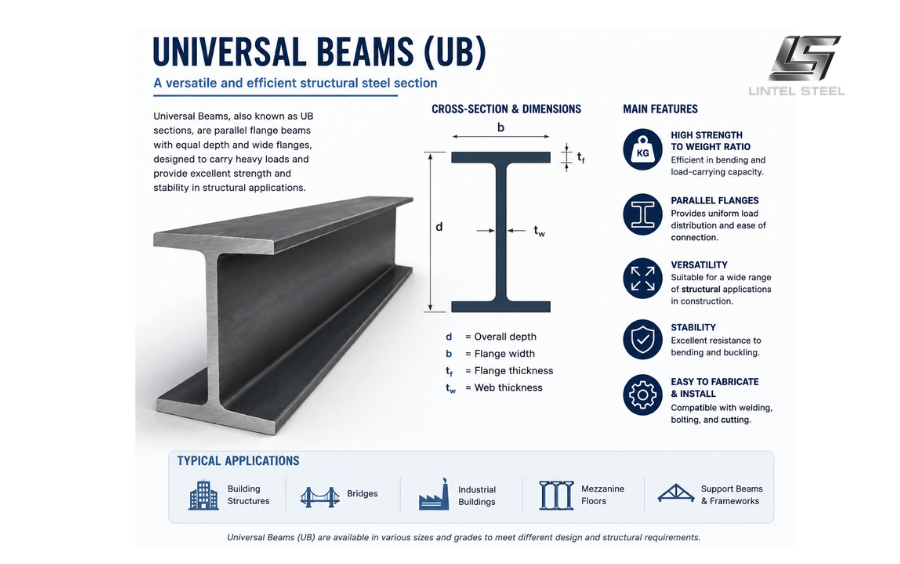
Universal Beams, commonly known as UBs, are among the most recognisable types of structural steel. They have an I-shaped cross-section consisting of two horizontal flanges connected by a vertical web.
The geometry of a universal beam makes it particularly efficient for resisting bending. This is why UBs are commonly used as horizontal members supporting floors, roofs, walls and other loads.
In residential construction, a UB may be used where a large opening is required and a structural support is needed above it. For example, removing an internal wall to create an open-plan living area may require a steel beam to carry the loads that were previously supported by the wall.
UBs are also widely used in commercial and industrial structures where longer spans and substantial loads need to be supported.
The exact UB size and grade should always be determined by the structural design. A larger-looking beam is not automatically the correct choice, because factors such as span, loading, deflection, connections and overall structural stability need to be considered.
Australian structural steel references commonly include Universal Beams under AS/NZS 3679.1. The Australian Steel Institute’s current range information lists Grade 300 Universal Beams among the standard hot-rolled open sections covered by the relevant standards.
Types of Structural Steel: Universal Columns
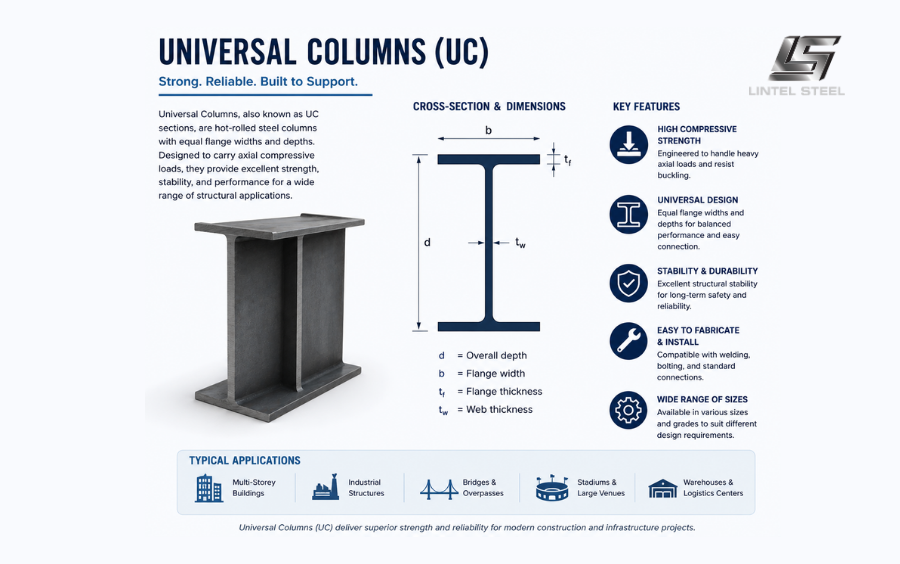
Universal Columns, or UCs, have a shape similar to Universal Beams but are generally designed with proportions that make them particularly suitable for carrying axial loads.
Columns are primarily vertical structural members. Their job is to transfer loads from beams, floors and roofs down toward the foundations.
UC sections are commonly used in building frames, commercial structures, industrial facilities and other projects where strong vertical supports are required.
Although they are often associated with columns, the final use of a particular steel section is determined by engineering design. A UC can potentially perform other structural roles depending on the design, but it should not be substituted for another section without appropriate engineering approval.
As with UBs, Universal Columns are included among the hot-rolled structural steel sections covered by AS/NZS 3679.1.
Types of Structural Steel: Parallel Flange Channels
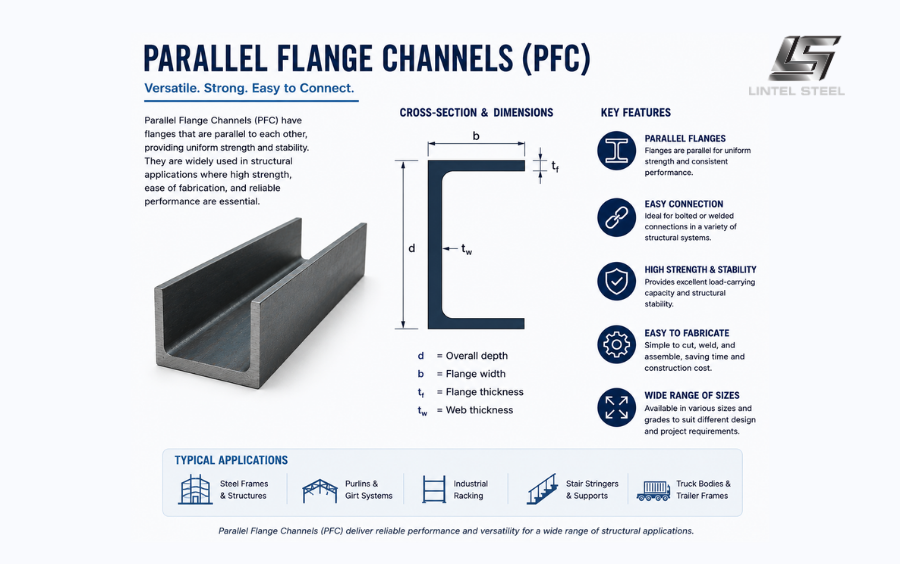
Parallel Flange Channels, commonly called PFCs, have a channel-shaped cross-section. Unlike an I-shaped beam, a PFC has one web and two flanges extending from the same side.
PFCs are versatile structural members and can be used in many different applications. They may be used for supports, framing, edge members, lintels, brackets and other structural components.
One advantage of a channel section is its relatively compact profile. It can be useful where a project requires structural support but available space is limited.
PFCs are also frequently combined with other steel sections. For example, they can be welded or bolted to plates, angles or other structural members to create fabricated components.
The Australian Steel Institute identifies Parallel Flange Channels as one of the standard hot-rolled open sections available under AS/NZS 3679.1.
Types of Structural Steel: Steel Angles
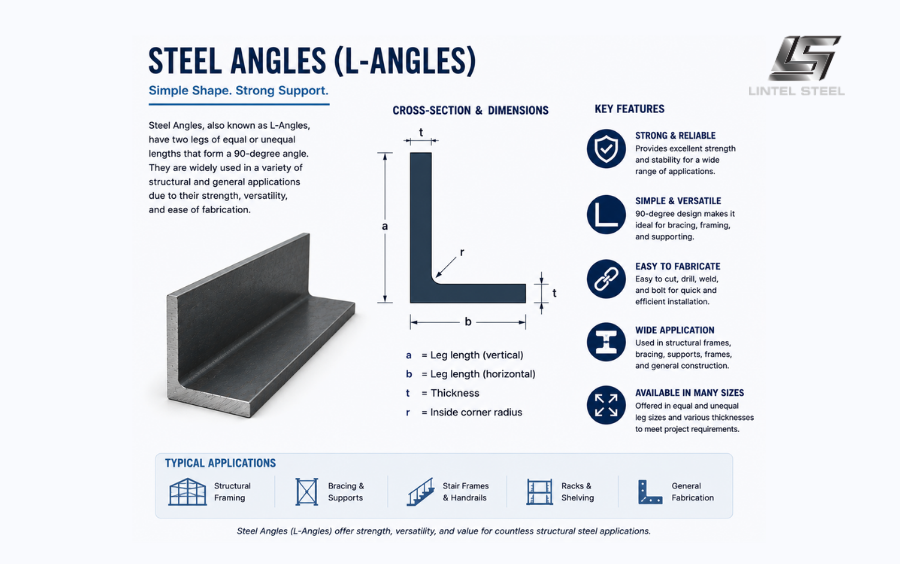
Steel angles have an L-shaped cross-section and are available in two common forms: equal angles and unequal angles.
Equal angles have two legs of approximately equal width, while unequal angles have legs of different widths.
Because of their simple but versatile shape, steel angles are used for many structural and fabrication applications. They can be used for bracing, framing, supports, connections, brackets and reinforcement.
Angles can also be useful when fabricating custom structural components. Their relatively simple geometry makes them easy to combine with plates, channels and other sections.
Equal and unequal angles are included among the hot-rolled structural steel sections covered by AS/NZS 3679.1.
For a project requiring a specific angle section, the engineer or fabricator needs to consider the dimensions, steel grade, connection method and loading conditions rather than choosing an angle based solely on its physical size.
Types of Structural Steel: T-Sections
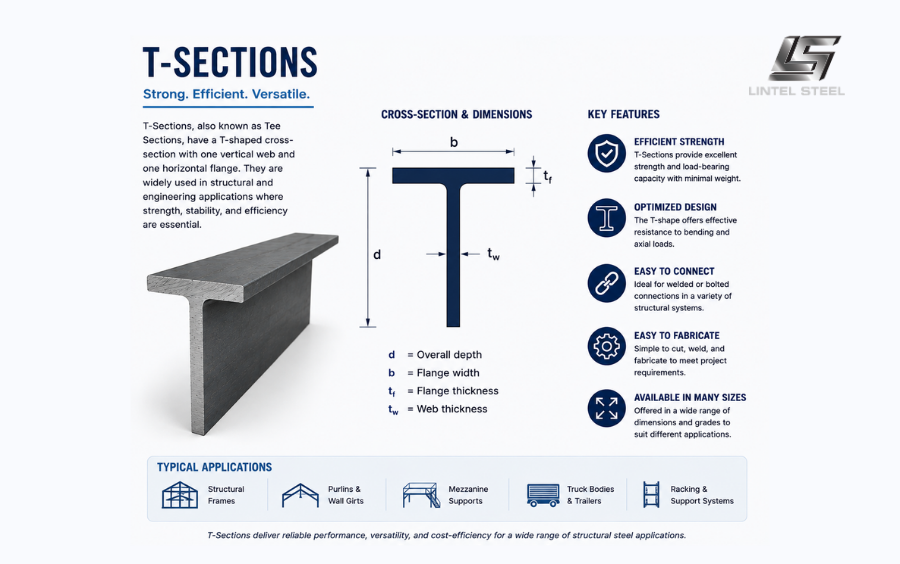
T-sections have a profile that resembles the letter “T”. They can be manufactured as dedicated sections or fabricated from other structural steel sections.
T-sections can be used in framing, reinforcement, supports and other structural applications. Their shape provides a flange and web arrangement that can make them useful for resisting particular types of loading.
In Australian structural steel ranges, tees may also be produced by cutting Universal Beams or Universal Columns. The Australian Steel Institute’s structural steel range information identifies beam tees and column tees among the available sections.
T-sections are generally selected when their specific geometry provides an advantage for the structural or fabrication requirements of the project.
Types of Structural Steel: Welded I-Sections
Not every structural beam is produced as a standard hot-rolled section.
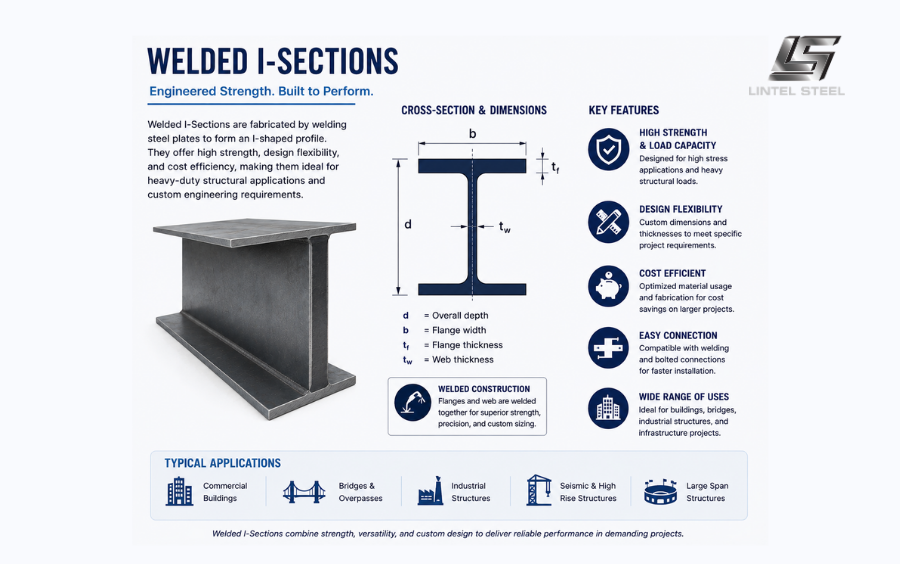
Welded I-sections are manufactured by welding steel plates together to create an I-shaped structural member. This approach allows manufacturers and fabricators to produce sections with dimensions that may not be available as standard hot-rolled products.
Welded I-sections can be particularly useful for larger or specialised structures where engineers need a particular combination of depth, flange width, thickness or structural capacity.
AS/NZS 3679.2 specifies requirements for welded I-sections for general structural and engineering applications.
Because welded sections are fabricated rather than simply supplied as standard rolled products, quality control and welding procedures are especially important. Fabrication should comply with the relevant project specifications and applicable Australian Standards.
Types of Structural Steel: Steel Plates and Flats
Structural steel is not limited to beams and hollow sections. Steel plates and flat products are also important components in structural construction.
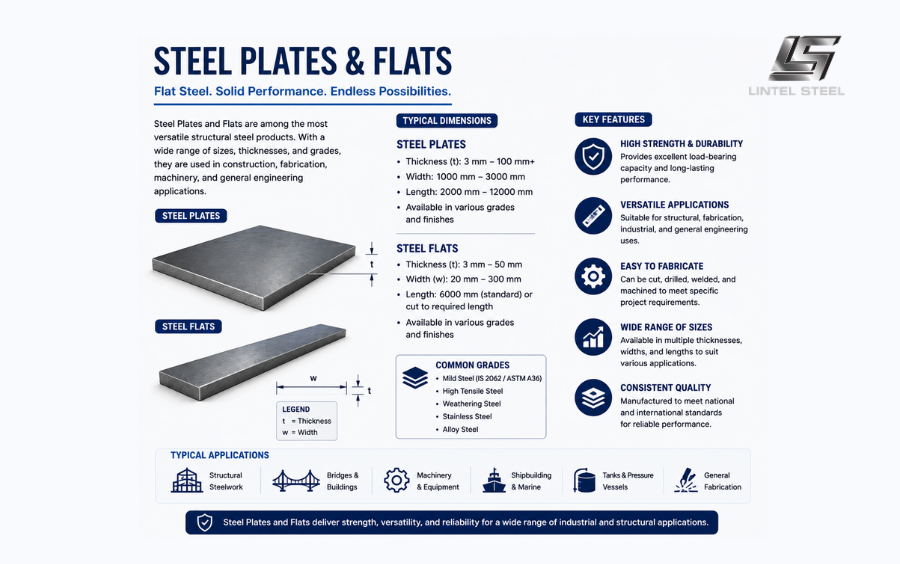
Steel plates are flat pieces of steel available in different thicknesses and sizes. They can be used for base plates, connection plates, gussets, brackets, stiffeners and fabricated structural components.
Flat bars are long, narrow steel sections with a rectangular cross-section. They can be used for supports, brackets, connections, frames and fabrication work.
In Australia, structural steel hot-rolled plates, floorplates and slabs are covered by AS/NZS 3678, while other flat products may fall under different material standards depending on their characteristics and intended use.
Plates are often combined with beams, columns and other sections to create connections or custom-fabricated structural assemblies.
Types of Structural Steel: Cold-Formed Steel Sections
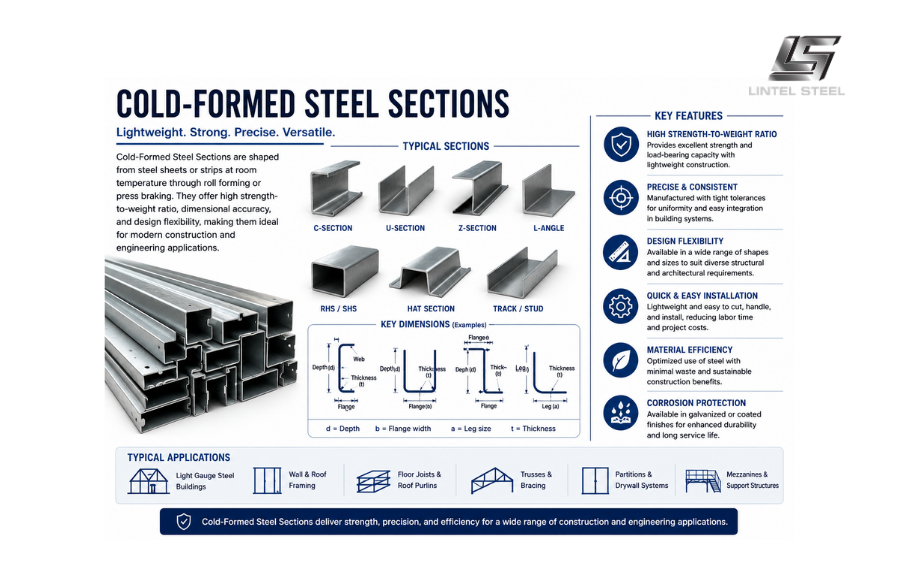
Cold-formed structural steel is manufactured by forming steel sheet or strip into a required shape without the same hot-rolling process used for traditional heavy structural sections.
Common cold-formed sections include channels, studs, tracks and other light structural profiles.
These products are particularly common in lightweight framing systems and can be useful for walls, roofs, partitions and other applications where a lighter structural solution is appropriate.
Cold-formed structural steel is addressed by AS/NZS 4600 for structural design, while cold-formed structural hollow sections are covered by AS/NZS 1163.
It is important to distinguish cold-formed light-gauge framing products from heavier structural steel sections such as UBs and UCs. They may all be made from steel, but they have different manufacturing processes, dimensions, applications and design requirements.
Types of Structural Steel by Steel Grade
Another way to classify structural steel is by its grade.
Steel grade indicates specified mechanical and material properties. In Australian standards, grades are commonly associated with minimum yield strength, expressed in megapascals (MPa), although the complete specification involves more than a single strength value.
For example, the Australian Steel Institute’s structural steel range identifies Grade 300 and Grade 400 welded beams and columns, as well as Grade 300 UBs, UCs, PFCs, angles and other hot-rolled sections.
Different projects may require different grades depending on structural loading, design requirements, fabrication considerations and environmental conditions.
A common mistake is assuming that choosing a higher-grade steel automatically makes a structure better. Structural engineering is more complicated than that. The section geometry, thickness, connection design, stability, fabrication and other factors all affect performance.
The grade specified by the engineer should therefore be followed carefully. The Australian Steel Institute advises stakeholders to take care when using materials without documented conformity to the relevant Australian Standards.
How to Choose Between Different Types of Structural Steel
Choosing the right type of structural steel begins with understanding what the member needs to do.
A horizontal beam carrying a floor load may require a different section from a vertical column. A lightweight wall frame will have different requirements from a large warehouse portal frame. A visible architectural column may also have different aesthetic requirements from steel hidden inside a wall.
The project’s structural engineer will consider factors such as span, load, deflection, strength, stability, connection requirements and the surrounding environment when selecting the appropriate section.
Fabrication is another consideration. Some sections may be readily available from suppliers, while others may require cutting, drilling, welding or custom fabrication.
Availability can also affect project planning. Working with a supplier that can provide accurate quantity take-offs, cutting services, fabrication and coordinated delivery can help reduce unnecessary delays between design and construction.
However, availability should never override engineering requirements. If a specified section is unavailable, any alternative should be assessed and approved through the appropriate engineering process.
Read more: Structural Steel Guide: Everything You Need to Know
Structural Steel Standards in Australia
For Australian construction projects, understanding the relevant standards is an important part of selecting structural steel.
AS/NZS 3679.1 covers hot-rolled bars and sections, including common structural profiles. AS/NZS 3679.2 covers welded I-sections, while AS/NZS 1163 covers cold-formed structural hollow sections. AS/NZS 3678 covers hot-rolled structural steel plates, floorplates and slabs.
Design requirements are addressed by standards including AS 4100 for steel structures and AS/NZS 4600 for cold-formed steel structures. Fabrication and erection are addressed by AS/NZS 5131, while AS/NZS 1554 covers structural steel welding.
These standards work together rather than functioning as isolated documents. The material, design, welding, fabrication and erection requirements all contribute to the final performance of a structural steel system.
For this reason, builders and project owners should use the latest applicable project documentation and seek advice from qualified engineers or other relevant professionals when making structural decisions.
Why Understanding the Types of Structural Steel Matters
Knowing the different types of structural steel makes it easier to understand engineering drawings, discuss requirements with suppliers and evaluate fabrication options.
A builder who understands the difference between a UB and a UC can communicate more clearly about the intended application. Knowing what PFC, RHS, SHS and CHS mean can also make it easier to understand material schedules and quotations.
For homeowners, this knowledge can be useful when discussing renovations or extensions that involve structural changes. For architects and designers, understanding the available sections can open up more possibilities when balancing structure, appearance and available space.
Most importantly, understanding steel sections helps prevent the common mistake of treating all structural steel as interchangeable.
Final Thoughts on the Types of Structural Steel Used in Construction
There are many types of structural steel available for modern construction, and each section has characteristics that make it suitable for particular applications.
Universal Beams are commonly used for horizontal load-bearing applications, while Universal Columns are widely used as vertical supports. PFCs provide a versatile channel-shaped option, while equal and unequal angles are useful for framing, bracing and connections. Hollow sections such as RHS, SHS and CHS offer efficient and often visually clean structural solutions. Welded I-sections and steel plates provide additional flexibility for larger or specialised structures.
The right choice depends on much more than the shape of the steel. The required grade, dimensions, loading, connections, fabrication method, environment and applicable standards all need to be considered.
For Australian construction projects, working from engineering documentation and using structural steel with documented conformity to the relevant standards is essential. When properly designed, specified, fabricated and installed, structural steel can provide a strong, durable and highly adaptable solution for projects ranging from residential construction to major commercial and industrial buildings.
If you are sourcing structural steel for a construction project, start with the engineering specifications and then work with an experienced supplier or fabricator who can help translate those requirements into accurately supplied and fabricated steel products.
Choose Lintel Steel – where precision meets performance in every structure we build.
Click here to get a quote and quantity takeoff for free.
You can find out more about us at our Fanpage Lintel Steel.


