
Structural Steel Guide: Everything You Need to Know

Structural steel is one of the most important materials in modern construction. From residential homes and warehouses to commercial buildings, bridges and large infrastructure projects, steel provides the strength and flexibility needed to create structures that are safe, durable and efficient.
However, if you are a homeowner, builder or someone planning a construction project, terms such as universal beams, PFC, RHS, steel grades and structural connections can quickly become confusing.
This structural steel guide explains the basics in simple terms. We will look at what structural steel is, the common types and shapes available, where it is used, how it is fabricated and installed, and what you should consider when choosing structural steel for a project.
Structural Steel Guide: What Is Structural Steel?
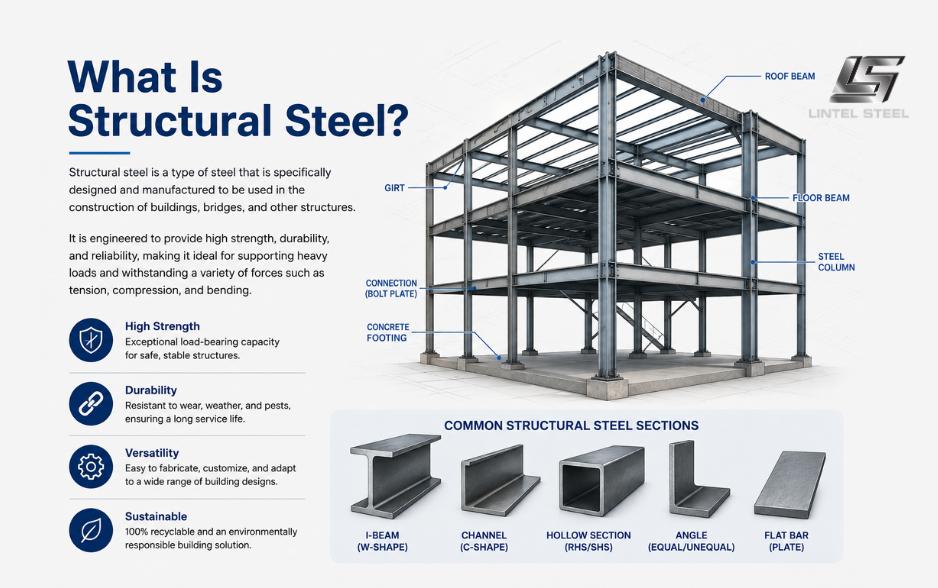
Structural steel is steel manufactured into specific shapes, sizes and grades for use as load-bearing components in buildings and other structures. Unlike decorative or non-structural steel products, structural steel is designed to carry loads and transfer forces safely through a structure.
You will commonly find structural steel in beams, columns, frames, roof structures, lintels, platforms and other load-bearing parts of a building.
Steel itself is primarily an alloy of iron and carbon, although other elements may be added or controlled to achieve particular mechanical properties. For structural applications, properties such as strength, ductility, weldability and dimensional consistency are particularly important.
In Australia, structural steel materials and construction are covered by a framework of Australian and Australian/New Zealand Standards. For example, AS/NZS 3679.1 covers hot-rolled bars and sections, while AS/NZS 1163 covers cold-formed structural steel hollow sections. Structural steel design is primarily addressed by AS 4100, while fabrication and erection are addressed by AS/NZS 5131.
This is why structural steel should not simply be selected based on its dimensions or appearance. The grade, material standard, design requirements, fabrication and installation all matter.
Why Is Structural Steel So Widely Used?
One of the biggest reasons structural steel is used around the world is its high strength-to-weight ratio. Steel can support substantial loads without requiring extremely bulky structural members, making it useful when designers need strength while maintaining efficient use of space.
Structural steel is also highly versatile. It can be cut, drilled, welded and fabricated into a wide variety of components. This gives engineers and architects considerable flexibility when designing anything from a relatively simple residential extension to a large commercial building.
Another advantage is the ability to prefabricate components. Structural steel members can be measured, cut, drilled and welded in a controlled fabrication environment before being delivered to the construction site. With accurate drawings and fabrication, this can make on-site assembly more organised and efficient.
Steel is also recyclable, and structural components can sometimes be reused depending on their condition, documentation and engineering requirements. This makes steel relevant to modern construction projects seeking to improve material efficiency and reduce unnecessary waste.
Structural Steel Guide to Common Steel Shapes
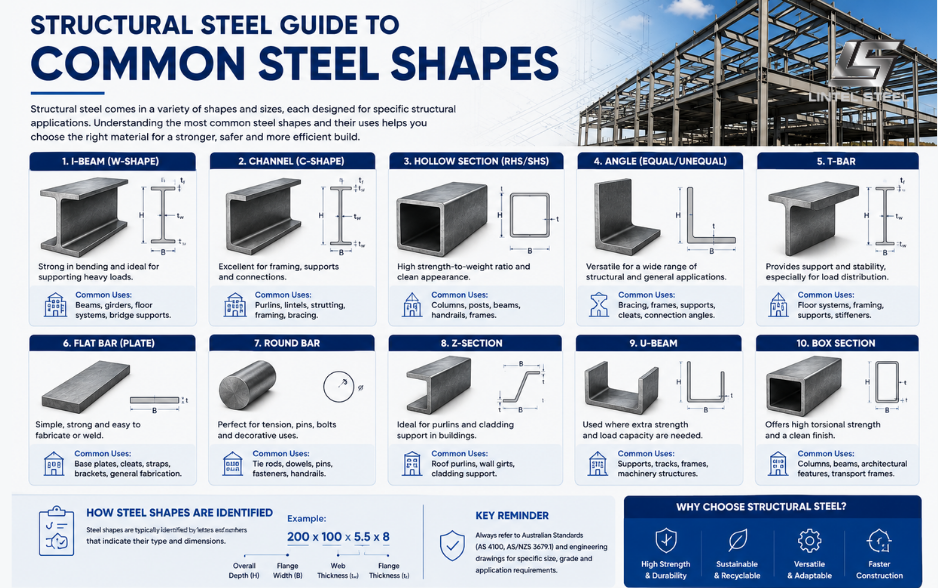
One thing that can confuse people when they first start looking at structural steel is the number of different shapes available. Each section has a particular geometry that makes it suitable for different structural applications.
Universal Beams, commonly referred to as UBs, have the familiar I-shaped profile. They are widely used as horizontal structural members because their shape makes them efficient at resisting bending. You will commonly see them supporting floors, roofs and openings.
Universal Columns, or UCs, look similar to universal beams but generally have different proportions. As their name suggests, they are commonly used vertically as columns, although the actual application must always follow the structural design.
Parallel Flange Channels, or PFCs, have a channel-shaped cross-section. They can be used for structural framing, supports, edge members and many other applications.
Rectangular Hollow Sections (RHS) and Square Hollow Sections (SHS) are closed steel sections. Their clean shape and structural properties make them popular for columns, frames, posts and architectural structures where the steel may remain visible.
Circular Hollow Sections (CHS) provide similar benefits in a round profile and are commonly found in columns, supports, trusses and exposed architectural applications.
Steel angles have an L-shaped profile and are available in equal and unequal configurations. They are frequently used for bracing, framing, supports, connections and lintels.
There are also steel plates, flats, T-sections and purpose-fabricated components. The right section depends on the loads, span, connection details, architectural requirements and structural engineer’s design.
Understanding Structural Steel Grades
Not all structural steel has the same mechanical properties. Steel grades help identify characteristics such as minimum yield strength and other specified material requirements.
Depending on the product and relevant standard, structural steel may be supplied in different grades. For example, the Australian Steel Institute’s National Structural Steelwork Specification identifies grades such as 300 and 350 for certain hot-rolled sections, while hollow sections covered by AS/NZS 1163 can include grades such as C350L0.
It is important not to assume that a higher number automatically means a product is better for every project. Structural design involves more than simply choosing the strongest available steel.
Engineers consider factors such as loading, span, member geometry, connection design, stability, fabrication requirements and the environment in which the structure will be used. For this reason, the steel grade specified on engineering drawings should be followed rather than substituted based only on availability or price.
Structural Steel Guide to Common Applications
Structural steel can be found in almost every major category of construction.
In residential projects, steel beams may be used to support floors, roofs and large openings. Steel columns can transfer loads to foundations, while steel lintels may support masonry above windows, doors and other openings. Structural steel is particularly useful where homeowners want wider openings or open-plan layouts that require significant structural support.
Commercial construction uses structural steel on a much larger scale. Offices, shopping centres, warehouses, factories and industrial facilities may rely on steel framing for their primary structural systems.
Steel is also commonly used for mezzanine floors, workshops, sheds, carports, canopies, stairs and platforms.
Infrastructure represents another major area of structural steel use. Bridges, transport facilities and industrial infrastructure often rely on engineered steel components because of their strength, versatility and ability to accommodate demanding structural requirements.
The key point is that structural steel is not a single product with one purpose. It is a family of engineered products that can perform many different structural roles.
How Is Structural Steel Fabricated?
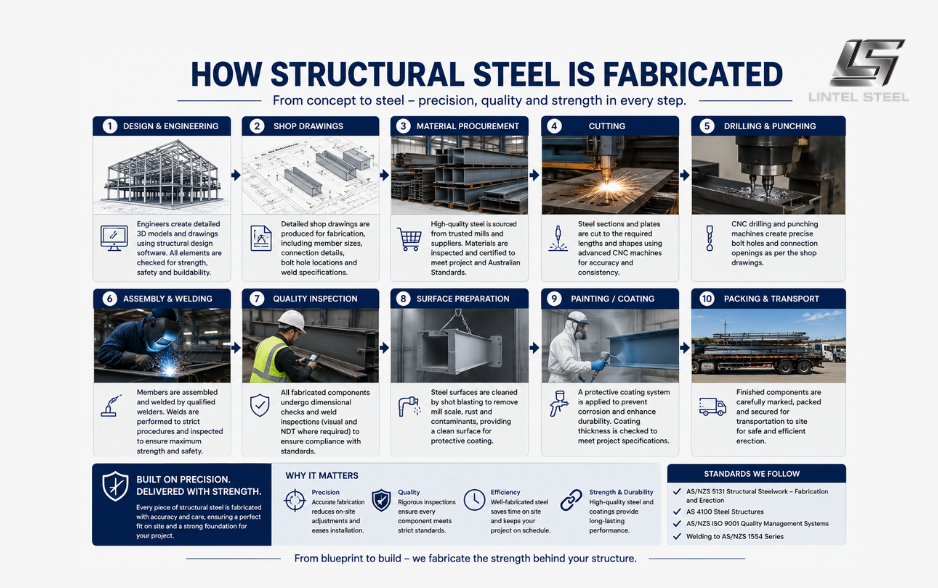
Structural steel fabrication is the process of turning standard steel sections and plates into components that are ready to be installed as part of a structure.
The process normally begins with engineering and fabrication information. Fabricators use drawings and specifications to determine the required dimensions, steel sections, hole positions, connection details, plates and other components.
Steel members can then be cut to the required lengths. Holes may be drilled or punched for bolted connections, while plates, cleats and other components can be prepared separately.
Where required, components are welded together. Welding must be performed according to the relevant project specifications and standards. In Australia, AS/NZS 1554 is the structural steel welding series, while AS/NZS 5131 addresses structural steelwork fabrication and erection.
Protective treatment may also be required. Depending on the project and environment, steel may be painted, galvanised or protected using another specified coating system.
Accuracy during fabrication is extremely important. A beam that is the wrong length or has connection holes in the wrong location can create significant problems during installation. Good fabrication therefore depends on accurate drawings, measurements, quality control and coordination between engineers, detailers, fabricators and installers.
How Is Structural Steel Installed?
Once fabricated, structural steel components are transported to the construction site and erected according to the approved design and construction documentation.
Installation may involve lifting beams and columns into position using cranes or other lifting equipment. Components are then connected using bolts, welds or a combination of connection methods depending on the design.
The order of installation matters. Structural frames need to remain stable throughout the erection process, not just after the entire building is complete. Temporary bracing may therefore be required while different parts of the structure are being installed.
AS/NZS 5131 provides an important framework for the fabrication and erection of structural steelwork in Australia. The Australian Steel Institute also provides a National Structural Steelwork Specification to help engineers and specifiers implement these requirements consistently.
Structural steel installation should always follow the project’s engineering documentation and applicable requirements rather than relying on general rules of thumb.
Structural Steel Connections: Bolted or Welded?
Connections are a critical part of any steel structure because they allow loads to transfer from one structural member to another.
Bolted connections use bolts, nuts and associated components to connect steel members. They are commonly used during site erection because components can be prefabricated with the necessary holes and then assembled on site.
Welded connections join steel components through welding. Welding can create strong, compact connections and is commonly performed during fabrication, although site welding may also be required for certain projects.
Many buildings use both methods. A fabricated beam, for example, might have connection plates welded to it in the workshop and then be bolted to another structural member on site.
The appropriate connection method should be determined through engineering design rather than selected solely for convenience.
Structural Steel and Corrosion Protection
Steel is durable, but unprotected steel can corrode when exposed to moisture and certain environmental conditions. Corrosion protection therefore needs to be considered as part of the overall structural system.
Paint systems are commonly used to provide a protective barrier between steel and the surrounding environment. Galvanising is another option and involves applying a zinc-based protective coating to steel.
The appropriate protection depends heavily on where the steel will be installed. Internal structural steel in a dry environment may face very different exposure conditions from steel installed outdoors or in a coastal environment.
This is particularly relevant in many Australian locations where structures may be exposed to salt, moisture, high temperatures and changing weather conditions.
Protection should therefore be specified according to the project’s exposure conditions, expected service life and maintenance requirements.
Structural Steel Standards in Australia
For Australian construction projects, compliance is an essential consideration when specifying, purchasing and installing structural steel.
AS 4100 is a key standard for the design of steel structures, while AS/NZS 4600 addresses cold-formed steel structures. Material standards include AS/NZS 1163 for cold-formed structural hollow sections, AS/NZS 3678 for hot-rolled plates, and AS/NZS 3679.1 and AS/NZS 3679.2 for hot-rolled bars and sections and welded I-sections respectively. AS/NZS 1554 covers structural steel welding, and AS/NZS 5131 deals with fabrication and erection.
The Australian Steel Institute notes that Australian Standards are not automatically regulations themselves, but relevant standards can become mandatory when referenced by legislation such as the National Construction Code or when incorporated into project specifications and contracts.
For builders and project owners, this makes documentation and material conformity important. Choosing steel simply because its dimensions appear correct may not establish that it meets the performance requirements of the specified material standard.
For actual structural design, material substitutions or compliance decisions, always refer to the project’s engineer and the current applicable NCC and Australian Standards.
Structural Steel vs Timber and Concrete
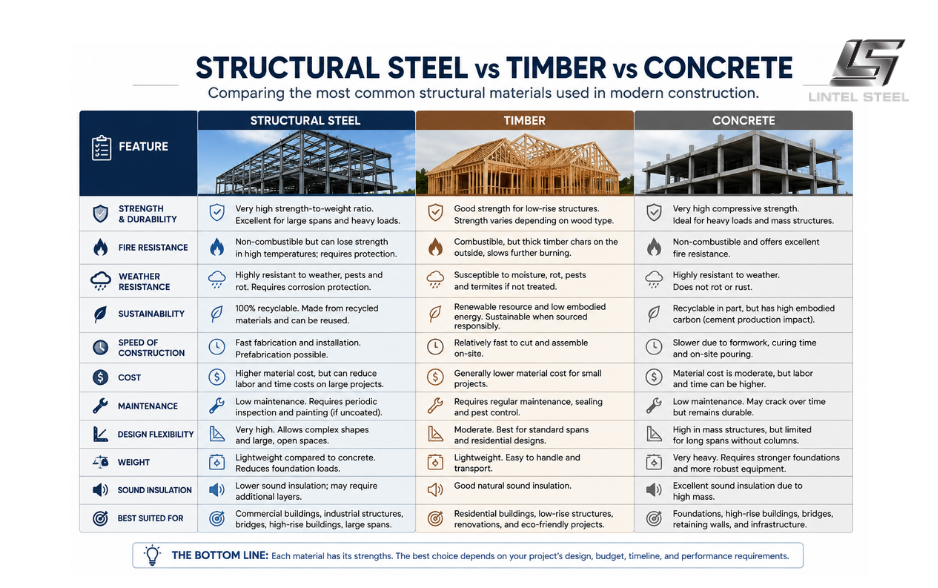
Structural steel is often compared with timber and reinforced concrete, but there is no single material that is best for every building.
Timber can be lightweight, easy to work with and suitable for many residential applications. Steel, however, can offer advantages where greater spans, higher loads or compact structural members are required.
Concrete provides excellent compressive strength and is widely used for foundations, slabs, columns and walls. Steel is often faster to assemble where prefabricated framing systems are suitable and can provide relatively slender structural members.
In practice, many modern buildings combine these materials. A project might use reinforced concrete foundations and slabs, structural steel beams and columns, and timber or light-gauge steel for non-primary framing.
Rather than asking which material is universally better, the more useful question is which material or combination of materials best meets the project’s structural, architectural, budget and construction requirements.
What to Consider When Buying Structural Steel
Buying structural steel involves more than comparing the price per metre or tonne.
The first consideration should always be the engineering specification. The required section, dimensions, grade, length and applicable material standard need to match the project documentation.
Fabrication requirements should also be considered early. If beams need to be cut, drilled, welded or fitted with plates and cleats, having this work completed accurately before delivery can reduce unnecessary work on site.
Delivery is another important factor. Structural steel members can be long and heavy, so access, unloading and site conditions should be considered before an order arrives.
Documentation and traceability may also be important depending on the project. Material conformity, fabrication records and other quality documentation can help demonstrate that the supplied steel meets the specified requirements.
Finally, consider the supplier’s overall capabilities. Reliable supply, accurate cutting, fabrication support, quantity take-offs and coordinated delivery can be just as important as the initial material price.
Structural Steel Guide: Choosing the Right Steel for Your Project
There is no universal steel section that works for every construction project. A small residential lintel and a major commercial beam may both be structural steel, but their design requirements are very different.
Start with the engineering drawings and specifications. These documents should identify the required steel members, sizes, grades and connection requirements.
From there, confirm availability with your steel supplier and determine whether fabrication is required before delivery. Avoid changing a specified section or grade simply because another option is cheaper or easier to source. Even apparently similar steel products can have different structural properties.
For larger or more complex projects, early communication between the engineer, builder, steel detailer, fabricator and supplier can prevent problems later. Resolving questions before fabrication is usually much easier than modifying structural components after they arrive on site.
Structural Steel Guide: Final Thoughts
Structural steel plays a fundamental role in modern construction because it combines strength, versatility and the ability to be fabricated into highly accurate structural components.
Understanding the basics can make planning a project much easier. Knowing the difference between beams, columns, channels, hollow sections and angles helps you understand engineering drawings and communicate more effectively with suppliers and fabricators. Understanding grades, connections, fabrication and corrosion protection also helps explain why structural steel should be selected as an engineered system rather than simply as a commodity.
The most important lesson from this structural steel guide is that every component needs to suit its intended structural role. Section size, steel grade, fabrication quality, connections, protective treatment and installation all contribute to the performance of the finished structure.
When structural steel is correctly designed, specified, fabricated and installed, it provides a strong and adaptable foundation for everything from homes and extensions to warehouses, commercial buildings and major infrastructure.
For any construction project in Australia, work from approved engineering documentation, use appropriately conforming materials and engage qualified professionals where structural design or compliance decisions are required.
Choose Lintel Steel – where precision meets performance in every structure we build.
Click here to get a quote and quantity takeoff for free.
You can find out more about us at our Fanpage Lintel Steel.


