
V-Shaped Steel: The Reliable Solution for Structures

What is V-shaped steel?
Also commonly known as angle steel or V-angle steel, it is a type of structural steel manufactured in the shape of the letter “V” or “L” with two perpendicular sides connected at a fixed angle, typically 90 degrees. This steel profile is widely used in construction, mechanical engineering, infrastructure, and industrial fabrication because of its excellent strength, durability, and flexibility.
V-shaped steel is produced through hot rolling or cold forming processes and is available in multiple dimensions, thicknesses, and material grades to suit different engineering requirements. Depending on the project specification, V-shaped steel can be equal-angle steel or unequal-angle steel.
Common types of V-shaped steel
Classified according to surface treatment method
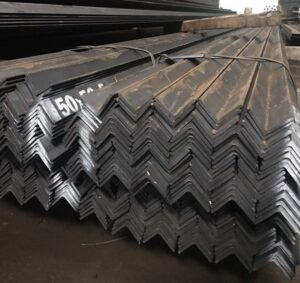
V-shaped steel
V-shaped steel products are manufactured from carbon steel, require no surface treatment, and retain the natural black color of the steel billet. Black V-shaped steel is generally inexpensive and commonly used in civil construction, furniture making, and general structural applications.
Stainless steel V-shaped
Stainless steel V-shaped are manufactured from stainless steel alloy and are highly valued for their superior performance and utility. They are particularly ideal for environments exposed to moisture, chemicals, or those requiring strict hygiene standards. The polished surface of the V-shaped profiles makes cleaning easier.
It is widely used in many fields, including:
- Factories and workshops
- Mechanical and machine manufacturing
- Bridges and roads, marine construction
- Prefabricated building structures
- Civil construction
- Medical facilities
Electro-galvanized V-shaped steel
Electrically galvanized V-shaped steel is coated with a thin layer of zinc through an electroplating process, with a thickness of 20 to 30 μm. This coating enhances rust resistance while maintaining a smooth and clean surface. The surface is brighter and smoother than that achieved using hot-dip galvanizing.
Hot-dip galvanized V-shaped steel
Hot-dip galvanized V-shaped steel is a product with a zinc coating applied by dipping steel in molten zinc, with a thickness of 70 to 90 μm. This zinc coating covers the entire surface of the product, creating a protective layer against corrosion caused by oxidizing elements. This type has high durability and is often used in harsh outdoor environments.
Classified according to their design and shape.
Angel bar/ Equal steel
This is a steel product with two equally sized flanges, hence the name “equal V” (or “standard V”). It is well-suited for structural welding, construction, and many other fields.
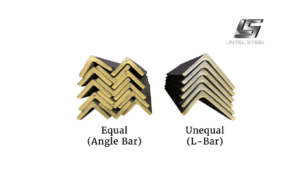
Asymmetrical V-shaped steel/ irregular V-shaped steel/ L-shaped steel/ L-angle steel
This type of steel has two unequal flanges, hence the name “asymmetrical V-shaped steel” (its cross-section resembles the letter L, hence it’s also called L-shaped steel). It’s not commonly used on a large scale, only in specific cases where the two flanges are unequal and regular V-shaped steel is impractical.
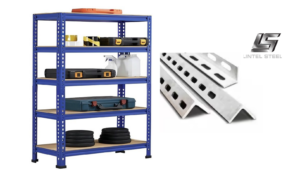
Slotted Angle Steel
Also known as Multi-purpose Slotted Angle, these products have numerous holes machined on both sides. The holes are uniformly cast, ensuring high precision and facilitating easy assembly. The product has a consistent and precise thickness and edge dimensions according to specifications.
They are commonly used in the assembly of various types of shelving, such as bookshelves, filing cabinets, supermarket shelves, storage racks, and many other applications.
V-shaped steel Production Process
Step 1: Raw Material Selection
The process begins with selecting high-quality steel billets or slabs. Carbon steel is the most commonly used material, although alloy steel and galvanized steel are also widely produced depending on the intended application.
Step 2: Heating Process
Steel billets are heated in industrial furnaces at temperatures ranging from 1,100°C to 1,250°C. Heating softens the metal, allowing it to be shaped more efficiently during rolling.
Step 3: Rolling and Forming
The heated steel passes through a series of rolling mills where it is gradually formed into the characteristic V-shaped profile. Precision rollers control the angle, dimensions and thickness.
Step 4: Cooling Process
After shaping, the steel is cooled naturally or through controlled cooling systems. Proper cooling ensures stable mechanical properties and minimizes internal stress.
Step 5: Surface Treatment
Depending on customer requirements, V-shaped steel may undergo additional treatments such as:
- Galvanization
- Anti-rust coating
- Surface polishing
- Protective painting
These treatments improve corrosion resistance and extend product lifespan.
Step 6: Quality Inspection
Before distribution, each steel profile undergoes strict inspection to verify:
- Dimensions
- Thickness tolerance
- Mechanical strength
- Surface quality
- Chemical composition
Only products meeting international standards are released to the market.
Specifications for V-shaped steel
Size and thickness
V-shaped steel is available in a wide range of sizes and thicknesses.
- The standard length of a V-shaped steel bar is 6m or 12m.
- The typical side dimensions of the steel range from 25mm to 250mm.
- The thickness of the steel usually ranges from 2mm to 25mm.
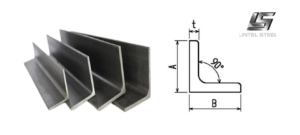
Common dimensions include:
| Size (mm) | Side a (mm) | Side b (mm) | Thickness (mm) | Weight (kg/m) |
| L25x25x3 | 25 | 25 | 3 | 1.12 |
| L30x30x3 | 30 | 30 | 3 | 1.36 |
| L40x40x4 | 40 | 40 | 4 | 2.41 |
| L50x50x5 | 50 | 50 | 5 | 3.79 |
| L63x63x6 | 63 | 63 | 6 | 5.79 |
| L75x75x6 | 75 | 75 | 6 | 6.94 |
| L90x90x8 | 90 | 90 | 8 | 10.90 |
| L100x100x10 | 100 | 100 | 10 | 15.10 |
| L120x120x12 | 120 | 120 | 12 | 21.80 |
| L150x150x15 | 150 | 150 | 15 | 34.50 |
Manufacturers can also customize dimensions according to engineering requirements.
Mechanical characteristics
Before discussing the load-bearing capacity of V-shaped steel, let’s look at the typical mechanical characteristics of the material, specifically:
Tensile Strength: High, meaning it can withstand strong tensile loads. This increases its ability to withstand tensile forces in building structures.
Ductility: Good, capable of bending without breaking. Ensures the safety of the structure in the event of large or varying loads.
Stiffness: Relatively high, helping to maintain the original shape of the structure under load. Therefore, V-shaped steel is very suitable for application in beam and column areas of buildings.
Bending Resistance: Good, increasing the ability to withstand loads arising from bending forces thanks to its V-shaped design.
Crack Resistance: Helps prevent crack formation during use.
Impact Resistance: Some types of V-shaped steel are reinforced to increase the material’s impact resistance, helping structures withstand unexpected impacts from heavy loads or external factors.
Wear Resistance: Some types of V-shaped steel, such as galvanized steel, have wear resistance, making them suitable for applications requiring high wear resistance, typically in the mining industry.
Advantages of V-shaped steel
V-shaped steel remains one of the most popular structural materials due to its many outstanding advantages.
Excellent load-bearing capacity: The angular V-shaped design increases rigidity and distributes loads efficiently. This allows the steel to withstand significant pressure without deformation, making it particularly suitable for high-traffic bridge construction.
Good durability: performs well in harsh environments, especially when galvanized or coated with an anti-corrosion layer.
Cost-effective: Compared to many other structural materials, this type of steel offers excellent performance at a relatively affordable price. Its durability also reduces long-term maintenance costs.
Easy to construct: Cutting, welding, drilling, and installation are convenient, shortening construction time. This flexibility simplifies construction and manufacturing processes.
Lightweight yet strong: Despite its strong mechanical performance, V-shaped steel remains relatively lightweight compared to more bulky structural components.
Variety of sizes: V-shaped steel profiles are manufactured in a wide range of sizes and thicknesses, making it easy to choose according to specific needs.
Applications of V-shaped steel
V-shaped steel is an essential component across numerous industrial and construction sectors.
- Civil and Industrial Infrastructure
In the realm of construction, this material is vital for creating beams, roof trusses, support frames, and load-bearing assemblies. It is also frequently utilized for railings, retaining walls, and iron doors. Its high rigidity and superior load-bearing properties significantly enhance the stability and lifespan of these essential structures.
For industrial applications, V-shaped steel is indispensable in building warehouses, factories, and prefabricated steel units. It is extensively used in crane systems, conveyors, and for the installation of heavy-duty piping and machine frames within factory environments.
- Mechanical Engineering and Fabrication
V-shaped steel is also used in the manufacture of machinery and industrial equipment due to its good machinability. Components such as supports, machine frames, foundations, hinges, or load-bearing mechanical parts can all be made from this type of steel to ensure accuracy and operational stability.
In addition, V-shaped steel is also used as frames for trucks, specialized vehicles, cargo bridges, load-bearing scaffolding, etc., helping to optimize production costs while still ensuring durability and technical safety requirements.
Noted on using V-shaped steel
To purchase satisfactory V-shaped steel, based on our years of experience in the industry, we offer the following tips:
High-grade V-shaped steel has a smooth, polished surface and a uniform dark blue color. This type of steel possesses excellent ductility, allowing for bending without fracture, while also offering superior strength and a long lifespan.
To ensure you receive genuine products, it is essential to verify the steel grade, production standards, and factory certificates. Always partner with a supplier known for their reputation and integrity.
Since price variations across the market are generally minimal, exercise caution when encountering unusually low price quotes. Such offers often carry a high risk of fraud or the delivery of substandard materials.
Furthermore, with V-shaped steel prices currently on an upward trend and further increases anticipated, securing your purchase early is highly recommended.
Conclusion
V-shape steel continues to be one of the most important structural materials in modern engineering and construction. Its excellent strength, durability, versatility, and cost efficiency.
Whether used in residential construction, industrial manufacturing, infrastructure development, or renewable energy projects, V-shaped steel provides reliable structural support and long-term performance. By understanding the production process, specifications, advantages, applications, and proper usage guidelines, businesses and contractors can maximize the value and efficiency of this essential steel material.
As construction technology continues evolving, V-shape steel will remain a key component in creating safer, stronger, and more sustainable structures worldwide.
Choose Lintel Steel for Superior Steel Solutions
At Lintel Steel, we offer premium-grade steel solutions for many applications across Perth and Western Australia. With over 11 years of industry experience, we deliver reliable products that meet strict engineering standards.
We also provide expert advice to help you select the best materials for your needs. Our team offers custom sizes, prompt delivery, and free quotes within 48 hours, helping you complete your project with confidence and precision.
Choose Lintel Steel – your trusted partner for steel products, strong, and superior steel solutions.
Click here to get a quote and quantity takeoff for free at Lintel Steel.
You can find out more about us at our Fanpage Lintel Steel.


