
Parallel Flange Channel vs. Tapered Flange: Why Parallel Design Wins in Modern Engineering

In structural engineering, small differences in steel section geometry can create major differences in performance, fabrication, and cost. One of the most important comparisons is between the parallel flange channel and the tapered flange channel. While both are widely used in construction and fabrication, the parallel flange design is increasingly preferred in modern engineering because it offers greater consistency, easier connection detailing, and better overall practicality.
This article from Lintel Steel explains the key differences between the two channel types and shows why parallel flange channels often outperform tapered sections in real-world applications.
What Is a Parallel Flange Channel (PFC)?
A parallel flange channel, often called a PFC, is a steel channel section with flanges that run parallel to each other from root to edge. This uniform geometry gives the section a clean, regular shape that is easier to design with, fabricate, and connect. PFCs are commonly used in building frames, supports, beams, lintels, and secondary structural members.
Because the flanges remain the same thickness and angle throughout the section, the load transfer is more predictable. That makes PFCs especially attractive in modern construction, where standardization and efficiency matter.
What Is a Tapered Flange Channel?
A tapered flange channel has flanges that slope inward or outward rather than remaining parallel. This older style of channel section was used extensively in traditional steel construction and remains useful in certain applications. Its geometry can reduce material in some cases, but it also introduces complexity in detailing and connection design.
Tapered flange channels may still perform well structurally, but they are often less convenient for modern fabrication methods and standard connection hardware. That is one reason many engineers now prefer parallel flange sections.
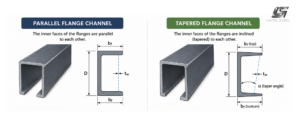
Parallel Flange vs. Tapered Flange: Key Structural Differences
The most obvious distinction between these two channel types lies in the flange geometry, but the impact extends far beyond appearance. A parallel flange channel offers a uniform contact surface, which simplifies bolting, welding, and bearing connections. A tapered flange section, by contrast, creates angled surfaces that can make fitting and load transfer less straightforward.
| Feature | Parallel Flange Channel | Tapered Flange Channel |
| Flange Shape | Parallel | Angled/Tapered |
| Flange Thickness | Uniform | Variable |
| Fabrication Complexity | Low | Higher |
| Bolted Connections | Simple | More Complex |
| Welding Efficiency | Excellent | Moderate |
| Structural Consistency | High | Lower |
| BIM Compatibility | Excellent | Moderate |
| Modern Availability | Widely Available | Limited |
| Preferred for New Projects | Yes | Rarely |
These differences significantly influence project costs, construction speed, and overall structural efficiency.
Why Parallel Flange Design Performs Better
Parallel flange design performs better primarily because it supports a more direct and reliable load path. When a member has flat, parallel flanges, forces are distributed more evenly through connections and adjacent structural elements.
Easier Connections and Fabrication
One of the biggest advantages of PFC sections is their ease of connection. Because the flanges are parallel and flat, engineers can design bolted and welded connections without accounting for flange angles. Fabricators can work more efficiently, and installation crews spend less time making adjustments on site.
Benefits include:
- Faster assembly
- Reduced fabrication time
- Simplified connection detailing
- Improved fit-up accuracy
- Lower labor costs
In large-scale projects where thousands of connections may be required, even small efficiency gains can translate into significant cost savings.
Improved Welding Quality
Welding performance is another area where PFC sections outperform tapered alternatives.
Uniform flange surfaces provide consistent contact between structural components, allowing welders to achieve better alignment and more reliable weld penetration.
Advantages include:
- Easier weld preparation
- Improved weld consistency
- Faster inspection processes
- Reduced risk of fabrication errors
For industrial facilities, heavy-duty platforms, and equipment support structures, these benefits contribute to higher-quality construction outcomes.
Greater Dimensional Consistency
Modern engineering increasingly relies on precision manufacturing and digital modeling technologies such as Building Information Modeling (BIM).
Parallel flange channels offer:
- Consistent geometry
- Improved manufacturing tolerances
- Better compatibility with automated fabrication
- More predictable structural behavior
This consistency simplifies design calculations and minimizes unexpected issues during construction.

Structural Performance Comparison
From a structural perspective, both section types can be engineered to carry significant loads, but parallel flange channels offer better predictability. The regular flange geometry helps create a stable section with consistent mechanical behavior. This is especially useful in projects that demand repeatable results across many similar members.
Load-Carrying Capacity
While both channel types can provide adequate structural strength, modern PFC sections are designed to optimize material distribution and structural efficiency.
For many applications, engineers find that PFC sections deliver:
- Better strength-to-weight ratios
- More efficient load transfer
- Improved overall performance
The actual load-carrying capacity depends on factors such as section size, steel grade, span length, and loading conditions. However, the geometric advantages of PFC sections often make them more practical for contemporary engineering requirements.
Stability and Reliability
Structural stability is a critical consideration in any design.
The uniform flange geometry of PFC sections contributes to:
- Predictable stress distribution
- Consistent load paths
- Improved structural analysis accuracy
- Enhanced design reliability
These characteristics are especially valuable in large commercial buildings, industrial plants, and infrastructure projects where performance and safety are paramount.
Cost Advantages of Parallel Flange Channels
At first glance, tapered flange channels may seem more economical because they can use material more selectively. In practice, however, the total cost picture is more complex. A section that is easier to fabricate, connect, and install can often save more money overall than a section that is slightly lighter but harder to work with.
Parallel flange channels reduce labor time because standard components fit more easily. They also reduce the need for custom fabrication, special washers, or additional adjustments during installation. Those savings can be significant on larger projects.
Lower Fabrication Costs
Fabrication represents a significant portion of overall project expenses. Because PFC sections require fewer adjustments during cutting, fitting, drilling, and welding, fabrication shops can process them more efficiently. Cost-saving factors include:
- Reduced labor hours
- Faster production schedules
- Less material waste
- Simplified manufacturing processes
Reduced Installation Costs
On-site installation becomes easier when components fit together predictably. Contractors benefit from:
- Faster erection times
- Reduced crane usage
- Fewer alignment issues
- Lower rework requirements
These advantages help keep projects on schedule and within budget.
Long-Term Economic Benefits
Beyond initial construction costs, PFC sections can contribute to lower lifecycle costs through:
- Improved durability
- Better structural performance
- Reduced maintenance requirements
- Enhanced adaptability for future modifications
For owners and developers, these long-term benefits can significantly improve project value.
Applications Where PFC Clearly Outperforms Tapered Sections
Parallel flange channels are especially strong in applications where ease of connection and predictable performance are essential. Their standard geometry makes mass fabrication and modular construction much simpler. This is one reason they are common in modern commercial and industrial work.
They are also favored in projects where speed matters. When crews can install components without complicated adjustments, the entire build process becomes more efficient.
Commercial Buildings
Modern commercial construction demands speed, efficiency, and flexibility. PFC sections are commonly used in:
- Office buildings
- Retail centers
- Warehouses
- Distribution facilities
Their ease of connection and fabrication helps accelerate project delivery timelines.
Industrial Facilities
Industrial environments often involve heavy loads, equipment supports, and complex structural systems. PFC sections are ideal for:
- Factory buildings
- Manufacturing plants
- Equipment platforms
- Maintenance structures
- Conveyor support systems
The consistent geometry simplifies both design and fabrication.
Infrastructure Projects
Infrastructure projects require reliable, durable structural components. PFC sections are increasingly specified for:
- Bridges
- Transportation structures
- Utility frameworks
- Public facilities
Their predictable performance aligns well with modern engineering standards and quality requirements.
Why Modern Engineering Standards Favor Parallel Flange Channels
Modern engineering values consistency, repeatability, and constructability. Parallel flange channels align well with all three. Their geometry supports cleaner detailing, easier inspection, and more reliable assembly, which is why they are often preferred in contemporary standards and project specifications.
Another reason for their popularity is compatibility with modern design workflows. Engineers now work with highly standardized component systems, digital modeling tools, and fast-paced construction schedules. A section that behaves predictably and connects cleanly is a better fit for that environment.
In short, the move toward parallel flange channels reflects a broader trend in engineering: performance design, but also for buildability. A section that is easier to manufacture and install can deliver better overall project value.

Choosing the Right Channel for Your Project
Choosing between a parallel flange channel and a tapered flange channel depends on the demands of the project. If the design prioritizes ease of fabrication, standard connection details, and predictable behavior, a PFC is usually the better choice. If the project involves a legacy system or a specialized load condition, a tapered channel may still be appropriate.
The best decision comes from balancing structural needs with construction practicality. Engineers should consider:
- Structural requirements
- Design standards
- Connection details
- Fabrication capabilities
- Budget constraints
- Material availability
Conclusion
Parallel flange channels have become a preferred choice in modern engineering because they combine structural reliability with practical advantages in fabrication, installation, and cost control. Their uniform geometry makes them easier to design with and easier to build with, which is a major advantage in fast-moving construction environments.
Tapered flange channels still have a place in certain specialized or legacy applications, but they are no longer the default choice for many new projects. For most modern structural needs, the parallel flange design wins because it delivers the best balance of performance, efficiency, and constructability.
Choose Lintel Steel for Superior Steel Solutions
Lintel Steel Parallel Flange Channels (PFCs) are high-strength structural steel sections with a U-shaped profile and parallel flanges. Engineered for superior load distribution and structural stability, PFCs are widely used in construction, engineering, and industrial applications. Their parallel flange design allows for easy connection and bolting, making them a preferred choice for heavy-duty frameworks and load-bearing structures.
At Lintel Steel, we offer premium-grade steel solutions for a wide range of applications across Perth and Western Australia. With over 11 years of industry experience, we deliver reliable products that meet strict engineering standards.
We also provide expert advice to help you select the best materials for your needs. Our team offers custom sizes, prompt delivery, and free quotes within 48 hours, helping you complete your project with confidence and precision.
Choose Lintel Steel – your trusted partner for galvanized products, strong and superior steel solutions.
Click here to get a quote and quantity takeoff for free at Lintel Steel.
You can find out more about us at our Fanpage Lintel Steel.


