
What Is a Parallel Flange Channel (PFC)? A Complete Guide

Parallel Flange Steel (PFC) is one of the most widely used structural steels in modern construction, engineering, and manufacturing. Known for its strength, versatility, and ease of machining, PFC steel plays a vital role in supporting construction projects, infrastructure, industrial plants, and heavy-duty structural frames.
Whether you are a structural engineer, contractor, architect, steel manufacturer, or simply someone who wants to understand steel products, learning about parallel flange steel can help you make informed decisions for your projects.
This comprehensive guide explains everything you need to know about parallel flange steel, including its definition, design characteristics, manufacturing process, advantages, applications, specifications, and comparisons to other steel types.
What is Parallel Flange Channel (PFC)?
A Parallel Flange Channel (PFC) is a structural steel section featuring a web and two flanges that run parallel to each other. It is commonly referred to as a C-channel, although the sections have specific dimensional standards that distinguish them from traditional channel sections.
The cross-section resembles the letter “C”, consisting of:
- A vertical web
- Two horizontal flanges
- Flanges positioned parallel to one another
- Uniform flange thickness along the section
The defining feature of a Parallel Flange Channel is that its flanges are parallel rather than tapered, providing improved connection capabilities and enhanced structural performance.
PFC sections are manufactured through hot rolling processes and are available in various sizes and steel grades to accommodate different structural requirements.
Understanding the Structure of Parallel Flange Channel Steel
Understanding the cross‑section of a PFC is vital for reading sizing charts and designing connections.
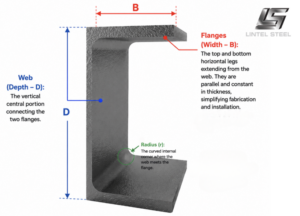
Web (Depth – D): The vertical central portion connecting the two flanges. Functions of the web include:
- Resisting shear forces (primary role)
- Providing overall stability
- Distributing loads throughout the section
- Preventing deformation under applied loads
The web carries much of the vertical loading within structural applications. Deeper webs give better bending strength.
Flanges (Width – B): The top and bottom horizontal legs extending from the web. They are parallel and constant in thickness, simplifying fabrication and installation, which is the defining characteristic of a PFC. The flanges’ primary functions are:
- Resisting bending moments
- Increasing section strength
- Improving load distribution
- Resist the compressive and tensile stresses from bending
- Facilitating connections with bolts and welds
Radius (r): The curved internal corner where the web meets the flange. This radius helps:
- Reduces stress concentration and makes hot‑rolling possible.
- Improve structural integrity
- Enhance fatigue resistance
- Increase durability under repeated loading
Mass per metre (kg/m): One of the most important numbers for a designer; it indicates both the weight of the beam and its overall strength.
Why is it called Parallel Flange Channel?
The name comes directly from its geometry. Traditional channel sections often have tapered flanges that angle inward. In contrast, Parallel Flange Channels feature flanges that remain parallel across their entire length.
This seemingly small design difference provides significant advantages:
- Easier bolt alignment
- Improved connection design
- Better compatibility with modern construction methods
- Enhanced fabrication efficiency
- More predictable structural behavior
Because of these benefits, this steel has become a preferred choice in many structural engineering applications worldwide.
How Parallel Flange Channel Steel is Manufactured
PFC steel is generally produced using the hot rolling process.
Step 1: Steel Billet Preparation
High-quality steel billets are heated to extremely high temperatures, typically above 1,000°C.
Step 2: Hot Rolling
The heated billet passes through a series of rollers that gradually form the characteristic channel shape.
Step 3: Dimensional Control
Precision rolling ensures:
- Consistent flange width
- Uniform thickness
- Accurate web dimensions
- Compliance with international standards
Step 4: Cooling
The steel section is cooled under controlled conditions to achieve the required mechanical properties.
Step 5: Cutting and Finishing
The finished sections are cut to standard lengths and prepared for distribution.
Additional treatments may include:
- Galvanization
- Protective coatings
- Surface finishing
- Quality inspections
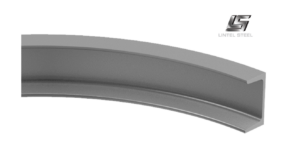
Key Characteristics of Parallel Flange Channel Steel
Superior Strength‑to‑Weight Ratio
The parallel flange design puts material exactly where it is needed for bending resistance. Compared with older tapered‑flange sections, PFC steel offers exceptional load-bearing capacity without added weight. Some modern PFC products are marketed as being “up to 20% stronger” for the same weight. Benefits include:
- Reduced structural mass
- Easier transportation
- Lower installation costs
- Improved construction efficiency
Easy Fabrication (No Special Washers Needed)
Because the flanges are perfectly flat and parallel, an ordinary washer and bolt can be used directly against the steel. On a tapered flange, the washer must be specially shaped, or it will not seat correctly. This simplification saves time on-site and in the workshop; fabricators can work more efficiently than with tapered channel sections.
Straightforward Welding
The uniform geometry makes jigging and alignment much simpler. For many common grades, no pre‑heating is required for welding, which reduces the labour and risk associated with on‑site fabrication.
Consistent Load Distribution
The parallel shape spreads stresses evenly across the connection, improving overall structural stability.
Versatility
PFCs can be incorporated into a wide range of construction and industrial applications as primary beams, secondary sections, lintels, bracing members, or reinforcing elements for existing structures.
Cost-Effective
A high strength-to-weight ratio means you can often use lighter PFC sections than traditional ones for the same job, directly reducing material costs. This can result in initial savings of 20-30% on structural steel costs.
Common Applications of Parallel Flange Channel Steel
Construction and Structural Frames
One of the most common applications of parallel flange steel is in construction, where it serves as the “backbone” of reliable structural frames. Thanks to its excellent strength-to-weight ratio and ease of connection, PFC sections are widely used in floor support systems, roof structures, wall frames, and various other building reinforcement applications. Their ability to efficiently distribute loads and resist bending forces contributes to the stability, safety, and long-term durability of civil, commercial, and industrial structures. Therefore, PFC steel has become the preferred choice for modern construction projects requiring both structural performance and cost-effective installation.
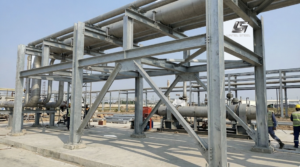
Transportation Equipment
Open sections make PFC a natural choice for the main chassis rails of trailers, buses, and railway wagons. It provides a lightweight yet very strong skeleton for truck bodies, trailer frames, railway infrastructure, and vehicle support structures. It offers a lightweight yet very strong skeleton that is easy to drill and easy to mount components.
The combination of high strength and relatively low weight makes PFC cross-sections particularly valuable in transportation applications where structural performance must be balanced with efficiency and load factor. Their strength and ease of machining also contribute to reduced maintenance requirements and extended service life in harsh transportation environments.
Agricultural and Industrial Infrastructure
PFC steel is widely used in industrial facilities such as factories, workshops, warehouses, and livestock barns. Its robust structural properties make it suitable for supporting heavy equipment, machinery, and operational infrastructure. Common applications include equipment support structures, mezzanines, access platforms, and substructure frames. The parallel flange design facilitates easy fabrication and installation, allowing engineers and contractors to create efficient layouts while maintaining the durability required for harsh industrial environments.
Mining and Resource Industry
The mining and resource industry often requires structural materials capable of operating under harsh conditions and bearing heavy loads. PFC steel is commonly used in conveyor support structures, mineral processing plants, equipment installations, and maintenance platforms. Its strength and resistance to deformation make it suitable for supporting heavy machinery and equipment operating in demanding industrial environments. Furthermore, PFC cross-sections can be easily fabricated and modified to meet the specific requirements of mining operations and resource processing facilities.
Lintels & Openings
The channel shape is ideal for spanning doors and windows in masonry walls. The flat flanges distribute the load of the bricks evenly, preventing localised cracking.
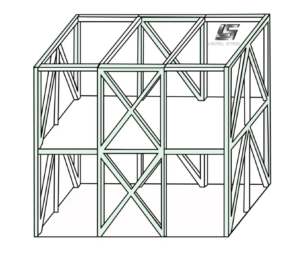
Bracing Systems
In seismic zones, the depth of a PFC (e.g., a 250 mm deep channel) gives good resistance against buckling, making it a trusted element for cross bracing
Conclusion
Parallel Flange Channel steel is a versatile and highly efficient structural steel section used across construction, infrastructure, manufacturing, transportation, and industrial sectors. By understanding its design, characteristics, applications, and selection criteria, project stakeholders can confidently choose the right Parallel Flange Channel section for their structural requirements.
As demand grows for sustainable, durable, and cost-effective construction materials, Parallel Flange Channel steel will continue to play a vital role in shaping the future of structural engineering and modern infrastructure.
Choose Lintel Steel for Superior Steel Solutions
Understanding the load-bearing capacity of Parallel Flange Channel steel helps you choose the right material, ensuring safety and efficiency for your project.
At Lintel Steel, we offer premium-grade steel solutions for a wide range of applications across Perth and Western Australia. With over 11 years of industry experience, we deliver reliable products that meet strict engineering standards.
We also provide expert advice to help you select the best materials for your needs. Our team offers custom sizes, prompt delivery, and free quotes within 48 hours, helping you complete your project with confidence and precision.
Choose Lintel Steel – your trusted partner for galvanized products, strong and superior steel solutions.
Click here to get a quote and quantity takeoff for free at Lintel Steel.
You can find out more about us at our Fanpage Lintel Steel.


