
H-Beam Steel: The Best Choice for High-Strength Structural Construction

In modern construction, material selection not only affects durability but also determines the cost and lifespan of a structure. Among various types of structural steel, H-shaped steel is becoming a top choice due to its superior load-bearing capacity and versatile applications.
So what is H-beam steel, what are its characteristics, and why is it so popular? Let’s explore this in detail with Lintel Steel in the article below.
What is H-beam steel?
H-shaped steel, also known as H-beam, is a type of long steel bar with an external cross-section resembling the capital letter “H”.
Its structure consists of:
- Two horizontal flanges
- A vertical web in the middle
The structure, with flange and web thicknesses being almost equal, creates the characteristic H shape, helping to distribute force evenly and increase load-bearing capacity.
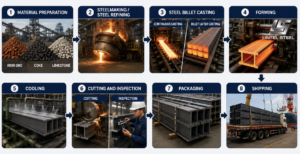
H-beam steel Production Process
Being was manufactured using a modern industrial process to ensure high quality and precision:

Material preparation
The raw materials for steel production are usually iron ore, coke, and limestone, which are carefully checked for chemical composition and quality.
These materials are fed into a blast furnace to produce pig iron, which is then converted into steel through the steelmaking process.
Steelmaking/ Steel refining
After obtaining pig iron, the steelmaking process takes place. Impurities are removed, and alloying elements such as manganese, silicon, and carbon are added to create steel with good mechanical properties.
Steel Billet Casting
Once the steel has been refined, it is cast into steel billets. These billets are heated to a high temperature (around 1200°C) to achieve a ductile state, usually rectangular or square in shape, depending on production requirements.
The casting process can be done by pouring molten steel into a mold or using a continuous casting method.
Forming
Steel billets are passed through a rolling system, such as hot or cold rolling, multiple times to form H-shaped profiles of standard dimensions.
Cooling
After rolling, the steel is cooled naturally or with water to stabilize the product structure.
Cutting and Inspection
The steel is cut to standard lengths (usually 6m or 12m) or to the customer’s required dimensions, then quality-checked before shipment.
This process ensures that the H-beam steel has high accuracy, a smooth surface, and stable mechanical properties.
Packaging and Shipping
Finally, the H-beam steel is packaged and prepared for shipment to the consumer.
Packaging needs to be done carefully to avoid damage during transportation.
Specifications for H-beam steel profiles
There are many different specifications of H-beam steel, each suitable for a specific application. To choose the right one, it is necessary to understand the dimensions, chemical composition, and technical characteristics.
Size and thickness
Standard H-beam steel can have lengths ranging from 6m to 15m. In practice, common lengths are 6m and 12m, with 12m being the most common.
For H-beam steel products with special dimensions or those outside the standard specifications, production will be done according to a separate agreement between the buyer and the manufacturer.
Chemical composition
The chemical composition of H-beam steel can vary depending on the specific standards and requirements of each product, but it must comply with standards such as JIS, ASTM, and EN. H-beam steel is typically manufactured from low-carbon structural steel or high-strength steel, with the basic composition including:
- Carbon (C): Increases hardness and strength
- Manganese (Mn): Increases ductility and load-bearing capacity
- Silicon (Si): Improves strength
- Sulfur (S) and Phosphorus (P): Controlled at low levels to prevent brittleness
In addition, H-beam steel may contain additional elements such as chromium (Cr), nickel (Ni), molybdenum (Mo), and vanadium (V) to improve mechanical properties and enhance strength.
The load-bearing capacity of H-beam steel
H-beam steel stands out for its superior load-bearing capacity thanks to:
- Symmetrical design, which helps distribute force evenly
- Wide flanges increase bending strength
- Thick web, increasing shear strength
Compared to other types of steel, H-beam can withstand:
- Large static loads (high-rise buildings, bridges)
- Dynamic loads (machinery, vibration)
- Environmental pressures (wind, earthquakes)
This helps reduce the number of columns and beams, optimizing space and construction costs.

Advantages of H-beam steel
H-shaped steel has become a top choice in the construction industry due to its many outstanding advantages. Here are some of its notable advantages:
- High load-bearing capacity: Designed to withstand heavy loads, especially in structures requiring high load-bearing capacity, such as bridges, factories, or high-rise buildings. With its sturdy and robust H-shaped structure, the H-beam has excellent load-bearing capacity, reinforcing the structure.
- Easy to fabricate and assemble: Manufactured according to standard specifications, it is easy to fabricate and assemble during construction. Rapid construction not only saves time but also reduces labor costs, resulting in high economic efficiency.
- Diverse sizes and steel grades: With a wide range of sizes and steel grades, users can choose H-beams to suit their specific needs. From small projects like residential houses to large projects like bridges, H-shaped steel can meet all requirements.
- Durability and ease of maintenance: Excellent corrosion and oxidation resistance extend the lifespan of structures. Maintenance and repair are also simpler compared to other materials, saving costs and effort.
- Environmentally friendly: H-shaped steel is a fully recyclable material, reducing waste and environmental pollution. Using recycled steel not only protects the environment but also demonstrates the company’s commitment to sustainable development.
Applications of H-beam steel
H-beam steel is widely used in many different fields due to its flexibility and diverse manufacturing specifications. Below are some common applications of H-steel:
Bridge and factory construction: thanks to its good load-bearing capacity and ease of processing. The sturdy structure of H-steel ensures safety for the structure and its users.
- Main columns and beams: with good load-bearing capacity. Flexibility in design and size selection optimizes the structure and performance of the building.
- Civil engineering structures such as houses, offices, or schools: used to create central column and beam frames. The variety of sizes and steel grades allows to suit all design requirements.
- Industrial structures such as factories, warehouses, or production workshops: H-shaped steel is used to create large load-bearing structures. High load-bearing capacity and ease of assembly save time and construction costs.
In addition to traditional applications, H-shaped steel is also used in many other fields, such as the production of household appliances, automobiles, highways, and ships. The flexibility and versatility of H-shaped steel have opened up many new opportunities in the application of this material.
Noted on using H-beam steel
To ensure effectiveness and durability, please note:
- Load calculation: Use software or consult a structural engineer to ensure the steel can withstand the actual load.
- Proper storage: For carbon steel, apply anti-rust paint or galvanize if used in a humid environment.
- Proper construction techniques: Ensure welding and bolt connections meet standards to avoid compromising load-bearing capacity.
Common types of H-beam steel
| Products | KG/M | Unit |
Price |
| H100 x 100 x 6 x 8 x 12m | 17.2 | Kg | Contact |
| H125 x 125 x 6.5 x 9 x12m | 23.6 | Kg | |
| H148 x 100 x 6 x 9 x 12m | 21.7 | Kg | |
| H150 x 150 x 7 x 10 x 12m | 31.5 | Kg | |
| H194 x 150 x 6 x 9 x 12m | 30.6 | Kg | |
| H200 x 200 x 8 x 12 x 12m | 49.9 | Kg | |
| H244 x 175 x 7 x 11 x 12m | 44.1 | Kg | |
| H250 x 250 x 9 x 14 x 12m | 72.4 | Kg | |
| H294 x 200 x 8 x 12 x 12m | 56.8 | Kg | |
| H300 x 300 x 10 x 15 x 12m | 94 | Kg | |
| H340 x 250 x 9 x 14 x 12m | 79.7 | Kg | |
| H350 x 350 x 12 x 19 x 12m | 137 | Kg | |
| H390 x 300 x 10 x 16 x 12m | 107 | Kg | |
| H400 x 400 x 13 x 21 x 12m | 172 | Kg | |
| H440 x 300 x 11 x 18 x 12m | 124 | Kg |
Choose Lintel Steel for Superior Steel Solutions
Understanding the load-bearing capacity of H-shaped steel helps you choose the right material, ensuring safety and efficiency for your project.
At Lintel Steel, we offer premium-grade steel solutions for many applications across Perth and Western Australia. With over 11 years of industry experience, we deliver reliable products that meet strict engineering standards.
We also provide expert advice to help you select the best materials for your needs. Our team offers custom sizes, prompt delivery, and free quotes within 48 hours, helping you complete your project with confidence and precision.
Choose Lintel Steel – your trusted partner for galvanized products, strong, and superior steel solutions.
Click here to get a quote and quantity takeoff for free at Lintel Steel.
You can find out more about us at our Fanpage Lintel Steel.


