
Galvanised Steel vs Painted Steel for Structural Applications

Protecting structural steel is essential if a building is expected to remain safe, attractive and economical throughout its intended life. Bare carbon steel can corrode when moisture and oxygen reach the surface, so most exposed members need a protection system selected for their environment. This leads many builders and property owners to ask the same question: which option is better when comparing galvanised vs painted steel?
The short answer is that neither coating is automatically right for every project. Hot-dip galvanising provides a zinc coating that protects the steel, including by sacrificial action at small damaged areas. A protective paint system uses carefully selected layers to form a barrier between the steel and its environment. Both can provide excellent results when specification, surface preparation, application, detailing and maintenance are handled correctly.
For Western Australian projects, the decision should reflect much more than the initial appearance. Coastal salt, industrial contaminants, rainfall, shelter, temperature, access for maintenance, design life and fabrication sequence can all influence performance. This practical galvanised vs painted steel guide explains the differences in friendly terms while helping buyers have a more informed conversation with their engineer, fabricator and coating specialist.
Galvanised vs Painted Steel: The Basic Difference
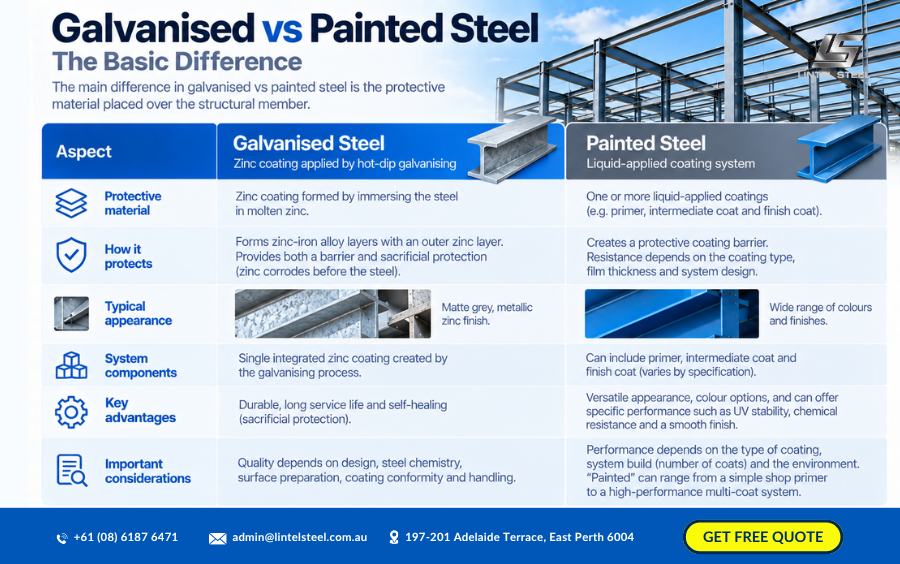
The main difference in galvanised vs painted steel is the protective material placed over the structural member. Hot-dip galvanising normally involves immersing a properly prepared, fabricated steel article in molten zinc. The process creates zinc-iron alloy layers bonded to the steel, with an outer zinc layer. The resulting metallic coating acts as both a barrier and a sacrificial form of protection.
Understanding galvanised vs painted steel begins with recognising these two different protection mechanisms.
Painted structural steel is protected by one or more liquid-applied coatings. A complete system can include a primer, intermediate coat and finish coat, although the exact combination depends on the specification. Different coatings provide corrosion resistance, film build, chemical resistance, UV stability, colour and appearance.
It is important to compare systems rather than labels. “Painted” could mean anything from a simple shop primer intended for temporary protection to a high-performance multi-coat system designed for a severe environment. Similarly, galvanising quality depends on design, steel chemistry, surface preparation, coating conformity and handling. A meaningful galvanised vs painted steel decision requires a defined environment and design life.
How Hot-Dip Galvanising Protects Structural Steel
During hot-dip galvanising, the completed steel article is cleaned to remove contaminants, rust and mill scale before it enters the zinc bath. The zinc reacts metallurgically with the steel surface. Because the item is immersed, the coating can reach many external and internal surfaces, provided hollow sections and fabricated details have been correctly designed with suitable venting and drainage.
The zinc coating first isolates the underlying steel from the atmosphere. It also provides sacrificial protection: zinc is more electrochemically active than steel and can help protect small exposed areas where the coating has been scratched or locally damaged. This characteristic is a major reason galvanising is widely used for external steelwork, infrastructure, handrails, frames and difficult-to-maintain structures.
Galvanising does not make a structure maintenance-free in every environment. Zinc is gradually consumed over time, and its life depends on the corrosion rate at the site. Highly corrosive exposure, persistent wetness, chemical contact and poor detailing can shorten service life. The galvanised vs painted steel choice should therefore use a realistic exposure assessment rather than the assumption that zinc lasts forever.
How Protective Paint Systems Work
A paint system protects steel primarily by creating a continuous barrier. The primer is designed to adhere to the prepared substrate and may add inhibitive or sacrificial properties. Intermediate coats build thickness and improve barrier protection, while the topcoat can provide colour, gloss retention, UV resistance and weathering performance.
Surface preparation is critical. Rust, mill scale, salts, oil, dust and moisture can prevent adhesion or promote corrosion under the coating. The required preparation method and cleanliness must match the selected system. Applying an expensive coating over an unsuitable surface rarely delivers the intended service life.
Paint offers enormous flexibility because the specification can be adjusted for the environment, desired finish and maintenance plan. However, it also means the phrase “painted steel” is incomplete without the full coating schedule. When evaluating galvanised vs painted steel, ask what preparation, primer, build coats, topcoat, dry film thickness, application conditions and inspection requirements are included.
This detail makes any galvanised vs painted steel quotation more transparent and easier to compare.
Galvanised vs Painted Steel for Corrosion Resistance
Corrosion performance is usually the central issue in a galvanised vs painted steel comparison. Galvanising forms a tough metallic coating and can protect edges, corners and recesses effectively when the item is suitable for immersion. Zinc’s sacrificial behaviour also offers some protection when minor local damage exposes steel.
Paint can provide very strong barrier protection, especially when a high-performance system is selected for the correct atmospheric corrosivity category. It can also be tailored for UV exposure, chemical splash or decorative requirements. Once a paint film is breached, however, exposed steel may rust if the defect is not repaired, and corrosion can sometimes spread beneath poorly adhered coating.
Neither performance can be reduced to one universal number. Coating thickness, environment, surface profile, workmanship, steel geometry, drainage and maintenance all matter. The best galvanised vs painted steel specification is the one developed for the actual location and verified during application.
A project-specific galvanised vs painted steel review is therefore more reliable than a generic product claim.
Galvanised vs Painted Steel in Western Australian Conditions
Western Australia contains a wide range of exposure conditions. A sheltered internal beam in a dry building has very different needs from an external canopy near the Indian Ocean. Coastal structures may receive airborne chloride deposits, while industrial areas can add pollutants. Inland heat and UV exposure can also affect colour and finish performance.
Distance from the coast is helpful but not enough to define corrosivity. Prevailing wind, elevation, shielding, rainfall washing, condensation, salt retention and time of wetness can make two nearby sites behave differently. Sheltered surfaces can sometimes retain contamination because rain does not wash them naturally.
For this reason, galvanised vs painted steel should be assessed member by member where exposure changes across a project. An enclosed internal frame may need a different system from exposed stairs, awnings or rooftop steel. WA buyers should provide the site location and intended use when requesting coating advice rather than simply ordering “galvanised” or “painted.”
Galvanised vs Painted Steel for Coastal Projects
Coastal construction deserves special attention because salt accelerates corrosion. Hot-dip galvanising is frequently selected for coastal structural components, but zinc is still consumed more quickly in aggressive marine conditions. The required coating life depends on the zinc thickness, local corrosion rate and whether the steel is directly exposed, sheltered or regularly wetted.
A properly specified paint system can also work in coastal environments. Its success depends heavily on surface preparation, film thickness, edge treatment, application control and future maintenance. Sharp edges and difficult weld details may receive less paint build unless they are prepared and stripe-coated as required.
In severe locations, designers may consider a duplex system consisting of paint over galvanising. The zinc and compatible paint layers work together to provide extended protection and colour. This option requires suitable preparation of the galvanised surface and compatible products; ordinary painting over fresh zinc without the correct process can lead to adhesion failure. Coastal galvanised vs painted steel decisions should be made with specialist input rather than a generic rule.
Galvanised vs Painted Steel Durability and Service Life
Service life means more than the number of years before a structure looks weathered. A coating may retain protective performance after its decorative appearance changes, and the point at which maintenance is economical may occur before widespread breakdown. Project documents should clearly define the expected durability and what condition triggers maintenance.
Galvanising often provides long periods with limited intervention in suitable atmospheric environments. It is particularly attractive where members will be difficult, dangerous or expensive to access later. Painted systems can also provide long durability when correctly specified, but planned inspection and maintenance are central to preserving the barrier.
The galvanised vs painted steel choice should compare expected time to first maintenance, access cost, shutdown requirements and repair complexity. A cheaper initial finish can become more expensive if scaffolding, traffic control or operational closures are required repeatedly over the building’s life.
Galvanised vs Painted Steel Initial and Whole-Life Cost
Initial cost depends on member size, weight, coating area, fabrication complexity, transport, batch quantity, selected paint system and access to suitable facilities. Galvanising may be economical for repeated components, but large articles can require special handling or fabrication in sections. Painting cost changes significantly with preparation grade, number of coats and quality-control requirements.
Whole-life cost is often more useful. It combines initial application with inspections, cleaning, touch-ups, recoating, access equipment, operational disruption and eventual refurbishment. Galvanising can have an advantage where low maintenance is valuable. Paint may be more economical where the environment is mild, future access is easy or colour changes are expected.
Quotations must cover equivalent scopes. A galvanised vs painted steel price comparison is misleading if one quote includes blasting, edge preparation, multiple coats and inspection while the other lists only a basic finish. Ask suppliers to state exactly what is included and which specification the work follows.
Galvanised vs Painted Steel Appearance and Colour
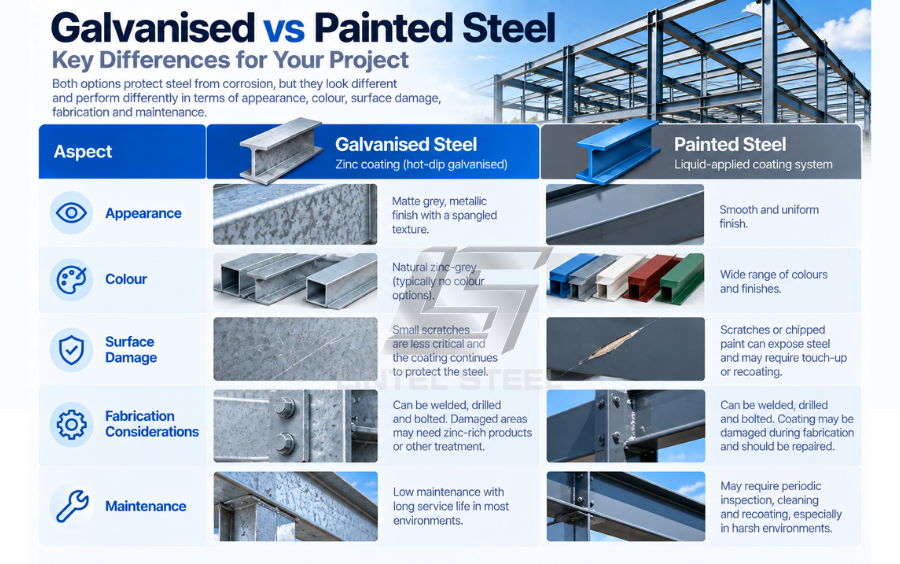
Fresh galvanising normally has a silver-grey appearance, but its surface can vary. Spangle, dull areas, differences in brightness, runs or local texture can occur without necessarily reducing protective performance. The finish usually weathers towards a more uniform matt grey over time. Architectural projects should agree on acceptable appearance rather than expecting every article to resemble a decorative chrome finish.
Paint offers much greater colour choice and can coordinate steelwork with cladding, signage, interiors or brand identity. Different products also provide various gloss levels and weathering characteristics. Dark colours exposed to WA sun may reach higher surface temperatures, while some pigments retain colour better than others.
If a project wants both zinc protection and a specific colour, a duplex coating may be appropriate. The aesthetic outcome still depends on the galvanised surface, preparation and paint build. For visible feature steel, galvanised vs painted steel should be reviewed with samples or agreed finish standards before production.
Galvanised vs Painted Steel Surface Damage
Construction sites are demanding environments. Chains, slings, forklifts, tools and adjoining trades can damage finished steel. A galvanised coating is metallurgically bonded and generally resists handling damage well. Where minor damage occurs, zinc can protect nearby exposed steel sacrificially, although larger damaged areas require an approved repair.
Painted members can also be handled successfully when protected and lifted correctly. Chips or scratches should be repaired using a compatible method that restores the specified coating system. Simply covering damage with an unrelated aerosol paint may improve colour while failing to restore corrosion protection.
Inspection after delivery and erection is good practice for both options. The galvanised vs painted steel handover plan should identify responsibility for repairs, acceptable methods and required documentation before access becomes difficult.
Galvanised vs Painted Steel Fabrication Considerations
Galvanising is normally completed after fabrication so welds, edges and the fabricated article receive zinc protection. The fabricator must design hollow sections, stiffeners and overlapping plates so fluids and gases can enter, drain and escape safely. Vent and drain provisions are essential, and large assemblies must suit the galvanising facility’s bath and handling limits.
The galvanising temperature and immersion process can affect some fabrications, so distortion risk should be considered during design and detailing. Weld quality, seal welding decisions and steel chemistry can also influence the final result. Early discussion among the engineer, fabricator and galvanizer is far better than modifying a completed frame.
Painted steel also demands fabrication planning. Sharp edges may need rounding, weld spatter and defects must be removed, and inaccessible crevices should be avoided. Fabrication after coating damages the protective system. Whichever option wins the galvanised vs painted steel review, the coating specification should be integrated into shop drawings and fabrication procedures.
Galvanised vs Painted Steel Maintenance
All exposed structures benefit from planned inspection. Checks should focus on water traps, dirt accumulation, damaged areas, coating breakdown, fasteners, connections and interfaces with other materials. Cleaning accumulated salts and debris can improve performance, particularly on sheltered coastal surfaces.
Galvanised steel may need little routine work in a suitable environment until the zinc has substantially weathered or local damage appears. Painted steel usually requires touch-ups and periodic recoating before widespread failure. Early maintenance is normally easier and less costly than allowing corrosion to develop across an entire frame.
Maintenance records help owners understand how the finish is performing. A sound galvanised vs painted steel decision includes an inspection and repair strategy at the design stage, not only a coating name on a drawing.
That planned approach turns galvanised vs painted steel into a whole-life asset decision.
Galvanised vs Painted Steel and Fire Protection
Corrosion coatings and fire-protection systems perform different jobs. Galvanising or conventional protective paint does not by itself provide the fire-resistance level that a building may require. Structural steel exposed to fire can lose strength and stiffness as its temperature rises, so separate protection may be needed.
Fire protection can involve boards, sprays, encasement or intumescent coating systems. Compatibility between primers, galvanised surfaces, adhesion layers and fire-protective products must be confirmed with the system supplier and project documentation. Substituting a coating can affect tested performance.
When comparing galvanised vs painted steel, coordinate the corrosion and fire strategies early. Applying one system and later discovering that it is incompatible with the required fire protection can create costly rework.
Galvanised vs Painted Steel and Connections
Bolts, washers, welds and connected materials form part of the corrosion-protection system. Galvanised members commonly use compatible galvanised fasteners where specified. Coating thickness must be considered at bolted interfaces and in holes, while field welding can damage zinc and requires appropriate controls and repair.
Paint systems may need masking at some friction-type connections or special treatment at contact surfaces, depending on the engineered connection. Site bolts, erection marks and damaged coating must be addressed in the final touch-up procedure.
Dissimilar-metal contact can create galvanic corrosion in the presence of an electrolyte. The risk depends on the metals, relative areas, exposure and separation details. A complete galvanised vs painted steel specification considers connections and interfaces, not only the main beams and columns.
Galvanised vs Painted Steel Under Australian Standards
Australian guidance separates the main coating families. AS 2312.1:2014 provides guidance for protecting structural steel against atmospheric corrosion with paint coatings. AS/NZS 2312.2:2014 covers hot-dip galvanising, while AS/NZS 4680:2025 specifies general properties and test methods for hot-dip galvanised coatings applied to fabricated iron and steel articles.
Other standards may apply to continuously coated sheet, hollow sections produced through specialised processes, fasteners, fabrication, welding or surface preparation. The correct reference depends on the product and coating route. A general request for “galvanised steel” does not automatically establish compliance with the standard intended by the designer.
Western Australia gives legal effect to the Building Code of Australia through its building framework. The relevant NCC edition, WA variations, project specification and referenced standards should be checked for the particular approval. A galvanised vs painted steel article can explain buying considerations, but an engineer or qualified coating professional must develop the project-specific specification.
Documented compliance is essential in every galvanised vs painted steel selection for structural work.
When Galvanised Steel Is Often the Better Choice
Hot-dip galvanising is often attractive for external members, exposed frames, stairs, platforms, handrails and steelwork that will be difficult to repaint. It can also suit projects where robust handling resistance and protection of suitable internal hollow surfaces are valuable.
That does not mean every member should be galvanised. Oversized fabrications, sealed cavities, unsuitable details, appearance expectations, chemical exposure and later welding can make another system more practical. The design must be compatible with immersion, venting, drainage and handling.
In a galvanised vs painted steel assessment, galvanising tends to stand out when long intervals between maintenance and dependable edge protection are high priorities, provided the environment and fabrication suit the process.
When Painted Steel Is Often the Better Choice
Paint is often preferred when a project needs a controlled colour, smooth architectural finish, easy future colour changes or a coating tailored to a particular chemical or atmospheric exposure. It can suit very large assemblies that are impractical to immerse and internal structural steel in controlled environments.
Paint also allows site repair and future overcoating, although these benefits depend on compatibility, preparation and access. A premium multi-coat system is very different from a temporary shop primer, so the full specification must follow the steel through procurement and construction.
Paint may lead the galvanised vs painted steel comparison when finish flexibility and system customisation are central, and when inspection and maintenance can be completed safely and economically.
When a Duplex System Makes Sense
A duplex system combines hot-dip galvanising with a compatible paint coating. It can provide colour, extended protection and a barrier that slows zinc consumption. If the paint is locally damaged, the underlying zinc continues to protect the steel, giving the system advantages beyond decoration alone.
Success depends on coordination. The galvanizer should know that the article will be painted, and the paint applicator must use suitable cleaning, preparation and coating products. New galvanised surfaces can contain contaminants or have a profile that requires treatment. Incorrect preparation is a common cause of peeling.
Duplex protection can be valuable for severe coastal exposure, highly visible projects or structures where future maintenance is disruptive. It should be specified as an integrated system rather than as an improvised compromise after the galvanised vs painted steel decision has already been made.
Common Galvanised vs Painted Steel Mistakes
One common mistake is selecting a coating from a broad location description such as “Perth” or “near the coast” without assessing the actual micro-environment. Another is accepting a coating name without the required surface preparation, thickness, inspection and repair details.
Late decisions also create problems. Steel detailed without galvanising vents or drains may require redesign, while members already fabricated with sharp edges and inaccessible gaps may be difficult to paint properly. Uncontrolled site welding, drilling and cutting can damage either system.
Finally, appearance should not be confused with protection. A shiny galvanised surface is not automatically better than a dull one, and a glossy paint finish does not prove that preparation or film thickness is correct. A reliable galvanised vs painted steel outcome depends on specification, application records and inspection—not colour alone.
How to Choose Galvanised vs Painted Steel
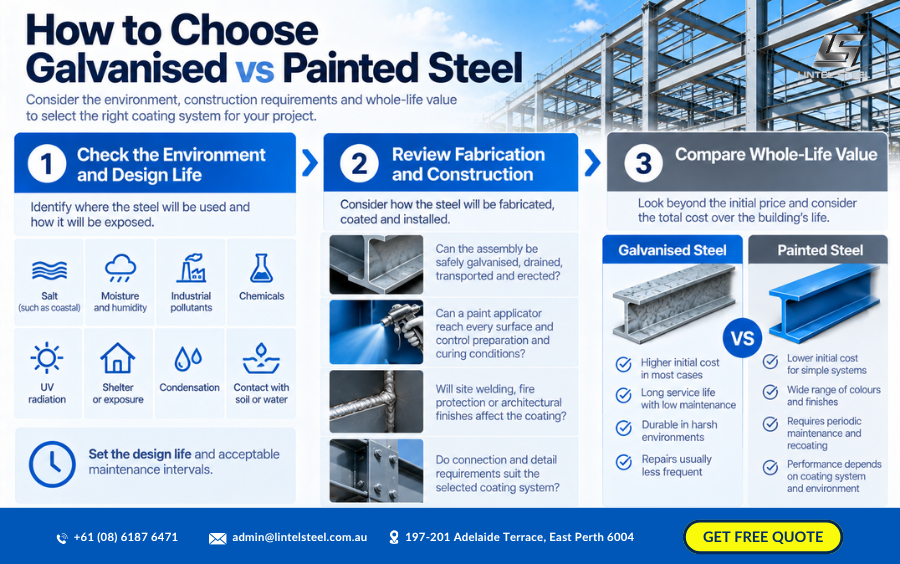
Start by identifying where every member will be located and how it will be exposed. Consider salt, moisture, industrial pollutants, chemicals, condensation, UV radiation, shelter and contact with soil or water. Then establish the intended design life and acceptable maintenance intervals.
Next, review fabrication and construction constraints. Can the assembly be safely galvanised, drained, transported and erected? Can a paint applicator reach every surface and control preparation and curing conditions? Will site welding, fire protection, architectural finishes or connection requirements affect the coating?
Finally, compare whole-life value rather than initial price. Include application, inspection, repairs, access, shutdowns and future recoating. The best galvanised vs painted steel solution is the documented system that meets the required performance with manageable risk and cost.
This balanced galvanised vs painted steel process supports better purchasing and maintenance decisions.
Ordering Coated Structural Steel in Western Australia
Clear information helps a WA steel supplier provide an accurate quotation. Supply current drawings, member schedules, grades, dimensions, quantities, fabrication details, site location, coating specification and delivery requirements. State whether galvanising or painting occurs before or after particular fabrication stages and who is responsible for final touch-ups.
Ask for documentation appropriate to the project, which may include coating certificates, batch records, thickness readings, inspection reports and repair procedures. Visible architectural steel may also need an agreed sample or finish expectations.
Your supplier can explain available steel products and processing services, but coating selection should follow the engineer’s drawings and a suitable corrosion assessment. Early coordination makes the galvanised vs painted steel decision easier to price and much easier to deliver correctly.
It also keeps the galvanised vs painted steel specification consistent from quotation to site delivery.
Frequently Asked Questions About Galvanised vs Painted Steel
Is galvanised steel always better outdoors?
No. Galvanising is highly effective for many outdoor applications, but performance depends on zinc thickness, exposure, detailing and contaminants. A correctly designed paint or duplex system may be more suitable where colour, severe chemicals or specific service conditions matter.
Is painted steel cheaper than galvanised steel?
It can have a lower initial cost in some projects, but not always. Surface preparation and high-performance multi-coat systems can be substantial. Compare equivalent specifications and include future access, maintenance and operational disruption.
Can galvanised structural steel be painted?
Yes. Paint over galvanising is known as a duplex system and is well established when compatible preparation and products are used. The galvanizer and coating supplier should be consulted early to avoid adhesion problems.
Can galvanised steel rust?
Yes. Zinc protects steel but is gradually consumed, and red rust can develop after protection is exhausted or where significant uncorrected damage exposes the substrate. White corrosion products can also form on zinc under certain storage or wet conditions.
Can painted or galvanised steel be welded on site?
Welding affects both coating systems and introduces safety, quality and repair requirements. It should follow approved procedures, with damaged protection restored using the specified repair method. Design connections to minimise avoidable site coating damage where practical.
Which finish is best near the ocean in WA?
There is no single answer for every coastal site. Exposure severity, shelter, salt deposition, design life and maintenance access must be assessed. Hot-dip galvanising, a high-performance paint system or a duplex system may be appropriate depending on those factors.
Final Verdict on Galvanised vs Painted Steel
Galvanising is a strong option when durable metallic protection, resistance to handling damage and long maintenance intervals are important. Paint offers excellent flexibility in colour, finish and performance characteristics. A duplex system can combine advantages when the project needs enhanced durability and a specific appearance.
The smartest choice is not based on a slogan. It comes from understanding the site, design life, member geometry, maintenance access and total installed cost. For structural steel in Western Australia, involve the engineer, fabricator, galvanizer or coating specialist and steel supplier before fabrication begins.
If you are sourcing beams, columns, channels, angles, plates or hollow sections for a WA project, provide Lintel Steel with the complete coating specification and current drawings to get free quotes and quantity take-off within 48 hours. A clear galvanised vs painted steel decision will support accurate pricing, efficient fabrication and a finish suited to the real conditions of your building.
Authoritative Resources
For current technical guidance, consult the Australian Steel Institute corrosion-protection resources, Standards Australia and the WA Building and Energy legislative framework. Project documents may reference AS 2312.1:2014, AS/NZS 2312.2:2014 and AS/NZS 4680:2025, among other standards applicable to the product and process.
This article provides general information only. Coating selection, structural design, fire protection, durability and regulatory compliance must be confirmed for the specific project by appropriately qualified professionals. Contact us for expert advice and a quote.


