Galvanised Steel: Overview, Types, Benefits and Uses
A material that is both durable and resistant to harsh environmental conditions is what builders seek in modern manufacturing. Among a wide range of alloys and metals, galvanised steel is a perfect choice thanks to its combination of steel’s hardness and zinc’s superior protective properties at a reasonable cost.
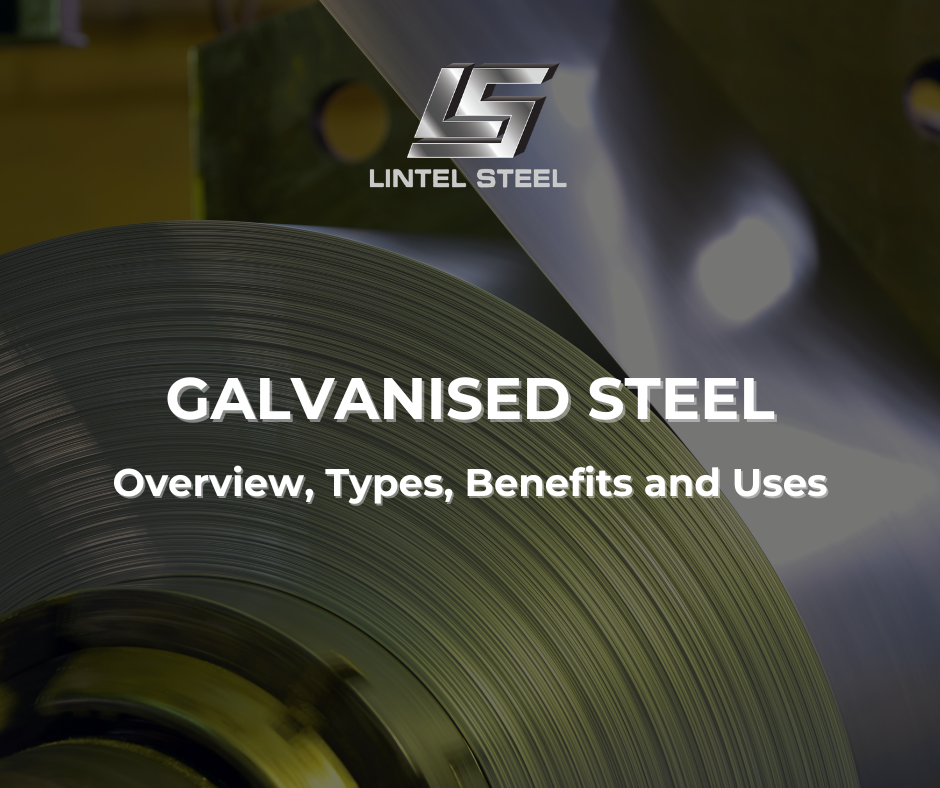
Galvanised steel is a type of steel with a protective zinc coating on its outer surface to increase its corrosion resistance, typically applied by hot-dipping the steel in molten zinc. It can be used in a wide variety of applications, the only commonality being the need for corrosion resistance.
So, what is galvanised steel? How it is manufactured, its properties, and its applications. This article by Lintel Steel will provide basic information about this material.
What is a Galvanised Steel
Galvanised steel is a type of steel coated with a layer of metal to protect the underlying steel from corrosion and oxidation. These outer coatings consist of zinc (Zn), zinc-iron alloys, and additional elements such as aluminum (Al), silicon (Si), phosphorus (P), nickel (Ni), etc. It can be added by electrolysis or hot-dip galvanizing. This zinc coating process is called galvanization. The coatings act as a barrier, preventing moisture and oxidation from reaching the underlying steel. When a corrosive environment acts on the material, the zinc layer will oxidize first, even if the coating is scratched or damaged. Therefore, galvanised steel has significantly better rust resistance than ordinary steel.
The steps in the galvanizing process
The first step in the galvanizing process involves preparing the metal for zinc coating. This includes cleaning the steel surface using various methods such as degreasing, chemical cleaning, and final surface cleaning. Proper surface cleaning and preparation are crucial to ensure effective adhesion and long-lasting durability of the zinc coating.
The next step is galvanizing, where the magic happens as the steel is completely immersed in a vat of molten zinc. Hot-dip galvanizing, at temperatures around 450°C (840°F), causes the zinc to react with the iron in the steel, forming a hard, durable, and corrosion-resistant coating. After coating, the steel must be cooled by immersion in a kinetic dipping solution or water, or by air cooling.
The final step is inspection. After cooling, the steel is thoroughly inspected to ensure the galvanizing process has been completed correctly. Two characteristics that need to be thoroughly checked are the thickness and appearance of the coating to ensure the uniformity of the zinc plating and compliance with technical standards. Additional adhesion tests are also performed, but are usually only carried out when a problem is suspected.
Methods of galvanizing
-
Hot-Dip Galvanizing
Hot-dip galvanising is one of the most straightforward and effective galvanising methods. The coating can penetrate deep into hard-to-reach areas such as edges, welds, corners, and joints, creating a galvanizing layer with good thickness, proportional to the structure, and with very few defects.
-
Pre-galvanizing
This method is also known as in-factory galvanizing. It is very similar to hot-dip galvanizing but is performed at the steel mill, allowing for faster and more efficient galvanizing on a larger scale than traditional methods. Pre-galvanizing is primarily used for materials that have a specific shape before being cut.
-
Electro-galvanizing
Unlike other methods, electro-galvanizing does not require a molten vat of zinc; instead, it uses electrolysis to apply a layer of zinc onto the base metal. This process allows for better control over the deposition rate and coating thickness.
-
Galvannealing
Galvannealing combines hot-dip galvanizing and annealing processes to create a specialized coating on steel sheets. The finished product is a zinc-iron alloy with a matte surface, ideal for paint adhesion. It is most commonly used in automotive, marine, and structural construction.
Other Galvanizing Methods
- Sherardizing
- Mechanical Plating
- Spray Galvanizing
What Does Galvanised Steel Look Like?
Galvanised steel typically has a bright, shiny surface, which can be dark, gray, or light gray. After galvanizing, a speckled pattern appears on the surface. This crystalline pattern has varying shades of dark and light spots depending on the galvanizing process. This helps distinguish it from untreated steel, which usually has a uniform color and a smoother surface.
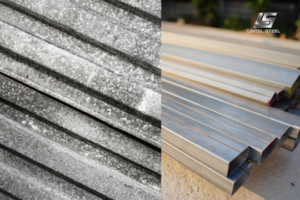
Click here for more information on the galvanised products: Galvanised Steel Angle, Galvanised Pipe, Galvanised Box Section
What are the advantages of galvanised steel?
Choosing a galvanised steel offers a wide range of advantages for builders, engineers, and fabricators. Beyond its basic strength, the galvanisation process adds qualities that make this type of steel stand out from untreated or painted alternatives.
Corrosion Resilience
The iron elements in steel are highly susceptible to rust, but the addition of zinc as a protective coating shields against moisture, chemicals, and other corrosive elements. As a result, galvanised steel exhibits superior resistance to environmental factors, making it ideal for outdoor applications.
Durability
In addition to corrosion resistance thanks to zinc, the mechanical properties of steel, such as high tensile strength and good impact resistance, are also enhanced. After galvanizing, an industrial steel sheet is estimated to last for more than 50 years in a temperate environment and more than 20 years in an environment with frequent water exposure.
Long-term Cost Effectiveness
The initial cost is low compared to most other treated steels. Combined with high corrosion resistance and strength, this reduces the need for frequent repairs, material replacements, and maintenance.
Furthermore, galvanised steel can be used immediately upon delivery. It requires no additional surface preparation, inspection, painting/coating, etc., further saving costs.
What is galvanised steel used for?

Galvanised steel is used everywhere!
Thanks to its valuable benefits, galvanised steel is widely used in many industries and fields. Especially in infrastructure, agriculture, automotive, and construction industries, which require reliable materials that can last for decades in all weather and outdoor conditions.
From small items like screws that need to withstand outdoor weather conditions to bicycle frames, car bodies, and exposed steel structures or frames to create indoor structures such as balconies, patios, stairs, ladders, walkways, and more. Galvanised steel is the ideal choice if your project will be used outdoors after completion. Fences, roofs, and outdoor walkways – all are excellent choices for galvanised steel!
Galvanised steel vs. Stainless steel
Although stainless steel can also be used for corrosion and rust resistance, there are benefits of galvanised steel that cannot be applied to stainless steel. For example, the price of stainless steel is much higher than that of galvanised steel. For most common applications, galvanised steel is the better choice for simplicity and cost.
Galvanised steel vs. Aluminum Steel
Both aluminum and galvanized steel play important roles in modern construction and manufacturing. While aluminum offers advantages in weight and natural corrosion resistance, galvanized steel provides superior durability and cost-effectiveness. Understanding the differences between these two materials will help you choose the most suitable solution for your specific applications.
To learn more, see our article on Galvanized Steel vs Aluminium Steel
Choosing Galvanised Steel from Lintel Steel
Lintel Steel offers a wide range of galvanised steel products designed to meet the diverse needs of our customers. Whether you operate in the construction sector or any other industry requiring durable and corrosion-resistant materials, our galvanised steel is the perfect choice.
We understand that different projects have different requirements, which is why we offer customized options to ensure our galvanised steel precisely meets your specifications.
If you need galvanised steel products for your construction project in Perth, call us today:
- Warranty for all our products
- Cost-effective and flexible pricing based on workload
- 24/7 service availability with urgent project support
- Full safety gear is provided, ensuring on-site safety during execution
Click here to get a quote and quantity takeoff for free.
You can find out more about us at our Fanpage Lintel Steel.