Comparison: Galvanised Steel and Aluminium Steel

When choosing building materials, there are many to consider, and it’s crucial to understand the differences between them to make the right choice for each project. Among them, galvanised steel and aluminium are both widely used in many fields such as industry, construction, manufacturing, and automotive. However, they serve different purposes depending on factors such as strength, weight, and corrosion resistance.
Galvanised steel is known for its strength and cost-effectiveness, making it a popular choice for structural applications. Aluminium, on the other hand, is a lightweight, corrosion-resistant metal ideal for environments where weight is a priority.
In this article, Lintel Steel will compare galvanised steel and aluminium, highlighting the strengths and weaknesses of each material. This knowledge will help you choose the right material for your project.
What is Galvanised Steel
Galvanised Steel refers to steel that has been coated with zinc to protect it from corrosion. The zinc coating acts as a barrier, preventing moisture and oxygen from reaching the steel surface and significantly reducing the risk of rust.
Common uses for galvanised include infrastructure, agriculture, automotive, and construction industries, which require reliable materials that can last for decades in all weather and outdoor conditions.
Key characteristics of galvanised steel
- Strong and highly durable
- Excellent resistance to rust and corrosion
- Cost-effective compared to many alternative metals
What is Aluminium Steel
Aluminium is a lightweight metal with natural corrosion resistance. Different from galvanised steel, aluminium naturally forms a protective oxide layer, making it ideal for humid environments. It is a good conductor of heat and electricity, and is also very malleable, formable, machined, and fabricated.
Common applications include aerospace, automotive, electronics, and construction. Thanks to its high strength-to-weight ratio, aluminium is a preferred choice for projects requiring weight reduction. Additionally, its non-magnetic and electrically conductive properties make it valuable in thermal and electrical conductivity applications.
Key characteristics of galvanised steel
- Lightweight and easy to transport
- Naturally corrosion-resistant
- High aesthetic appeal
Galvanised Steel and Aluminium: Properties
To better understand the differences between galvanised steel and aluminium in terms of properties, let’s take a closer look at the factors below.
Physical Property Comparisons
| Property | Galvanised Steel | Aluminium |
| Density | 7.85 g/cm³ | ~2.7 g/cm³ |
| Strength | Higher tensile strength (~250-550 MPa) | Lower tensile strength (~90-300 MPa) |
| Surface Properties | Coating weight 30-350 g/m² on both sides (e.g., Z30-Z350) | can be highly reflective |
| Weight | Heavier | Lightweight (about 1/3 the weight of steel) |
| Machinability | Harder to machine, requires special tools | Easier to machine and fabricate |
| Thermal Conductivity | ~45–60 W/m·K, unaffected by the galvanised layer | ~235 W/m·K |
| Electrical Conductivity | Electrical conductivity: slightly lower than pure steel | High conductivity (about 60% of copper’s conductivity) |
| Coefficient of Thermal Expansion | 11.5 x 10⁻⁶/°C | 23 x 10⁻⁶/°C |
Chemical Property Comparisons
| Property | Galvanised Steel | Aluminium |
| Melting Point | ~1,370–1,530°C (steel core); Zinc layer melts at ~419°C | ~660.3 °C (1220.5 °F) |
| Composition | Steel (iron + carbon) with a zinc coating | Primarily aluminium |
| Corrosion Resistance | Based on a zinc coating; can corrode if damaged. | Naturally corrosion-resistant |
| Oxidation Reaction | Zinc coatings slow down oxidation, but steel will rust if the coating is scratched. | Aluminium oxide protects against further oxidation. |
| Acid Resistance | Zinc plating dissolves in strong acids | Corrosion resistance is average, but it can be corroded in strong acids |
| Base Resistance | Zinc coatings offer some resistance, but steel can still be affected | It may react with strong alkaline solutions |
Key Differences Between Galvanised Steel and Aluminium
Appearance
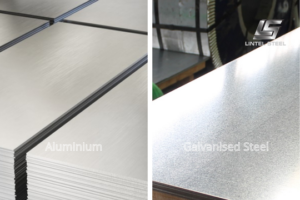
Galvanised steel has a rough surface due to its zinc coating. Initially, it may have a slightly shiny, gleaming appearance, but over time, it will dull to a greyish hue.
In contrast, aluminium has a smooth, polished surface, with a bright silver coating that retains its reflectivity over time. It can also be polished or electroplated for a more refined look or a different colour.
Corrosion Resistance
Galvanised steel: Protected by a zinc coating, which prevents rust, it offers good corrosion resistance. The zinc acts as a sacrificial protective layer, corroding first to protect the underlying steel. However, in highly acidic or alkaline environments, the coating can be damaged more quickly, leaving the underlying steel susceptible to corrosion.
Aluminium: Naturally forms a protective oxide layer that offers good corrosion resistance without further treatment, especially in saltwater environments. However, this layer can be damaged by strong alkalis or certain chemicals.
Both galvanised steel and aluminium offer good corrosion resistance, but galvanised steel may perform better in some acidic environments, while aluminium excels in saltwater environments.
Durability
Both galvanised steel and aluminium are corrosion-resistant; however, both materials can be susceptible to damage from dents or scratches, affecting their durability and aesthetics. Unlike steel, it will not rust, but large dents can affect its function.
In terms of durability, galvanised steel may be more durable, especially with proper maintenance. However, aluminium requires less maintenance due to its inherent corrosion resistance.
Strength-to-Weight Ratio
Galvanised steel: Naturally, steel is a strong material, and the addition of zinc adds a minimal amount of weight.
Aluminium: Lightweight yet strong, ideal for applications requiring reduced weight.
This means that for the same weight, an aluminium part will be stronger than its galvanised steel counterpart. Aluminium is the best choice in terms of strength-to-weight ratio, making it the preferred choice when weight is a critical factor.
Cost-effectiveness
Galvanised steel has a lower initial cost and is a better choice for projects with limited budgets. However, the durability of aluminium in corrosive environments can result in lower long-term costs due to lower maintenance requirements. The most cost-effective choice depends on the specific application and lifespan requirements.
How to Choose Between Galvanised Steel and Aluminium?
The choice between galvanised steel and aluminium ultimately depends on the project requirements. Here are the key factors to consider:
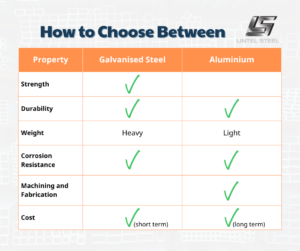
Strength and Load-Bearing Needs – If your project requires a high-strength material to support the structure, then galvanised steel is the better choice due to its superior tensile strength and toughness. It is commonly used in construction, heavy machinery, and industrial framing, particularly suitable for structural and heavy-load applications.
Weight Factor – If minimising weight is a top priority, aluminium is the ideal choice. Aluminium weighs about one-third less than steel, ideal for transportation, aerospace, and lightweight structural applications where reducing mass improves efficiency.
Corrosion Resistance – Both materials perform well in harsh weather environments. For environments exposed to moisture and chemicals, aluminium has an advantage due to its naturally occurring oxidation layer that resists rust. In acidic environments, galvanised steel also offers good corrosion resistance but can degrade over time if the zinc coating wears off.
Machining and Fabrication – If your project requires aesthetics and versatility, such as forming, welding, or machining, aluminium is generally more malleable and easier to machine than galvanised steel, which is harder and requires special tools for processing. It performs particularly well in environments where minimal maintenance is needed, and aesthetics are important.
Cost and Budget – Galvanised steel is generally more affordable than aluminium, making it a better choice for projects with limited budgets. However, aluminium’s durability in corrosive environments can offset the higher initial cost through reduced maintenance costs and a longer lifespan.
In some cases, combining both materials can yield the best results. By using galvanised steel for structural components and aluminium for finishing details, you can achieve a balance between performance and design.
By evaluating the durability, weight, corrosion resistance, and cost requirements of your project, you can determine whether galvanised steel or aluminium is the more suitable material for your application.
Lintel Steel – Your Trusted Steel Merchant in Perth
Lintel Steel has been a trusted steel merchant in Perth for more than 11 years. Our team supplies a wide range of high-quality steel products for residential, commercial, and industrial projects across Western Australia, designed to meet our customers’ diverse needs. Whether you operate in the construction sector or any other industry requiring durable and corrosion-resistant materials, our products are the perfect choice.
If you need steel products for your construction project in Perth, call us today:
- A full range of steel beams, tubes, angles, plates, and C sections
- Warranty for all our products
- Cost-effective and flexible pricing based on workload
- Full safety gear is provided, ensuring on-site safety during execution
- 24/7 service availability with urgent project support
Click here to get a quote and quantity take-off for free.
You can find out more about us at our Fanpage Lintel Steel.