
Common Types of Corrosion in Construction and How to Prevent

Steel corrosion is not just a cosmetic issue – it is a “silent enemy” that gradually destroys structures, machinery, and infrastructure, causing billions of dollars in economic losses each year.
Corrosion deteriorates the integrity of metals through interactions with the surrounding environment, leading to significant financial impacts across key industries such as construction, automotive, and manufacturing.
Understanding the most common types of corrosion is essential for selecting the right protection methods, thereby extending material lifespan and minimizing maintenance costs.
What is corrosion?
Corrosion is the degradation of a metal or alloy due to chemical or electrochemical reactions between the material and its surroundings. For common engineering metals such as carbon steel, stainless steel, zinc, copper, and aluminum, corrosion can be understood as the thermodynamic reverse of the metal extraction and refining process.
This phenomenon leads to changes in material properties, significantly reducing metal performance, shortening the lifespan of structures, and causing substantial economic losses across industries such as construction, manufacturing, and mechanical engineering.
Understanding common types of corrosion will help businesses and engineers select appropriate protection solutions that are cost-effective and ensure long-term structural durability.
Causes of Steel Reinforcement Corrosion in Construction
Steel reinforcement corrosion can occur in all three environments: solid, liquid, and gas.
- In liquid environments: occurs when structures are exposed to seawater, acidic water, mineral water, groundwater, or industrial wastewater, as these types of water contain corrosive elements.
- In gaseous environments: occurs when structures are exposed to industrial emissions from factories using chemicals or in structures near the sea, affected by sea winds.
- In solid environments: occurs when structures are exposed to fertilizers or pesticides, but only if these chemicals are damp.
In addition, material corrosion is very diverse and influenced by many factors such as erosion by water flow, organisms adhering to the building structure, the impact of physical conditions, and electrochemical currents.
The most common types of corrosion
Uniform Corrosion
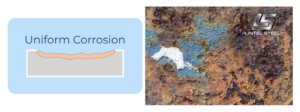
This occurs across the entire metal surface upon contact with acidic or atmospheric environments. This type of corrosion occurs on all unprotected steel substrates over time, at a higher rate in marine environments due to the salinity and humidity of the air. In industrial environments, this is not the most common type of corrosion.
Signs:
- The metal surface thins evenly, and a layer of rust appears covering the entire surface, usually reddish-brown in color.
- Commonly seen in steel exposed to humid air.
Countermeasures:
- Material Selection: Use higher-strength alloys (stainless steel, nickel alloys, copper-nickel, copper-aluminum) for the working environment.
- Surface Protection Coating: Apply durable coatings/primers (epoxy, polyurethane, metal plating, or galvanizing) to protect the metal from the environment.
- Design: Increase corrosion resistance in designs that allow for drainage to prevent water accumulation, limiting exposure to corrosive environments.
- Maintenance & Monitoring: Schedule ultrasonic thickness surveys and monitor corrosion rates (thickness testing, ER probes) to plan for replacements before failure occurs.
Galvanic Corrosion
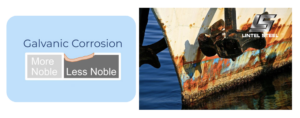
Electrochemical, or bimetallic corrosion, occurs when there is a potential difference between two unequal metals when they are immersed in a corrosive or conductive solution. The more chemically active metal (cathode) will corrode rapidly, while the less chemically active metal (anode) is protected.
This is the most common type of corrosion in real life.
Signs
- Commonly seen at bolted joints or ship hulls. Also common in sheet metal, where the sheets are often made of steel, and the tubes are made of another metal (copper or titanium).
- The surface patchy, non-uniform corrosion.
- The anodized area may show more severe corrosion than other areas.
- This often occurs in humid environments, water, or salt solutions.
- Leakage current or electrochemical reactions may occur.
Countermeasures:
- Compatibility: Avoid combining different metals in the design, or combine compatible materials from the same family.
- Insulation: Use an insulating layer between the two metals (gaskets, plastic seals).
- Protection system: Add a coating over the more precious metal to prevent cathode expansion, or sacrifice an anode protection in submerged systems.
- Area ratio control: Make the anode area larger than the cathode area to reduce local current density (different metals).
- Maintenance design: Allow for easy replacement of sacrificial parts and periodic inspection of connections.
Pitting Corrosion
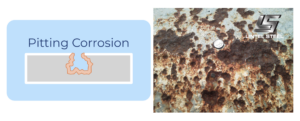
Is a type of localized corrosion that creates small but deep holes on the metal surface. These holes grow rapidly in depth while the rest of the surface remains intact, making them difficult to detect but extremely dangerous.
Stainless steel and other passivated metals such as aluminum and its alloys, are particularly susceptible to pitting corrosion. It is commonly found in stainless steel in chloride-containing environments.
Signs:
- The appearance of tiny holes on the metal surface
- The holes may penetrate deep inside, causing perforation
- Difficult to detect with the naked eye in the early stages
Countermeasures:
- Alloy selection: high pitting resistance suitable for chloride environments.
- Design for access: avoid chloride deposition and concentration; provide flushing and drainage.
- Surface cleaning: weld quality control, smooth surface finish, avoid machining marks at stress points, clean any deposits on the metal surface.
- Coatings & Inhibitors: use defect-free coatings; use validated corrosion inhibitors from the compatibility process.
- Investigation: rigorous periodic inspection (microscope, eddy current, dye penetration into small parts) and electrochemical testing during quality assessment (pitting potential).
Crevice Corrosion
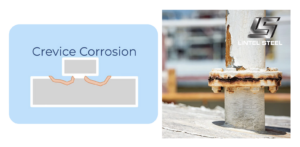
Similar to pitting corrosion, but occurs in narrow gaps such as under nuts, washers, or between overlapping metal plates where oxygen is difficult to circulate, and fluid is trapped and cannot flow, creating a localized corrosion environment.
Signs
- Commonly found at joints, bolts, and rivets.
- The outer surface may appear normal, but the inside of the gap is severely corroded.
- Dirt and moisture may be visible in the gap.
Countermeasures
- Limit gap design: (if possible), use flush or recessed screws, continuous welds, or gasket geometry that does not trap fluid.
- Seal gaps: Use sealants, gaskets, silicone sealants, or specialized fillers to prevent water ingress.
- Materials & Coating Selection: Use gap-resistant alloys or robust coatings that provide good corrosion resistance in enclosed environments.
- Cleaning & Maintenance: Regularly inspect and disassemble assemblies for cleaning, removing residue and debris. Ensure proper drainage and ventilation in assembly areas.
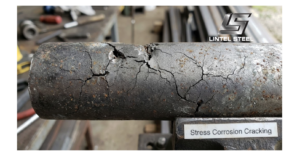
Stress Corrosion Cracking – SCC
This occurs when a metal is simultaneously subjected to tensile stress (extensibility) and a corrosive environment. The result is the formation of tiny cracks leading to sudden fractures.
Signs
- Small cracks appear on the surface
- Cracks can spread quickly and cause sudden fracture
- Often occurs in areas subjected to high tensile stress
Countermeasures
- Environmental control: Limit working at excessively high temperatures in sensitive environments, control pH, and apply inhibitors when indicated.
- Material modification: Use SCC-resistant alloys for specific environments (e.g., low-sensitivity stainless steel, duplex steel, nickel alloys).
- Eliminate or reduce tensile stress: Redesign to reduce working stress, control preloading/tightening processes, perform excess stress relief (thermal), or use compression surface treatment methods (shot peening).
- Monitoring: Perform NDT (Non-Destructive Testing) on cracks (dye penetrant, ultrasound, acoustic emission), and periodically remove/inspect critical fasteners.
Hydrogen-Induced Cracking (HIC)
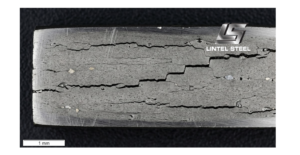
Hydrogen-assisted cracking is one of the most dangerous and difficult-to-detect forms of metal corrosion. It is a combined mechanical and electrochemical corrosion phenomenon that leads to the cracking of certain materials.
It occurs when hydrogen atoms penetrate the metal through processes such as electroplating, welding, and acid cleaning. This limits the use of high-strength galvanized products in dry indoor environments.
Signs
- Common in the industries: Oil and gas (pipelines, storage tanks), high-strength steel structures, heavy-duty bolts and screws, automotive industry, and aerospace.
- Cracks usually develop from the inside out and are often difficult to observe with the naked eye.
- There are no clear signs of plastic deformation before cracking; sudden fracture may occur.
Countermeasures
- Process control: Avoid hydrogen charging operations on vulnerable parts; when plating/welding is required, use a low-hydrogen process and a suitably formulated bath.
- Material and hardness control: Use lower-strength or true-to-specified materials and hardness limits with documented HIC resistance.
- Surface treatment & coating: Use diffusion barriers or coatings that reduce hydrogen penetration where appropriate.
- Expertise & inspection: Require supplier documentation on hydrogen embrittlement mitigation, post-plating baking certificates, and fracture certificates if defects occur.
Why is corrosion resistance important?
Cost Optimization (Economics)
Global damage from corrosion amounts to trillions of US dollars annually, including costs associated with maintenance, replacement parts, and unplanned downtime.
For industries such as oil and gas, automotive, and infrastructure, these costs can account for a significant portion of operating expenses.
Risks to Life and Property
Failure of critical structures (bridges, buildings, pipelines, aircraft) due to corrosion can lead to fires, sudden collapses, environmental disasters, and long-term economic disruption.
For example, pipeline leaks due to corrosion can cause oil spills, while bridge collapses due to corroded fasteners can lead to tragic accidents.
Impact on Product Quality
In industries such as food processing, pharmaceuticals, and medical devices, corrosive products (e.g., metal ions) can contaminate products, posing risks to consumer health and safety.
This can also lead to non-compliance with regulations and damage to brand reputation.
Factors such as environmental conditions, oxidation, abrasion, and many other phenomena can affect the lifespan of a structure, but with proper protection, its lifespan can be ensured and extended – thus avoiding repair or replacement costs.
Choose Lintel Steel for your Steel Structure Fabrication in Perth
At Lintel Steel, we have been a trusted steel structure fabricator in Perth for more than 11 years, delivering high-quality fabricated steel for residential, commercial, and industrial projects. Our team specializes in custom steel frames, all manufactured to Australian Standards.
From design and fabrication to installation, we provide end-to-end steel solutions built for strength, accuracy, and reliability. We also offer free, no-obligation quotes within 48 hours to help you start your project with confidence and efficiency.
Choose Lintel Steel – where precision meets performance in every structure we build.
Click here to get a quote and quantity takeoff for free.
You can find out more about us at our Fanpage Lintel Steel.


