
Structural Steel Requirements Under the NCC

Choosing structural steel involves more than finding a beam that fits your building plans. The material, design, connections and installation all need to work together to support the finished structure.
Understanding structural steel NCC requirements helps builders, homeowners and buyers ask better questions before placing an order. It also makes quotations easier to compare and reduces uncertainty about the documents required for approval.
The National Construction Code, commonly called the NCC, establishes requirements for Australian buildings. However, compliance involves more than a supplier describing a product as “Australian Standards compliant.”
This guide explains the main structural steel NCC considerations, how they connect to Australian Standards and what to discuss with your engineer and steel supplier.
What Do Structural Steel NCC Requirements Cover?
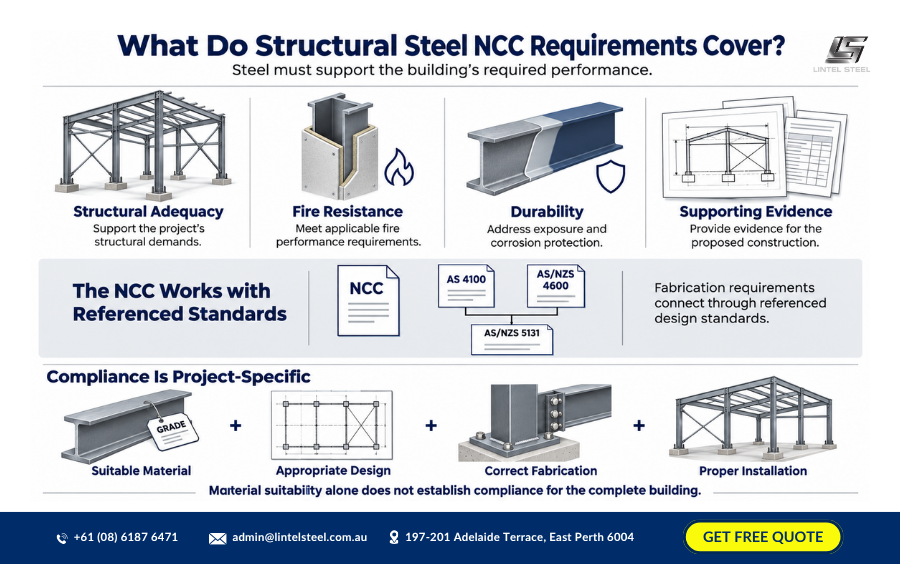
Structural steel NCC requirements address how steel contributes to a building’s performance. Depending on the project, relevant considerations include structural adequacy, fire resistance, durability and evidence supporting the proposed construction.
The NCC works alongside referenced standards rather than providing every steel design calculation within its own pages.
The Australian Steel Institute explains that standards such as AS 4100 and AS/NZS 4600 are primary NCC references. Fabrication requirements in AS/NZS 5131 are connected through referenced design standards.
For buyers, structural steel NCC compliance is therefore a project-specific question. A suitable material still needs an appropriate design, correct fabrication and proper installation.
Start Your Structural Steel NCC Check with the Building Type
Before selecting steel, establish the building classification and applicable NCC edition.
A detached house and a multi-storey commercial building do not necessarily follow identical provisions. Project location, approval arrangements and jurisdictional variations also need consideration.
Your structural steel NCC review should identify the relevant requirements before procurement begins. Ask the designer or building surveyor to confirm the basis being used.
The newest published standard or code edition should not automatically replace the documents governing an existing project. Record the applicable editions and amendments in the specification.
This gives everyone involved in structural steel NCC coordination a consistent reference when preparing drawings, quotations and purchase orders.
Structural Steel NCC Compliance Pathways Explained
The NCC is performance-based. Compliance can be demonstrated through a Deemed-to-Satisfy Solution, a Performance Solution or a combination of both, using the applicable assessment processes.
A Deemed-to-Satisfy approach follows the relevant prescribed provisions and referenced documents. A Performance Solution demonstrates that the relevant Performance Requirements are satisfied through an appropriately developed and assessed solution.
Structural steel NCC decisions about these pathways belong within the project’s design and approval process. They should not be improvised when a specified product becomes unavailable.
For purchasing purposes, establish the accepted design basis first. Then source steel and fabrication services matching that basis, rather than expecting product selection alone to resolve compliance.
How Design Standards Support Structural Steel NCC Requirements
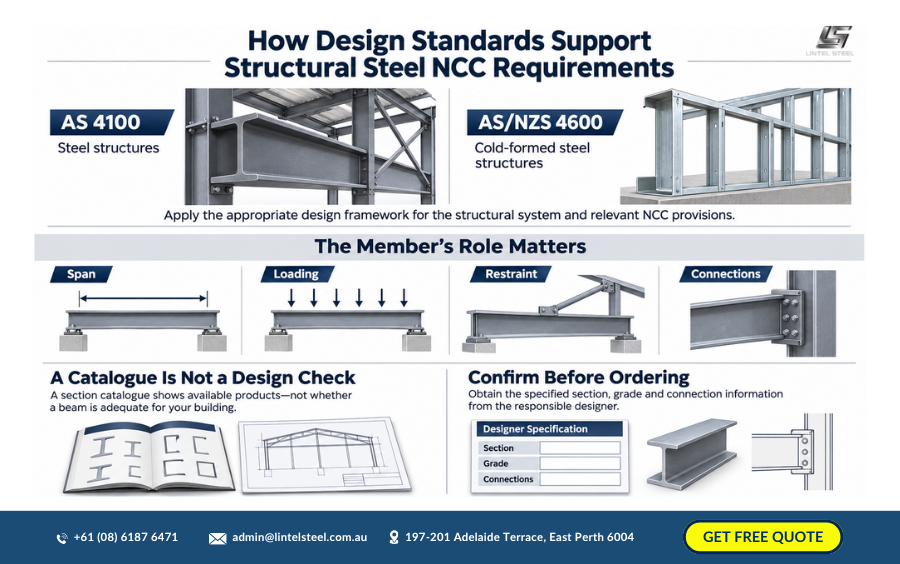
AS 4100 addresses steel structures, while AS/NZS 4600 addresses cold-formed steel structures. Their application depends on the structural system and the relevant NCC provisions.
A substantial hot-rolled beam and a light-gauge framing member may both be steel, but they require consideration within the appropriate design framework.
Structural steel NCC design also involves the member’s role within the building. Span, loading, restraint and connections all influence the result.
A supplier’s section catalogue can help identify available products. It cannot establish whether a beam is adequate for your particular building.
Before ordering against structural steel NCC requirements, obtain the specified section, grade and connection information from the responsible designer.
Housing Provisions Have Important Limitations
Some housing projects can use the NCC’s prescriptive provisions for particular structural steel members.
For example, Part 6.3 of the NCC 2022 Housing Provisions addresses specified applications involving bearers, strutting beams, lintels and columns. Its application is subject to stated limitations and conditions.
A structural steel NCC span table should never be treated as a universal beam-selection chart. Support conditions, load arrangements and the scope of the table must match the proposed work.
Imagine using a table intended for distributed loading where a concentrated load is introduced. The section’s appearance does not reveal whether that assumption remains valid.
Refer situations outside the prescribed scope to the responsible engineer.
Material Grades and Structural Steel NCC Specifications
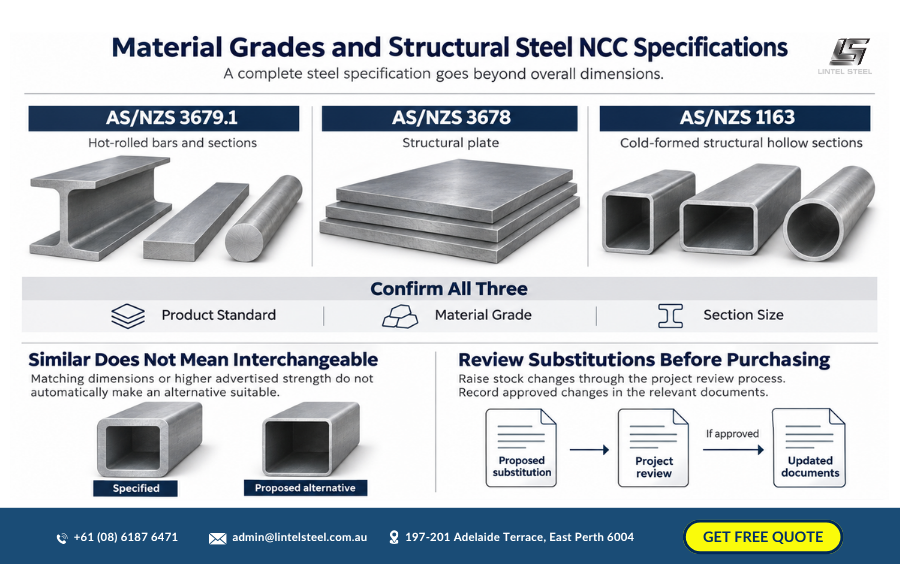
A complete steel specification identifies more than overall dimensions.
Material standards address different product families. Common references include AS/NZS 3679.1 for hot-rolled bars and sections, AS/NZS 3678 for structural plate, and AS/NZS 1163 for cold-formed structural hollow sections.
For structural steel NCC procurement, confirm the product standard and grade alongside the section size.
Two hollow sections can have similar dimensions without being interchangeable. Likewise, a higher advertised strength does not automatically make an alternative suitable.
If stock availability changes, raise the proposed substitution before purchasing. Structural steel NCC acceptance should follow the project’s review process, with any approved changes reflected in the relevant documents.
Fabrication Turns the Design into Finished Steelwork
Fabrication involves turning stock material into the assemblies shown on the project drawings.
Cut lengths, holes, plates and connections need coordination. A beam can have the correct grade and section size while still being unsuitable because its fabricated details are wrong.
Structural steel NCC coordination therefore extends beyond material supply into fabrication specifications and quality controls.
The Australian Steel Institute’s National Structural Steelwork Specification helps engineers and specifiers communicate project requirements associated with AS/NZS 5131. It includes project-specific selections and supporting drawing notes.
When comparing quotations, clarify whether the price includes detailing, fabrication, inspections, coatings and supporting records. A stock-steel quotation covers a different scope from a finished assembly.
Connections Need Structural Steel NCC Attention Too
Connections transfer forces between members and into the supporting construction. Their details deserve the same care as the main beams and columns.
Welds, bolts, base plates and anchors should follow the engineering specification. Replacing a specified fastener or altering a plate to simplify installation may affect the design.
A useful structural steel NCC purchasing discussion includes who supplies connection components and who checks compatibility with the supporting structure.
Before fabrication starts, resolve unclear details through the agreed project process. Before installation, confirm that the latest drawings are available.
These steps help maintain the structural steel NCC design intent as information passes between the engineer, supplier, fabricator and installer.
Read more: Australian Standards for Structural Steel Explained
Fire Resistance Is Different from Non-Combustibility
Steel being non-combustible does not mean every unprotected steel member automatically achieves the required fire-resistance level.
The relevant building element may need a specified fire-resistance level, commonly abbreviated to FRL. Whether protection is required depends on the building and the accepted design.
Structural steel NCC fire assessment must address the actual element and construction arrangement. NCC Specification 1 describes procedures for determining FRLs, including recognised design and testing pathways.
If a protective system is specified, coordinate it with the steelwork and other finishes.
Do not assume that ordinary paint provides fire protection. Confirm the required system, supporting evidence and installation requirements before including it in a structural steel NCC order.
Corrosion Protection Must Suit the Exposure
A steel column in a coastal outdoor location faces different exposure from a beam within a dry internal space.
Structural steel NCC durability considerations should therefore be translated into a clear project specification. “Painted steel” may not adequately describe the required preparation and coating system.
The Australian Steel Institute highlights the need to select corrosion protection using the intended environment and whole-of-life considerations.
Discuss coating compatibility, access for maintenance and treatment of areas affected by subsequent work.
Structural steel NCC coordination is easier when the finish is established before fabrication. Late coating changes can affect preparation, detailing, cost and delivery arrangements.
Evidence of Suitability Supports Structural Steel NCC Compliance
Documentation needs to support the proposed product, design or construction method.
The ABCB’s evidence-of-suitability handbook explains that appropriate evidence can include certificates, reports, calculations and other supporting information. The appropriate form depends on the particular circumstances.
For structural steel NCC purchasing, ask what records will accompany the supplied material and fabricated components.
Material identification, test documentation and fabrication records have different purposes. A material certificate does not establish that every connection was fabricated correctly, while an engineering drawing does not identify the material actually delivered.
Arrange structural steel NCC documentation before production rather than trying to reconstruct the evidence after installation.
Buying Steel with Clear Responsibilities
Start your enquiry with current drawings, specified grades, quantities, finishes and delivery requirements.
Explain whether you need stock lengths, processed components or complete fabricated assemblies. Identify any unresolved information so the supplier can state its pricing assumptions.
Structural steel NCC responsibilities should remain clear throughout the order. Confirm who designs, who fabricates, who installs and who reviews proposed changes.
For example, if a specified beam is unavailable, the supplier can propose an alternative for assessment. The responsible designer then determines whether it is acceptable and what other details need updating.
This is a more reliable approach than allowing purchasing decisions to introduce undocumented design changes.
Make Structural Steel NCC Requirements Part of Your Order
Structural steel NCC requirements connect the building’s design with the material and workmanship delivered on site.
For buyers, the practical priorities are clear specifications, appropriate supporting evidence and coordinated responsibilities.
Before placing an order, share the project documents with your steel supplier and confirm the accepted design basis with your building professional. Address sections, grades, connections, finishes and records together.
Considering structural steel NCC requirements early helps you compare equivalent quotations, resolve questions before fabrication and purchase steel that matches your project.
Contact Lintel Steel for free quote and quantity take-off.
Authoritative Resources
- Australian Building Codes Board, National Construction Code: https://ncc.abcb.gov.au/