Australian Standards for Structural Steel Explained

Ordering structural steel involves more than choosing a beam size or comparing prices. The steel must have the right material properties, suit the engineer’s design and come with the information needed to establish its suitability for the project.
That is where Australian steel standards come in. They provide a framework for specifying steel products, designing structures, controlling fabrication and checking the finished steelwork.
For builders, homeowners and construction-product buyers, the standard numbers can initially look confusing. AS 4100, AS/NZS 1163 and AS/NZS 5131 may appear together on a specification, but each addresses a different part of the job.
This guide explains how those requirements fit together and what to check before placing a structural steel order.
What Are Australian Steel Standards?
Australian steel standards are technical documents that establish requirements for steel materials, structural design and construction processes. Some apply to the steel product itself, while others address how it is designed, fabricated or installed.
The prefix AS identifies an Australian Standard. AS/NZS identifies a joint Australian and New Zealand Standard.
There is no single document covering every aspect of structural steel. Instead, several standards work together. A structural engineer uses design standards, a manufacturer works to the relevant material standard, and a fabricator follows the specified fabrication and process requirements.
Standards are not automatically legislation simply because they exist. They can become mandatory through references in legislation and the National Construction Code, or become contractual requirements when included in project specifications. The Australian Steel Institute explains this distinction within its steel standards framework.
For a buyer, the useful question is therefore more specific than “Does this steel meet Australian Standards?” Ask which standards, grades and supporting documents apply to the actual product and project.
How Australian Steel Standards Connect to Your Building Project
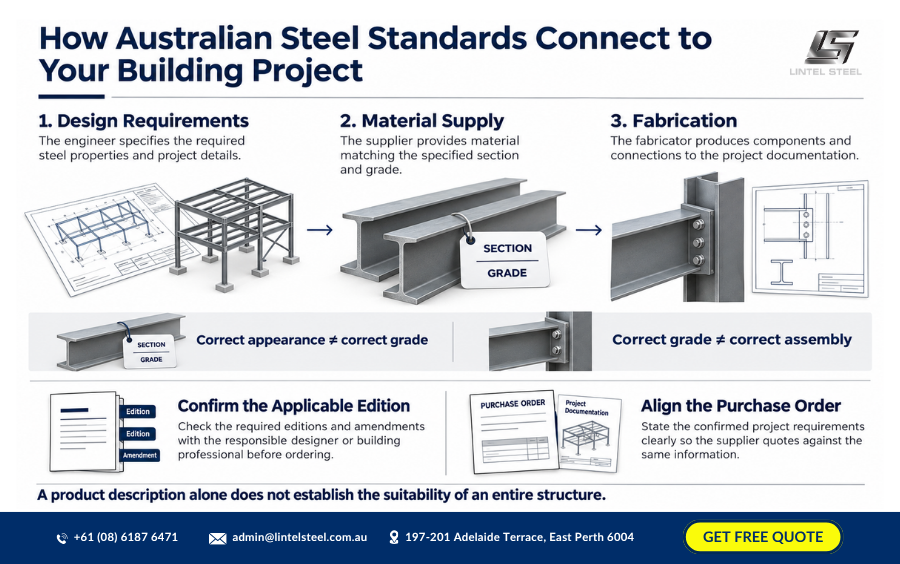
Think of structural steel compliance as a chain of related decisions.
The engineer establishes the design requirements. Those requirements depend on steel having specified properties. The supplier provides the selected material, and the fabricator turns it into components that match the project documentation.
A problem at one stage can affect the others. For example, a beam that looks correct may still have the wrong grade. A correctly graded beam may also become an unsuitable assembly if its connections are fabricated incorrectly.
This is why a product description alone cannot establish the suitability of an entire structure.
The relevant editions and amendments also matter. A newly published standard does not necessarily replace the edition referenced by the applicable regulatory framework or an existing contract immediately. Confirm the project’s requirements with the responsible designer or building professional before ordering.
Your purchase order should then reflect those requirements clearly, so the supplier is quoting against the same information the project team is using.
Australian Steel Standards for Beams, Columns, Plate and Hollow Sections
Different steel products fall under different material standards. Understanding the main references makes product descriptions and quotations easier to read.
AS/NZS 3679.1 covers hot-rolled bars and sections. It is a common reference for structural sections such as universal beams, universal columns, channels and angles.
AS/NZS 3678 covers hot-rolled structural steel plates, floorplates and slabs. AS/NZS 3679.2 addresses welded I-sections.
For cold-formed structural hollow sections, the key reference is AS/NZS 1163. These products include square, rectangular and circular hollow sections, commonly abbreviated to SHS, RHS and CHS. The Australian Steel Institute identifies these documents as part of the structural steel material standards framework.
These references help define what is being purchased, but the standard number is only part of the specification. Section dimensions, wall or plate thickness, grade and any additional project requirements still need to be identified.
A request for “rectangular steel tube” leaves considerably more room for misunderstanding than a complete structural product specification.
What AS 4100 Means for Structural Steel Design
AS 4100, Steel structures, is a major Australian structural steel design standard. It helps engineers assess how steel members and connections perform within a structure.
It has a different purpose from a material standard. A material standard addresses the product’s specified characteristics; a design standard helps establish how that material can be used structurally.
Standards Australia describes AS 4100 and AS/NZS 5131 as complementary documents supporting the design and construction of steel structures.
For buyers, this distinction explains why selecting a beam from a supplier’s catalogue does not replace engineering design. Two beams may fit the available space but behave differently under the project’s loads.
If the specified beam is unavailable, ask the engineer to assess a proposed alternative. Choosing a different section based only on similar dimensions or a higher advertised strength can overlook connection, stability and serviceability requirements.
Steel Grades: Why Size Alone Is Not Enough
Steel size and steel grade describe different things.
The size identifies the component’s geometry. The grade identifies specified material characteristics relevant to its intended use. A complete order needs both.
For example, two hollow sections may have the same external dimensions and wall thickness while carrying different grade designations. That does not make them automatically interchangeable.
It is also unwise to assume that a higher measured strength on a test certificate permits a higher design capacity. The Australian Steel Institute cautions that actual mill test results are not a substitute for the characteristic values and reliability framework used in structural design.
The practical approach is straightforward: order the grade specified, retain its identification and refer proposed changes to the responsible engineer.
This also helps when comparing quotations. A cheaper offer may reflect a different product specification rather than a better price for the same steel.
Australian Steel Standards for Fabrication and Erection
Once steel is cut, drilled, welded and assembled, the quality of those processes becomes part of the finished structure.
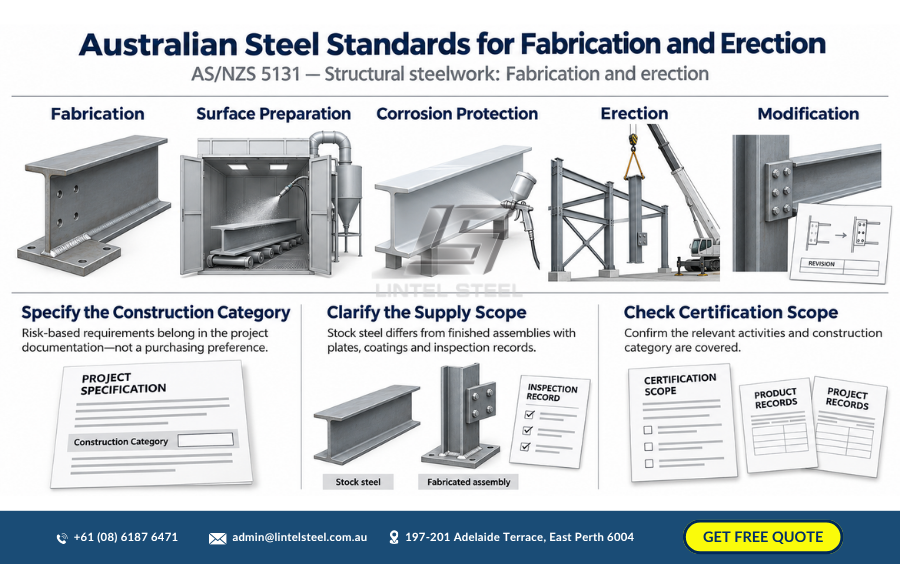
AS/NZS 5131, Structural steelwork—Fabrication and erection, addresses this stage. Its scope includes fabrication, surface preparation, corrosion protection, erection and modification of structural steelwork.
It also introduces construction categories, which provide a risk-based way of setting requirements for a structure or its components. The category should be addressed in the project documentation rather than treated as a purchasing preference.
If you are buying fabricated assemblies, clarify the scope before accepting a quotation. Supplying stock steel is different from supplying finished columns with welded base plates, connection plates, coatings and inspection records.
Fabricator certification can provide useful assurance, but its scope matters. Check whether it covers the relevant activities and construction category. Certification should support the project’s quality requirements alongside the necessary product and project records.
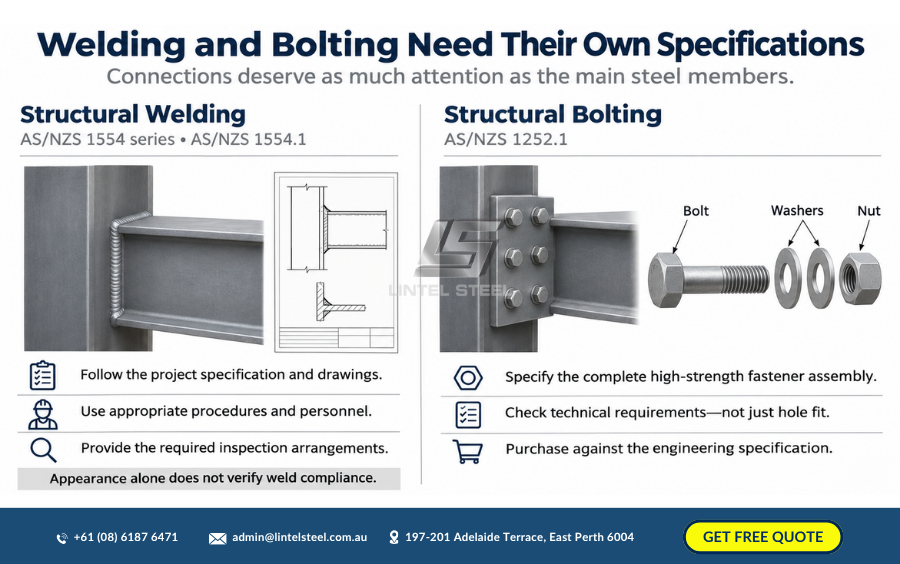
Welding and Bolting Need Their Own Specifications
Connections deserve as much attention as the main steel members.
The AS/NZS 1554 series addresses structural steel welding, with AS/NZS 1554.1 covering the welding of steel structures within its scope. The applicable welding requirements should be established through the project specification and relevant drawings.
A neat-looking weld does not, by itself, demonstrate that all specified welding requirements have been met. The fabricator needs the appropriate procedures, personnel and inspection arrangements for the work.
Structural bolting also involves more than selecting a bolt that fits the hole. AS/NZS 1252.1 addresses technical requirements for high-strength structural fastener assemblies comprising bolts, nuts and washers.
For customers, the main takeaway is to purchase connections against the engineering specification. Avoid replacing specified fasteners or altering weld details to simplify installation without the appropriate review.
Corrosion Protection Is Part of the Steel Specification
Structural capacity is only one consideration. Steel also needs suitable protection for its exposure conditions and intended service.
A beam inside a dry building faces different conditions from an exposed coastal column. The coating system should reflect that environment, along with accessibility and maintenance expectations.
The AS/NZS 2312 series provides guidance on protecting structural steel against atmospheric corrosion using protective coatings. AS/NZS 4680 addresses hot-dip galvanized coatings on fabricated ferrous articles. The Australian Steel Institute identifies these as important references for corrosion protection.
Be specific when requesting a finish. “Painted” or “galvanized” may be too broad to communicate the complete project requirements.
Confirm the specified preparation, coating system and treatment of areas affected by subsequent work. Clear instructions help suppliers price the intended scope and reduce uncertainty later.
What Documents Should Accompany Structural Steel?
Documentation should connect the steel supplied to the specification ordered.
Depending on the product and project, this can include test and inspection certificates, product identification, conformity information and fabrication records.
The Australian Steel Institute explains that relevant material standards include requirements for identification and the availability of test and inspection certificates for produced batches. It also highlights the importance of adequate documentation when establishing material compliance.
Ask about documentation before purchasing, particularly if the steel will be cut or processed before delivery. Establish how identification will be maintained through those operations.
A generic certificate for a product range is not the same as evidence linked to the supplied material. Likewise, a material certificate does not establish that every subsequent fabrication operation was completed correctly.
Keeping these distinctions clear makes handover records more useful and helps resolve questions without unnecessary delays.
Does Imported Steel Meet Australian Requirements?
Imported steel can be used on Australian projects when the necessary requirements are satisfied. The country of manufacture alone does not establish compliance or non-compliance.
The important issue is the evidence supporting the product and, where relevant, the fabricated assembly.
An overseas grade designation should not simply be assumed equivalent to an Australian specification. The project team needs an appropriate basis for accepting the material.
WorkSafe Victoria’s guidance on imported structural steelwork highlights verification against relevant Australian standards and maintaining traceability through fabrication, transport and erection. It also recommends recognised independent certification for overseas fabricators supplying principal contractors.
The same purchasing discipline is useful for locally sourced products: confirm the specification, check the evidence and establish who is responsible for resolving any gaps before delivery.
How to Order Structural Steel with Greater Confidence
Start with the current engineering drawings and specification. Use them to identify the required sections, grades, quantities and fabrication details.
Then clarify the finish, documentation, delivery arrangements and any inspection requirements. If information is still provisional, identify it clearly so the supplier can explain the assumptions behind the quotation.
Consider a simple example: two suppliers quote for a fabricated column. One includes the specified grade, base plate, coating and supporting records. The other prices only the column section and basic welding. The totals cannot be compared fairly until the scope is aligned.
A clear purchase order helps prevent this situation. It gives the supplier a defined requirement and gives your project team a practical reference for checking the delivery.
Choosing Structural Steel That Matches Your Project
Australian steel standards work together to connect design assumptions, material properties and construction quality.
You do not need to memorise every standard number to make a better purchasing decision. Focus on obtaining the specified product, confirming the fabrication scope and keeping documentation linked to the steel supplied.
Before placing your next order, share the project requirements with your construction-products supplier. Confirming sections, grades, finishes and records early makes it easier to source steel that matches the job and keeps the project moving.