
Structural Steel Fabrication Process Explained

Structural steel arrives on a building site looking ready for installation, but a great deal of planning and skilled work happens before that moment. Beams must be checked, cut, drilled, assembled, welded, inspected, protected against corrosion and delivered in the correct sequence. Together, these activities form the structural steel fabrication process.
For builders and property owners, understanding this process makes it easier to request accurate quotations, avoid delays and recognise why complete drawings matter. For engineers and fabricators, careful coordination turns a design into components that can be manufactured safely and erected efficiently.
This guide explains structural steel fabrication in friendly, practical language for Western Australian projects. It covers the main workshop stages, quality controls, Australian standards and ordering information without suggesting that every project follows exactly the same path. The precise process depends on the structure, construction category, steel grade, connection design, coating system and project specification.
What Is Structural Steel Fabrication?
Structural steel fabrication is the controlled process of converting standard steel products into finished load-bearing members and assemblies. The starting materials may include universal beams, universal columns, channels, angles, hollow sections, plates, flat bars and other structural products. The finished items may become columns, rafters, trusses, portal frames, lintels, stairs, platforms or connection assemblies.
Fabrication normally includes interpreting drawings, preparing shop details, procuring steel, identifying materials, marking, cutting, drilling, forming, fitting, welding, inspection, surface treatment and dispatch. Some projects also require trial assembly, non-destructive testing, survey checks or special traceability documentation.
The work is different from simply supplying stock lengths. A stockholder may sell a standard beam, while a structural steel fabrication workshop turns that beam into a project-specific member with the required length, end plates, holes, stiffeners, cleats and protective finish.
Why Structural Steel Fabrication Matters
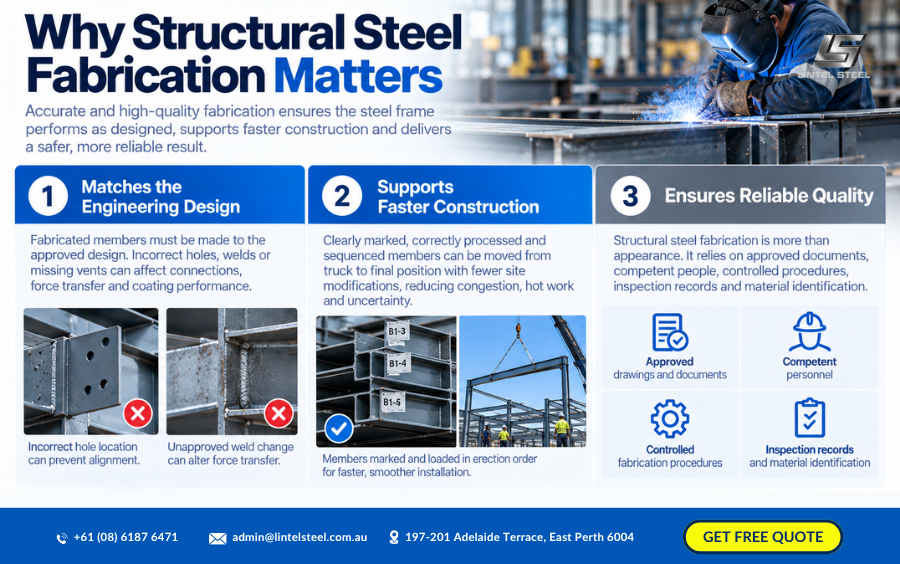
A steel frame can only perform as intended when the fabricated members match the engineering design. A hole placed incorrectly can prevent a bolted connection from aligning. An unapproved weld change can alter force transfer. Missing vents may make galvanising unsafe, while poor surface preparation can shorten coating life.
Good structural steel fabrication also supports construction speed. Members that arrive clearly marked, correctly processed and loaded in erection order can move from truck to final position with fewer site modifications. That reduces congestion, hot work and uncertainty on the project.
Quality is not only about appearance. A neat weld is not proof of capacity, and a fresh coat of paint does not confirm the correct steel grade. Reliable structural steel fabrication combines approved documents, competent personnel, controlled procedures, inspection records and material identification.
Structural Steel Fabrication Starts with Design Information
Before workshop production begins, the fabricator needs coordinated design information. Engineering drawings generally define member sizes, steel grades, connection forces or details, levels, geometry and performance requirements. Architectural and services information may also affect openings, clearances and exposed finishes.
Incomplete information creates risk. If mechanical ducts, façade supports or equipment loads are not coordinated, later changes may require new holes, stiffeners or replacement members. Site dimensions can also differ from early drawings, particularly in alterations and extensions.
The structural steel fabrication team should identify discrepancies and submit requests for information rather than silently making assumptions. Clear revision control is essential so estimators, detailers, workshop personnel and installers all work from the current approved documents.
Structural Steel Fabrication Shop Drawings and Detailing
Shop detailing translates engineering intent into instructions that the workshop and erection crew can use. Detailers model or draw each member, connection, plate, bolt, weld and assembly. They also assign part marks so components can be tracked from production to site.
Modern structural steel fabrication often uses three-dimensional modelling. A coordinated model can expose clashes, generate material lists and provide data for computer-controlled cutting or drilling equipment. It can also help plan transport, crane lifts and erection sequencing.
Shop drawings normally go through a review process defined by the project. Approval does not transfer the fabricator’s responsibilities or allow changes to engineering intent. Once drawings are released for construction, uncontrolled revisions should be avoided because one small change can affect materials, machine files, coatings and delivery schedules.
Structural Steel Fabrication Material Procurement
After quantities and specifications are established, the required steel can be ordered. The purchase information should clearly identify product designations, grades, dimensions, lengths, applicable standards and any certification requirements. Availability and mill lengths can influence splices, waste and lead times, so early discussion with a WA steel supplier is valuable.
Structural steel fabrication relies on receiving the correct material, not simply something with similar dimensions. A different grade or wall thickness can change capacity, weld requirements and connection performance. Substitution should follow the project’s approval process.
On receipt, steel is checked against purchase documents and delivery records. Depending on the project, material certificates and traceability may need to remain linked to individual members or batches throughout fabrication. Damaged, heavily corroded or incorrectly identified products should be isolated until their status is resolved.
Structural Steel Fabrication Material Identification
Material identification prevents mix-ups between grades, sizes and project components. Workshops may use tags, paint marks, stamped identifiers, barcodes or digital production systems. The chosen method must remain legible without damaging the steel or interfering with welding and coatings.
Traceability requirements vary with the specification and construction category. Some projects need records that connect a finished member to its material certificate, while other work uses batch-level controls. The fabricator’s quality plan should explain how identity is preserved after a stock length is cut into several parts.
Reliable identification makes structural steel fabrication more efficient as well as compliant. Operators can confirm they have the correct item, inspectors can match work to drawings, and erection crews can locate members quickly when bundles arrive on site.
Structural Steel Fabrication Marking and Measuring
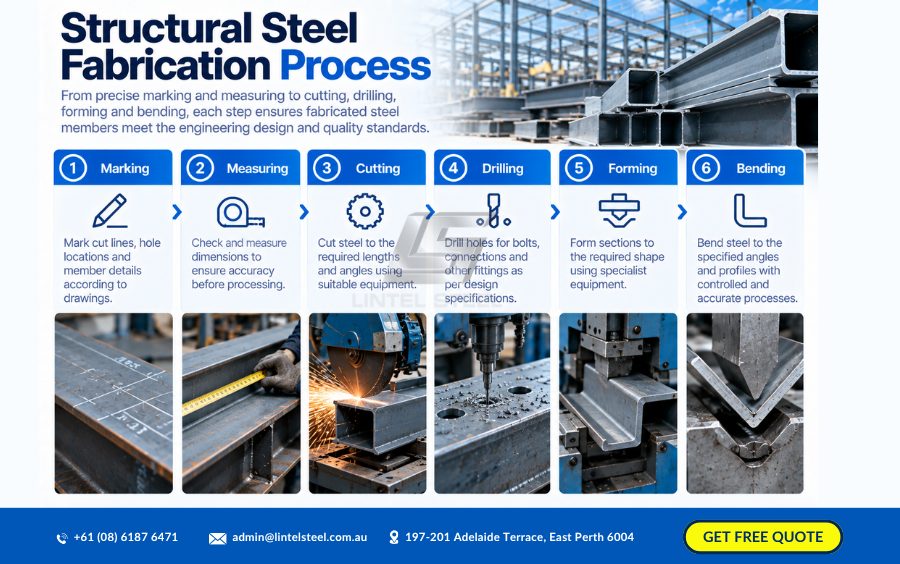
Before processing, parts are marked or programmed from approved workshop information. Traditional marking uses tapes, squares, templates and marking tools. Automated lines can measure, drill, cut and mark directly from digital files, reducing repetitive manual layout.
Accuracy still needs verification. Machines require calibration, input data must be correct and reference points must remain consistent. Fabricators account for cut width, weld shrinkage, forming allowances and specified tolerances when determining finished dimensions.
Good structural steel fabrication uses checking methods suited to the component. A simple cleat may need a dimensional check, while a complex frame could require jigs, templates or survey equipment. Errors are easier to correct before welding locks an assembly together.
Structural Steel Fabrication Cutting
Steel can be cut with band saws, circular saws, oxy-fuel equipment, plasma systems, lasers, shears or other suitable processes. The choice depends on material type, thickness, edge quality, production volume and the next fabrication step.
Computer-controlled equipment can create accurate profiles and reduce waste by nesting parts efficiently on plate. Thermal cutting is useful for complex shapes and thick plate, but heat-affected edges, dross and distortion must be managed where required. Saw cutting often produces clean, square ends for beams, columns and hollow sections.
After cutting, edges may need grinding, machining or dressing. Sharp burrs can interfere with fit-up, handling and coating coverage. The structural steel fabrication specification determines acceptable edge condition and whether particular surfaces require special preparation.
Structural Steel Fabrication Drilling and Holes
Bolted connections rely on correctly sized and positioned holes. Workshops commonly use drill lines, magnetic drills, CNC machines or punches where the applicable requirements permit. Hole type, diameter, tolerance and edge distance must match the drawings and connection design.
Slots may be specified to accommodate movement or erection tolerance, but they should never be added merely because parts do not align. Enlarging holes on site without approval can reduce connection performance and damage protective coatings.
During structural steel fabrication, hole patterns are checked before dispatch. Templates or trial assembly may be used for critical interfaces. Coordinating connection plates digitally is particularly valuable where multiple beams meet a column or existing structure.
Structural Steel Fabrication Forming and Bending
Some components require bending, rolling or pressing. Examples include curved beams, folded plates, brackets, stair elements and architectural features. The forming method depends on grade, thickness, bend radius, section shape and required accuracy.
Cold forming can change material properties locally, while hot forming introduces different controls. Excessive force or an unsuitable bend radius may cause cracking, distortion or loss of dimensional accuracy. The procedure should match the material and project requirements.
Formed parts are checked against templates, dimensions or model geometry before they move to assembly. Where heat straightening or correction is necessary, structural steel fabrication procedures should control temperature and technique rather than relying on improvised workshop methods.
Structural Steel Fabrication Fit-Up and Assembly
Fit-up is the stage where cut and processed parts are brought together before final welding. Assemblers use drawings, jigs, clamps, strongbacks and measuring equipment to position end plates, stiffeners, cleats, base plates and other components.
Correct root gaps, alignment and joint preparation are important for welding. Tack welds hold pieces in place, but they must follow the applicable welding requirements because defective tacks can become part of the finished joint or cause cracking.
Experienced structural steel fabrication teams also think ahead to bolting, coating, transport and erection. A plate that can be welded in the workshop may still block access to a bolt or create a water trap. Identifying these issues during fit-up prevents difficult site corrections.
Structural Steel Fabrication Welding
Welding joins steel components by melting and fusing material according to an approved process. Common methods in structural workshops include gas metal arc welding, flux-cored arc welding and manual metal arc welding. The selected process depends on the joint, position, steel, environment and productivity requirements.
Structural welding is controlled work. Weld procedures specify essential variables such as consumables, current range, joint preparation, position and preheat where necessary. Welders must be appropriately qualified for the work they perform. Joint surfaces need to be clean and fit-up must meet the procedure.
Heat input and welding sequence affect distortion and residual stress. Balanced sequences, restraints and suitable assembly planning help keep members within tolerance. Structural steel fabrication should never treat extra weld metal as automatically better; oversized or poorly sequenced welds can add heat, cost and deformation without improving the engineered connection.
Structural Steel Fabrication Weld Inspection
Inspection begins before the arc is struck. The inspector can verify material identity, joint preparation, consumables, welder qualifications, procedure details and fit-up. During welding, controls may include interpass cleaning, temperature checks and monitoring of technique.
Completed welds receive visual inspection, and the project may require non-destructive testing such as magnetic particle, ultrasonic, radiographic or penetrant testing. The appropriate method and extent depend on weld type, risk, construction category and specification. Testing does not replace good workmanship; it verifies selected aspects of completed work.
If a weld is nonconforming, the defect is assessed and repaired using an approved approach. Records should show the inspection, result, repair and reinspection. This documentation is a central part of quality-managed structural steel fabrication.
Structural Steel Fabrication Dimensional Inspection
Welding and handling can cause movement, so finished members are checked for length, straightness, sweep, camber, twist, hole position and connection geometry. The applicable tolerances depend on the standards and project documents.
Inspection equipment can range from tapes and levels to calibrated total stations or laser systems. Large trusses and complex assemblies may be trial-fitted in the workshop to confirm alignment before they are separated for transport.
Dimensional compliance affects more than appearance. A base plate outside tolerance can shift a column, while cumulative errors can prevent roof members from meeting. Effective structural steel fabrication finds discrepancies before delivery, when correction is generally safer and less expensive.
Structural Steel Fabrication Surface Preparation
Steel surfaces must be prepared for the specified corrosion-protection system. Depending on the finish, preparation can involve degreasing, abrasive blasting, power-tool cleaning, removal of weld spatter, edge treatment and cleaning of dust or soluble contaminants.
Paint performance relies heavily on surface condition and profile. Applying a premium coating over mill scale, oil or dust can lead to early breakdown. Corners, welds and difficult areas may need extra preparation or stripe coating to achieve adequate coverage.
For hot-dip galvanising, the completed article must be designed for safe venting, drainage and immersion. Hollow sections and enclosed spaces require correctly located holes. Structural steel fabrication and galvanising planning should happen before welding, not after a sealed assembly reaches the galvanizer.
Structural Steel Fabrication Painting and Galvanising
Protective paint systems can include primers, intermediate coats and topcoats selected for the project environment. Application conditions, mixing, recoat intervals and dry film thickness need control. Areas damaged during transport or erection require compatible repair procedures.
Hot-dip galvanising immerses fabricated steel in molten zinc, creating a bonded metallic coating. It can provide durable protection and reach suitable internal surfaces, but member size, venting, drainage, steel chemistry, distortion risk and appearance expectations must be considered.
Western Australia includes dry internal environments, coastal zones and industrial exposure. The right structural steel fabrication finish depends on the micro-environment and design life. “Painted” or “galvanised” alone is not a complete coating specification.
Structural Steel Fabrication Marking for Delivery
Before dispatch, every member should carry a clear erection mark that corresponds with the drawings. Small parts and bolts may be packed by assembly or erection zone. Labels must survive handling and, where possible, remain readable after coating.
Loading sequence matters. A truck packed only for maximum capacity may place the first required members underneath everything else. Coordinating workshop completion, coating cure, transport restrictions, site storage and crane sequence can reduce double handling.
Structural steel fabrication does not end when a member leaves the workshop. Suitable dunnage, restraints and lifting methods help prevent distortion and coating damage. Delivery documents allow the site team to check what has arrived and identify missing items promptly.
Structural Steel Fabrication and Site Erection
Erection turns separate fabricated members into a stable structure. The erection plan should consider crane positions, lift weights, access, temporary bracing, connection sequence, exclusion zones and changing stability as work progresses.
Columns are positioned on foundations or supporting structures, beams and braces are installed, and connections are completed according to the drawings. Survey checks confirm line, level and plumb. Temporary supports remain until the permanent load-resisting system is complete and authorised.
Unplanned site modification should be avoided. Cutting, welding, drilling or forcing members to fit can affect strength, fatigue behaviour, coatings and alignment. When an issue arises, the structural steel fabrication team, engineer and erector should agree on a documented solution before work continues.
Structural Steel Fabrication Quality Documentation
A fabrication quality package records how the steelwork was produced and verified. Its contents depend on project requirements but may include approved shop drawings, material certificates, weld procedure qualifications, welder qualifications, inspection and test plans, non-destructive testing reports, coating records and nonconformance close-outs.
Documentation should be created as the work progresses, not reconstructed at project completion. Digital systems can link member marks with material, welding and inspection records, making information easier to retrieve.
For buyers, a clear documentation requirement prevents misunderstandings in quotations. Structural steel fabrication pricing should account for the specified inspection, traceability and handover records rather than treating them as an unexpected addition after production.
Structural Steel Fabrication Under Australian Standards
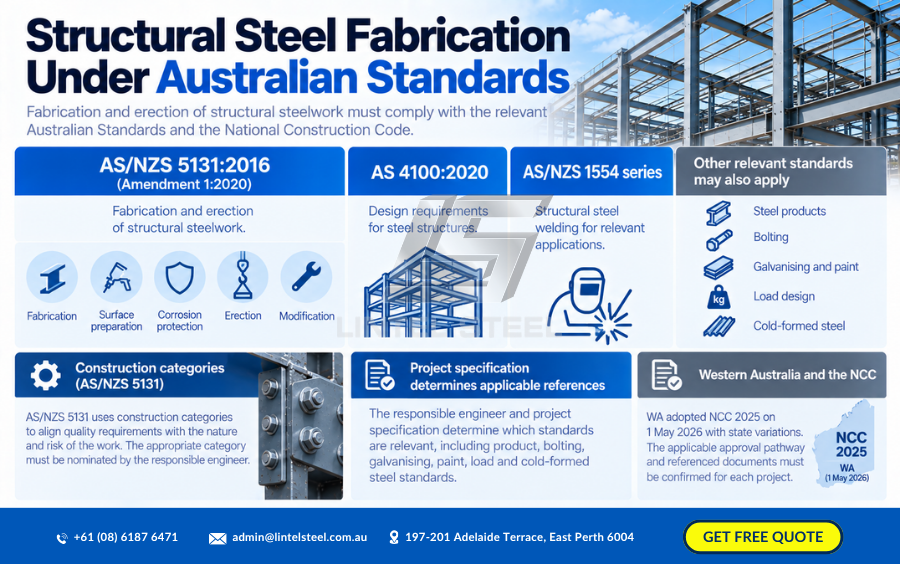
AS/NZS 5131:2016, including Amendment 1:2020, sets requirements for fabrication and erection of structural steelwork. Its scope includes fabrication, surface preparation, corrosion protection, erection and modification. AS 4100:2020 provides requirements for steel structures, while the AS/NZS 1554 series addresses structural steel welding for relevant applications.
Product, bolting, galvanising, paint, load and cold-formed steel standards may also apply. The responsible engineer and project specification determine which references are relevant. AS/NZS 5131 uses construction categories to align quality requirements with the nature and risk of the work; the appropriate category should be nominated rather than guessed by the supplier.
Western Australia adopted NCC 2025 on 1 May 2026 with state variations. The applicable approval and referenced documents must be confirmed for each project. This article describes general structural steel fabrication practice and is not a substitute for engineering or compliance advice.
Structural Steel Fabrication Technology
Digital modelling, CNC cutting, automated drilling, robotic welding and production tracking are changing steel workshops. These tools can improve repeatability, reduce manual marking and connect design data with fabrication equipment.
Technology does not eliminate human responsibility. Model information must be correct, machines require calibration, welding remains procedure-controlled and inspection is still necessary. Automation can reproduce an error very efficiently if the source data is wrong.
The most effective structural steel fabrication businesses combine technology with experienced detailing, workshop knowledge and quality management. This balance supports faster production while preserving traceability and practical constructability.
Structural Steel Fabrication Lead Times and Cost
Fabrication cost is influenced by steel weight, number of parts, connection complexity, weld volume, hole quantity, surface treatment, testing, documentation, transport and erection constraints. Two frames with similar tonnage can have very different labour requirements.
Lead time includes more than workshop hours. Engineering coordination, shop drawing review, material availability, production scheduling, coating turnaround and delivery planning all matter. Changes after drawing approval can interrupt several stages at once.
Early engagement gives a structural steel fabrication supplier time to suggest practical efficiencies without changing design intent. Standardising plates, reducing unnecessary connection variations and coordinating member lengths can save labour and material when approved by the designer.
Common Structural Steel Fabrication Mistakes
Starting from incomplete or outdated drawings is one of the costliest mistakes. Other problems include ordering the wrong grade, losing traceability, overlooking coating access, placing holes incorrectly, welding without suitable procedures and failing to plan transport dimensions.
Site teams can create further risk by modifying members without approval. A slot cut to make a bolt fit may conceal a dimensional issue, while welding galvanised steel introduces safety and repair requirements. Even small changes should follow project controls.
Strong structural steel fabrication processes use hold points, inspections and revision control to catch errors early. The goal is not merely to find defects at the end; it is to prevent them through coordinated information and controlled work.
Choosing a Structural Steel Fabrication Supplier in WA
A capable supplier should understand the products, processing and documentation required for the project. Buyers can ask about workshop capability, quality systems, relevant certifications, welding procedures, inspection arrangements, coating partners, transport limits and experience with similar work.
Price is important, but scope clarity is equally important. Confirm whether the quotation includes detailing, material, cutting, drilling, welding, bolts, coatings, testing, delivery, erection or only selected services. Exclusions should be easy to identify.
For WA projects, local knowledge can help with freight distances, site access, coastal durability and delivery sequencing. The right structural steel fabrication partner communicates early, raises uncertainties and supplies documentation that matches the contract.
Ordering Structural Steel Fabrication Services
Provide current engineering and architectural drawings, specifications, member schedules, site address and required dates. State the applicable construction category, coating system, inspection needs and whether installation is included. Existing-building projects should also include verified site dimensions where possible.
Avoid requesting a fixed price from an undeveloped sketch and expecting it to remain unchanged after connections and finishes are added. A preliminary budget can be useful, but the final quotation needs a defined scope.
If your project requires beams, columns, channels, angles, plates or hollow sections, a WA steel supplier can help with product availability and processing options. Final member sizes and connections must still follow the engineer’s design. Clear information is the foundation of accurate structural steel fabrication.
Frequently Asked Questions About Structural Steel Fabrication
What is included in structural steel fabrication?
It can include shop detailing, material procurement, cutting, drilling, forming, assembly, welding, inspection, coatings, marking and delivery. The precise scope varies, so quotations should state inclusions and exclusions clearly.
How long does fabrication take?
Timing depends on design readiness, steel availability, tonnage, complexity, workshop capacity, approvals, coating and testing. A simple package may move quickly, while complex frames with extensive welding and inspection require more time.
Can a fabricator change a structural design?
A fabricator may propose alternatives or improve constructability, but changes affecting engineering intent require approval through the project’s design process. Substituting members, grades or connections without authorisation is not appropriate.
Is all fabricated steel welded?
No. Some components are cut and drilled for bolted assembly with limited welding, while others contain substantial welded connections. The design, member type and erection strategy determine the joining methods.
Should steel be painted or galvanised?
The answer depends on exposure, design life, appearance, maintenance access and member geometry. Paint, hot-dip galvanising or a duplex system may be suitable. The project should contain a complete corrosion-protection specification.
Why are shop drawings necessary?
Shop drawings communicate member geometry and fabrication details to the workshop and site. They help coordinate connections, dimensions, marks, holes, welds and assemblies before steel is processed.
A Better Structural Steel Fabrication Outcome
Successful fabrication begins with complete information and ends with steelwork that fits, performs and can be traced to its quality records. Every stage matters: detailing supports accurate processing, correct material supports design capacity, controlled welding supports connection performance, and suitable coatings support durability.
For builders and developers, early coordination is the simplest way to reduce risk. Engage the engineer, detailer, supplier, fabricator, coating specialist and erector before deadlines become urgent. Confirm drawings, grades, connections, finishes, inspection and delivery sequence before production begins.
If you are planning a residential, commercial or industrial project in Western Australia, send your current drawings and material schedule to Lintel Steel for an accurate quotation. Well-managed structural steel fabrication can help your project move from design to installation with fewer surprises and better long-term value.
Get free quote and quantity take-off here
Authoritative Resources
For current requirements, consult Standards Australia, the Australian Steel Institute, the National Construction Code and the WA Building and Energy legislative framework. Project documents may reference AS/NZS 5131:2016 including Amendment 1:2020, AS 4100:2020 and the applicable AS/NZS 1554 welding standard.
This article provides general information only.


