
Hot-Rolled vs Cold-Formed Steel: Key Differences

Steel is used throughout Western Australian construction, from house frames and roof trusses to warehouses, commercial buildings and large industrial structures. However, not every steel product is made or designed in the same way. One of the most useful distinctions for builders, designers and buyers is hot rolled vs cold formed steel.
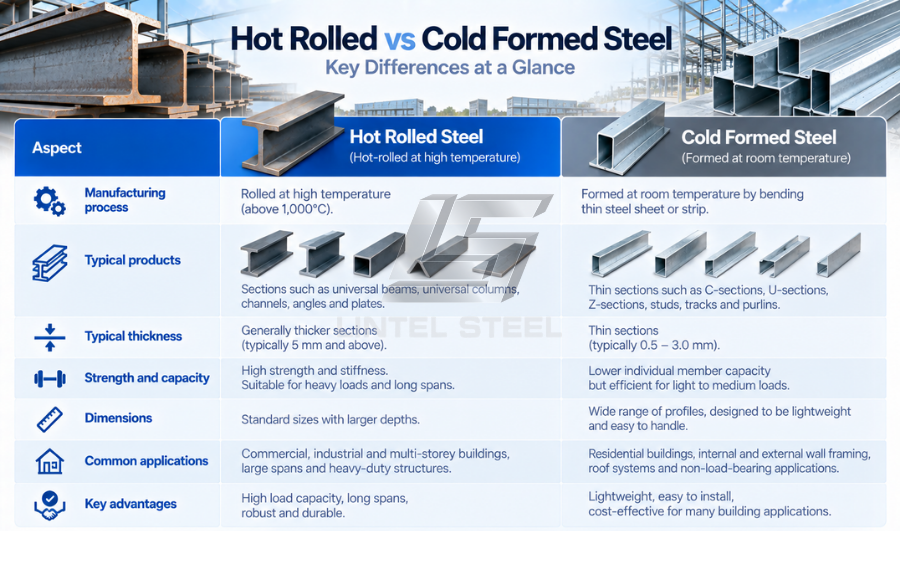
Hot-rolled steel is shaped at high temperatures and commonly supplied as substantial structural sections such as universal beams, universal columns, channels, angles and some hollow sections. Cold-formed steel is usually made by bending or roll-forming thinner sheet or strip at or near room temperature into efficient profiles such as studs, tracks, purlins, girts, joists and light framing components.
Neither option is automatically better. They usually perform different jobs, and many successful buildings combine both. Understanding hot rolled vs cold formed steel helps project teams choose suitable products, prepare realistic budgets and coordinate engineering, fabrication, coatings and installation before material arrives on site.
Hot Rolled vs Cold Formed Steel at a Glance
The central difference in hot rolled vs cold formed steel is how the sections are manufactured. Hot rolling shapes steel while it is above its recrystallisation temperature, allowing thick material to be formed into robust profiles. Cold forming shapes comparatively thin steel sheet after the base material has cooled, using rollers or presses to create folds, lips and flanges that provide stiffness.
In practical construction terms, hot-rolled members often form the primary load-bearing skeleton. A universal beam might span a large opening, while a universal column can carry loads from several levels. Cold-formed products often work as repeated members in wall, floor or roof systems, distributing forces through closely spaced sections, bracing, sheeting and connections.
This is not a simple “heavy versus weak” comparison. A cold-formed system can be highly efficient, while a hot-rolled member can achieve loads and spans that a single thin section cannot. The correct hot rolled vs cold formed steel decision depends on the complete structure, not appearance alone.
What Is Hot-Rolled Structural Steel?
Hot-rolled steel is produced by passing heated steel through rollers to create a required shape and size. Because the material is formed while hot, manufacturers can produce thick sections with substantial cross-sectional area. After rolling, the steel cools, is straightened and is cut into commercial lengths.
Common hot-rolled structural products include universal beams, universal columns, parallel flange channels, equal and unequal angles, flat bars and plates. Structural hollow sections are manufactured through processes that may include hot forming, cold forming or combinations of stages, so buyers should refer to the relevant product standard rather than assuming every hollow section belongs neatly to one category.
Hot-rolled members are widely used for portal frames, columns, long-span beams, transfer structures, mezzanines, industrial platforms, large roof supports and major residential openings. They are commonly drilled, cut, welded, bolted, galvanised or painted as part of a fabricated steel package.
What Is Cold-Formed Steel?
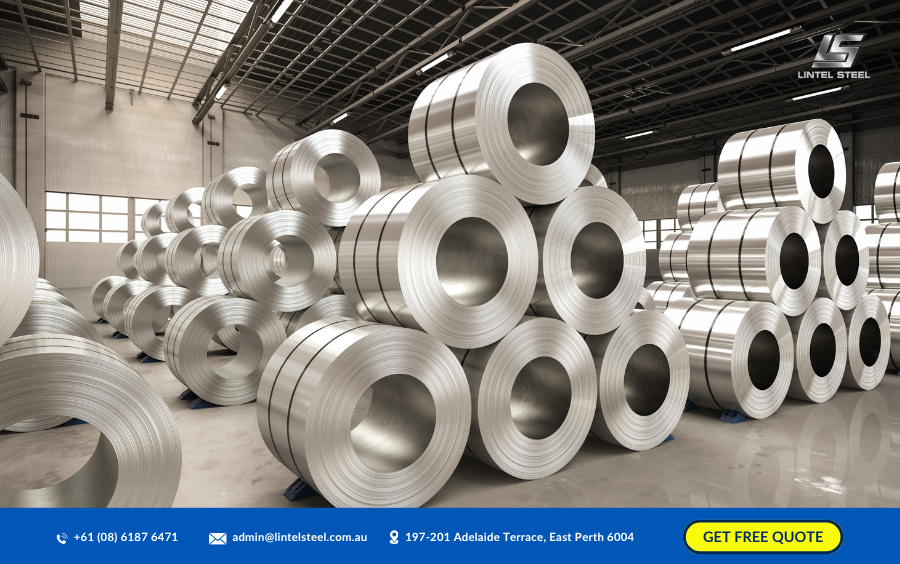
Cold-formed steel starts with steel sheet or strip, often supplied in coils. Roll-forming machines or presses bend the material into open shapes such as C-sections, Z-sections, channels, studs, tracks and hat profiles. The folds make a thin sheet much stiffer than it would be if left flat.
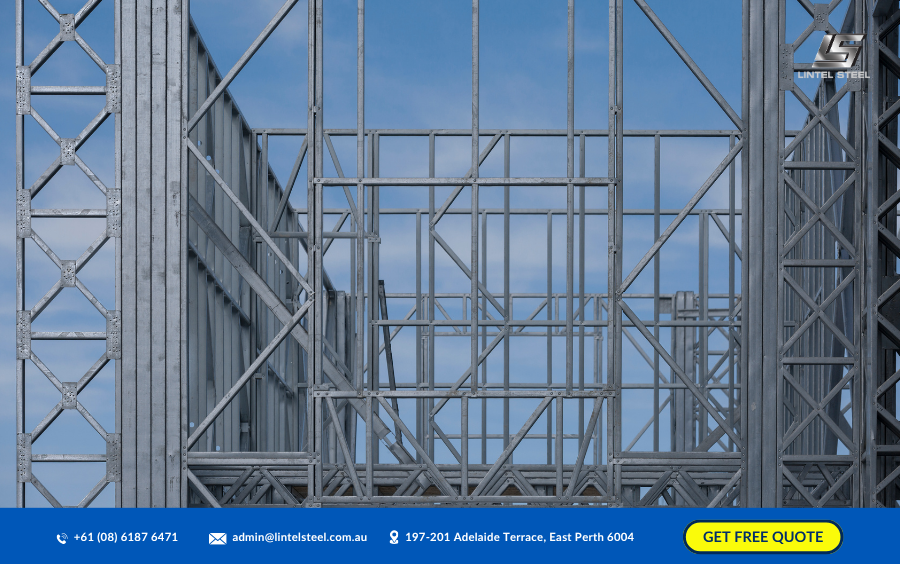
Cold-formed components are used in light-gauge wall frames, roof trusses, floor joists, battens, purlins, girts, modular panels, storage systems and many secondary structural applications. Some profiles are proprietary products with tested capacities, compatible connections and installation rules.
Cold-formed steel should not be confused with the everyday retail term “cold-rolled steel.” Cold rolling commonly refers to sheet or coil processed for tighter dimensional tolerances and a smoother surface. Cold forming refers to creating a structural shape from sheet or strip. These ideas can overlap, but they are not interchangeable descriptions.
Hot Rolled vs Cold Formed Steel Manufacturing
Manufacturing explains many of the differences in hot rolled vs cold formed steel. Hot rolling uses high temperature to reduce and shape steel efficiently. The process can create large, solid-looking sections with thick webs and flanges. Cooling can produce residual stresses, scale and normal dimensional variation that designers and fabricators understand and allow for.
Cold forming shapes the material without reheating it to hot-rolling temperatures. A continuous roll-forming line can produce long, accurate sections with repeated bends. Press-braking may be used for shorter or customised profiles. The forming operation can increase strength in parts of the section, but it also produces residual stresses and makes local buckling behaviour important.
Modern production equipment can punch holes, mark components and cut sections to length from digital data. This supports prefabricated framing and efficient installation. Even so, hot rolled vs cold formed steel products must match their drawings, grades, tolerances and design standards; a similar-looking substitute may behave differently.
Hot Rolled vs Cold Formed Steel Strength
Asking which product is stronger can be misleading. Steel grade describes material properties, while structural capacity also depends on section geometry, thickness, unsupported length, restraint, connections and loading direction. A heavy hot-rolled beam generally carries far more load than one light-gauge stud, but that does not make the stud unsuitable for a correctly designed wall system.
Hot-rolled sections often have relatively stocky plate elements and large section properties. They are well suited to high forces, concentrated loads and long spans. Cold-formed sections obtain efficiency from carefully shaped thin elements, but those elements can experience local, distortional or overall buckling if they are not adequately designed and restrained.
A valid hot rolled vs cold formed steel comparison therefore uses engineered alternatives that satisfy the same load, deflection, vibration, fire and durability requirements. Comparing yield strength alone does not show how a finished member or system will perform.
Hot Rolled vs Cold Formed Steel Weight
Cold-formed framing is usually much lighter per member. Components may be bundled for transport and, where safe-work requirements permit, moved manually around a site. Lower frame weight can be useful for prefabricated panels, upper-storey additions, modular buildings and sites with limited crane access.
Hot-rolled steel is heavier, and substantial members often require planned lifting, delivery sequencing and mechanical handling. That extra mass is not simply a disadvantage. One robust beam may replace numerous smaller members or internal supports, helping create valuable open floor space.
The whole structure must be assessed when comparing hot rolled vs cold formed steel weight. A lightweight frame may reduce some gravity actions, but foundations still need to resist wind uplift, lateral forces and site-specific soil movements. Bracing, sheathing, connections and finishes also contribute to total building mass.
Hot Rolled vs Cold Formed Steel Spans and Loads
Hot-rolled members are usually the preferred starting point for long clear spans, heavy equipment, large openings, multi-storey columns and concentrated reactions. Universal beams and fabricated girders can provide significant bending capacity, while columns and braced frames transfer loads through the building.
Cold-formed steel is highly effective where loads can be shared across repeated joists, studs, purlins or truss members. Longer spans may require deeper profiles, thicker material, closer spacing, built-up sections or intermediate restraint. Manufacturer span tables are useful only within their stated loading, support and installation conditions.
Western Australian wind regions can strongly influence roof and wall framing. Cyclonic conditions in northern WA may create demanding uplift and connection forces. A hot rolled vs cold formed steel selection must use the project’s wind classification or engineered wind actions rather than a general rule of thumb.
Hot Rolled vs Cold Formed Steel Applications
Hot-rolled structural steel is common in commercial frames, warehouses, workshops, industrial facilities, large canopies, mezzanines, apartment buildings and residential beams. It is particularly useful where a small number of substantial members must carry large loads or span wide spaces.
Cold-formed steel is widely used for house frames, townhouses, internal partitions, low-rise load-bearing walls, roof trusses, floor joists, purlins, girts, ceilings and modular construction. It also works as secondary framing attached to a hot-rolled primary structure.
Many projects do not need an either-or answer. A warehouse may use hot-rolled columns and rafters with cold-formed purlins and girts. A house may use cold-formed wall and roof framing with hot-rolled beams above wide doors. In practice, hot rolled vs cold formed steel often describes complementary systems.
Hot Rolled vs Cold Formed Steel Connections
Connections are fundamental to structural performance. Hot-rolled members commonly use bolted end plates, cleats, base plates, welded joints and structural anchors. These details can transfer substantial forces but require accurate fabrication, bolt installation, weld quality and erection tolerances.
Cold-formed framing frequently uses self-drilling screws, bolts, rivets, straps, brackets or proprietary clips. Because the connected material is thin, fastener pull-out, bearing, tear-out, edge distance and local deformation may control capacity. The number, type and position of fasteners should follow engineered details.
Service holes and site changes also require care. Some cold-formed sections include engineered punch-outs, but additional cuts can weaken a member. Hot-rolled beams or columns must not be drilled, notched or cut without engineering approval. Connection costs and constructability should be included in every hot rolled vs cold formed steel review.
Hot Rolled vs Cold Formed Steel Fabrication
Hot-rolled products often pass through a structural steel workshop for cutting, coping, drilling, welding, trial assembly and coating. Computer-controlled machinery supports accuracy, but detailing is still essential. Connection geometry, welding access, bolt clearances, member orientation and erection sequence all affect fabrication.
Cold-formed members can be manufactured directly to length with service holes, identification marks and connection details. Complete wall panels, roof trusses or floor cassettes may be assembled in a factory before transport. This controlled production can reduce site cutting and improve repeatability.
Late design changes are costly in either system. Changes to a fabricated beam may require engineering review and workshop reprocessing, while changes to cold-formed framing can disrupt load paths and proprietary details. Coordinated drawings make hot rolled vs cold formed steel construction faster and more predictable.
Hot Rolled vs Cold Formed Steel Construction Speed
Both systems support off-site manufacturing. Hot-rolled frames can arrive cut, drilled, welded and coated for bolted erection. A well-planned portal frame can establish the main building envelope quickly, especially when delivery and lifting follow the erection sequence.
Cold-formed steel suits repeatable production and panelisation. Lightweight wall panels or trusses can be fabricated while site work proceeds, then installed with less heavy lifting. Pre-punched services and labelled components can further streamline following trades when the design is coordinated.
Speed depends on more than steel type. Incomplete engineering, late service changes, missing connections, poor access or incorrect components can delay either system. The best hot rolled vs cold formed steel program includes design freeze dates, shop drawings, procurement lead times, delivery stages and temporary bracing.
Hot Rolled vs Cold Formed Steel Dimensional Accuracy
Cold-forming equipment can produce highly consistent repeated profiles, which is valuable for modular layouts, wall panels and precise interfaces with linings. The finished framing remains dimensionally stable and does not shrink because of changing moisture content.
Hot-rolled sections are manufactured to established tolerances, but cooling and straightening can produce normal variations in straightness, flange alignment and dimensions. Fabricators account for these tolerances in connection detailing and erection. Architectural designs should not assume that raw structural steel has the precision of a finished-machined product.
The relevant question is whether the chosen product meets its specified tolerances and whether adjoining construction can accommodate them. A hot rolled vs cold formed steel decision based purely on perceived accuracy overlooks fabrication, assembly and installation tolerances.
Hot Rolled vs Cold Formed Steel Corrosion Protection
Both product types require durability planning. Hot-rolled steel may be blast-cleaned and painted, hot-dip galvanised or protected by another specified system. Coating selection depends on atmospheric corrosivity, design life, member geometry, maintenance access and the project specification.
Cold-formed framing is commonly produced from metallic-coated sheet, with the coating applied before the section is formed. Cut edges, fasteners, swarf, contact with incompatible materials and moisture management still matter. Components intended for protected internal framing should not automatically be used in exposed coastal conditions.
WA includes mild internal environments and severe marine or industrial exposures. In a hot rolled vs cold formed steel comparison, confirm that every member, connection and fastener is suitable for its actual micro-environment. Good drainage and avoidance of moisture traps are just as important as the coating name.
Hot Rolled vs Cold Formed Steel Near the WA Coast
Coastal salt can accelerate corrosion when it accumulates on steel surfaces. Distance from the ocean is only one factor; wind direction, shielding, rainfall washing, humidity and sheltered ledges can change local exposure significantly. An external member and a dry internal member on the same project may need different protection.
Hot-rolled members can use galvanised, painted or duplex systems selected for the exposure. Cold-formed framing requires an appropriate base coating and compatible fasteners, flashings and adjoining materials. Site cutting should follow the manufacturer’s durability guidance, and loose metal swarf should be removed.
For coastal hot rolled vs cold formed steel projects, discuss the address, member location and expected design life with the engineer and supplier. A generic statement such as “galvanised” is not a complete durability specification.
Hot Rolled vs Cold Formed Steel Fire Performance
Steel is non-combustible, but it loses strength and stiffness as its temperature increases. Fire resistance therefore depends on member size, loading, exposure and the complete protection system. Hot-rolled steel may use boards, sprays, encasement or intumescent coatings where a fire-resistance level is required.
Cold-formed wall and floor systems often obtain fire resistance from tested assemblies that include framing, plasterboard, insulation, fasteners, joints and spacing. Replacing one layer, changing stud spacing or introducing unprotected penetrations can affect the rated result.
It is incorrect to select hot rolled vs cold formed steel on the assumption that either system is automatically fireproof. Fire engineering and building classification requirements should be coordinated with structural design, services and architectural finishes.
Hot Rolled vs Cold Formed Steel Thermal and Acoustic Performance
Steel conducts heat readily. Hot-rolled beams can create concentrated thermal bridges at balconies, façades or roof interfaces, while closely spaced cold-formed studs can create repeated bridges through a wall. Continuous insulation, thermal breaks and careful junction detailing help manage heat flow and condensation risk.
Acoustic performance depends on the entire wall, roof or floor assembly rather than the frame alone. Cavity insulation, board layers, resilient channels, separation, junction sealing and service penetrations all influence sound transmission. A lighter frame is not automatically acoustically poor, nor is a heavier beam automatically sufficient.
Energy and acoustic consultants should assess the complete construction. Including these requirements early makes the hot rolled vs cold formed steel choice more accurate and prevents difficult retrofits after framing is installed.
Hot Rolled vs Cold Formed Steel Cost
Material rates alone do not reveal installed cost. A hot-rolled option may involve fewer but heavier members, workshop fabrication, freight, coatings, cranage and bolted erection. A cold-formed option may use more individual components, proprietary connectors, detailed assembly and additional bracing or sheathing.
Repetition can make cold-formed framing economical, particularly when digital manufacturing and panelisation reduce site labour. Hot-rolled steel can create open space, remove columns and support large loads efficiently, producing value that is not visible in a price-per-kilogram comparison.
A fair hot rolled vs cold formed steel estimate should compare engineered designs with equivalent performance. Include detailing, supply, fabrication, coatings, transport, lifting, installation, temporary works, fire protection, insulation, linings and maintenance.
Hot Rolled vs Cold Formed Steel Sustainability
Steel can be recovered and recycled, and accurate manufacturing can minimise site waste. Cold-formed sections use thin material in efficient shapes, while hot-rolled frames can achieve long spans and adaptable spaces with relatively few members. Both approaches can support off-site production and future disassembly when designed accordingly.
Sustainability cannot be judged from weight alone. Product sourcing, recycled content, manufacturing energy, transport, coating life, operational energy, adaptability and end-of-life recovery all contribute to environmental impact. A slightly heavier system with a long life or flexible floor plan may outperform a lighter system that requires early replacement.
For a meaningful hot rolled vs cold formed steel assessment, project teams can request verified environmental information and compare complete building options rather than relying on broad marketing claims.
Hot Rolled vs Cold Formed Steel Under Australian Standards
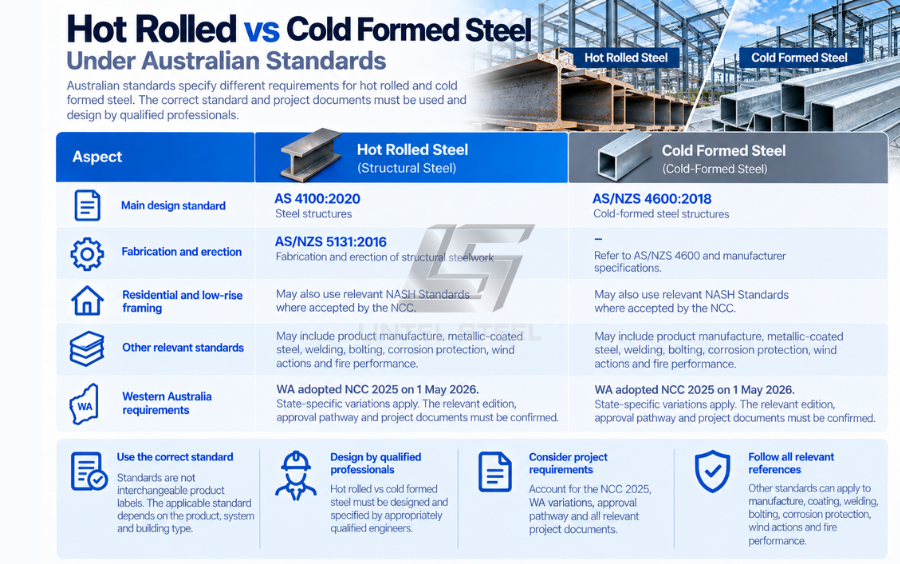
Australian structural steel design uses standards appropriate to the product and system. AS 4100:2020 sets requirements for steel structures and is commonly associated with conventional structural members. AS/NZS 4600:2018 addresses cold-formed steel structures. AS/NZS 5131:2016 provides requirements for fabrication and erection of structural steelwork.
Residential and low-rise steel framing may also use the applicable NASH Standards where accepted by the National Construction Code. Other references can apply to steel product manufacture, metallic-coated sheet, welding, bolting, corrosion protection, wind actions and fire performance.
Western Australia adopted NCC 2025 on 1 May 2026 with state-specific variations. The relevant edition, approval pathway and project documents still need to be confirmed. Standards are not interchangeable product labels, so hot rolled vs cold formed steel must be designed and specified by appropriately qualified professionals.
How to Choose Hot Rolled vs Cold Formed Steel
Start with the load path and architectural outcome. Large clear spans, heavy point loads, multi-storey columns or major transfer beams often favour hot-rolled members. Repeated wall panels, roof trusses, lightweight floors and modular low-rise construction may favour cold-formed systems.
Next, consider logistics and interfaces. Site access, crane availability, transport lengths, service routes, cladding support, fire protection, insulation, finishes and erection sequence can change which solution is most practical. Review connection labour as carefully as member supply.
Finally, compare equivalent engineered options over the building’s life. The best hot rolled vs cold formed steel solution may be hybrid: substantial primary members where capacity is needed and lightweight secondary framing where repetition and low mass create value.
Buying Hot Rolled vs Cold Formed Steel in Western Australia
Accurate purchasing begins with current drawings and schedules. For hot-rolled products, provide section designations, grades, lengths, quantities, hole patterns, fabrication details, coating requirements and delivery constraints. Clarify whether the quotation covers stock lengths, processed material or complete fabrication.
For cold-formed products, identify the exact profile, base metal thickness, grade, coating designation, length, punch pattern and proprietary system where applicable. Similar overall dimensions do not guarantee the same capacity. Studs, tracks, brackets, screws and straps may need to remain within one engineered system.
A WA steel supplier can explain product availability and processing services, but should not be asked to replace the project engineer. Clear documentation makes a hot rolled vs cold formed steel order easier to quote, manufacture and deliver correctly.
Common Hot Rolled vs Cold Formed Steel Mistakes
One mistake is assuming “cold-formed” means inferior steel. The system can be efficient and strong when correctly engineered. The opposite mistake is treating a thin member as a direct substitute for a hot-rolled beam because its depth looks similar.
Another problem is making unapproved site alterations. Cutting flanges, enlarging service holes, removing bracing or changing fasteners can interrupt the intended load path. Coating damage, incompatible fixings and trapped moisture can also reduce durability.
The most avoidable error is ordering from preliminary drawings. Before purchasing hot rolled vs cold formed steel, confirm revisions, quantities, grades, coatings, connection details and who is responsible for fabrication and installation.
Frequently Asked Questions About Hot Rolled vs Cold Formed Steel
Is hot-rolled steel stronger than cold-formed steel?
Not as a universal rule. Hot-rolled structural members are generally thicker and suited to heavier individual loads, while cold-formed sections use efficient shapes and repeated members. Capacity depends on grade, geometry, thickness, restraint, span, connections and loading.
Is cold-formed steel the same as light-gauge steel?
Light-gauge structural framing is a major category of cold-formed steel. However, cold-formed products also include heavier purlins, girts, decking and other profiles. Terminology varies, so the exact section and standard should be stated.
Can hot-rolled and cold-formed steel be used together?
Yes. Hybrid construction is common. Hot-rolled columns, beams or rafters may form the primary structure, while cold-formed joists, purlins, girts or wall frames complete the building. Their connections and different tolerances must be coordinated.
Which option is cheaper?
Neither is always cheaper. Geometry, quantities, spans, labour, fabrication, connections, coatings, freight, lifting and finishes all affect total cost. Compare complete engineered alternatives rather than price per metre or tonne.
Which is better for house construction?
Cold-formed framing is widely used for residential walls, floors and roofs. Hot-rolled beams and columns are useful for large openings, upper-floor supports and architectural layouts. Many houses use both systems.
Which steel is best for coastal Western Australia?
Either system can work when its coating, fasteners, detailing and maintenance plan suit the local exposure. Coastal selection requires project-specific durability advice rather than choosing solely by manufacturing method.
Final Verdict on Hot Rolled vs Cold Formed Steel
Hot-rolled steel excels as substantial primary structure where buildings require heavy capacity, long spans and large connections. Cold-formed steel excels where lightweight, repeatable and accurately manufactured components can share loads as a complete framing system.
The right decision comes from matching the material to the job. Span, load, building height, wind actions, fire requirements, thermal design, durability, access and total installed cost should all be considered. Frequently, the most efficient result uses both product families.
If you are sourcing steel for a residential, commercial or industrial project in Western Australia, involve your engineer and steel supplier early. A well-documented hot rolled vs cold formed steel strategy supports accurate pricing, smoother fabrication and a safer, more efficient build.
Get free quote and quantity take-off here
Authoritative Resources
For current technical information, consult Standards Australia, the National Association of Steel Framed Housing, the National Construction Code and the WA Building and Energy legislative framework. Relevant project documents may reference AS 4100:2020, AS/NZS 4600:2018, AS/NZS 5131:2016 and applicable NASH Standards.
This article provides general information only.


