
Hot-Dip Galvanized Steel: What Manufacturers Should Know

In construction and mechanical engineering, steel is an indispensable material. However, one of its biggest challenges is corrosion over time, especially in harsh environments.
Hot-dip galvanized steel is one of the most effective metal protection solutions available today, particularly favored in heavy industrial and civil construction projects. This type of steel stands out for its fire resistance, as it does not produce toxic smoke when burning, can withstand strong impacts, and effectively protects internal components when used as a protective material.
Let’s explore hot-dip galvanized steel in detail with Lintel Steel – from the manufacturing process to practical applications – and why it is the optimal choice for many projects.
What is Hot-Dip Galvanised Steel?
Hot-dip galvanized (HDG) steel is a type of ordinary carbon steel that has been coated with a layer of zinc through a hot-dip galvanizing process. This zinc layer creates a “shield” that protects the steel from environmental factors such as moisture, oxygen, and chemicals. For 190 years now, the demand for hot-dip galvanizing has been steadily increasing to serve construction, transportation, and protective products requiring higher standards.
Key characteristics
Zinc coating thickness: 40-80μm (while cold zinc coating thickness is only 20-30μm)
Surface: Rough, uneven coating, not perfectly smooth. Has a “silver” sheen when viewed from a distance and may exhibit zinc inclusions (natural crystalline patterns formed during the cooling process).
Uniform coating: Covers the entire surface, including corners and gaps. However, the final coating may not be consistent compared to other galvanizing processes.
High corrosion resistance: Zinc acts as a sacrificial protection layer, preventing steel from rusting even when the surface is scratched.
Long-term durability: Yield strength 195 (MPa). Tensile strength 320÷520 (Mpa). Therefore, the lifespan can be up to 20–50 years depending on the environment (coastal, industrial, urban).
Long-term cost-effective: The initial cost may be higher than regular steel, but it saves on maintenance and replacement costs.
With the above characteristics, hot-dip galvanized steel pipes are considered a cost-effective alternative. This material can be used instead of austenitic stainless steel or aluminum for optimal corrosion resistance.
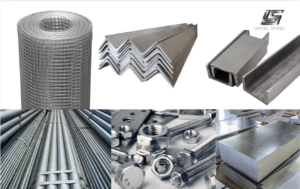
Information on hot-dip galvanized steel products
- Hot-dip galvanized steel pipes
- Hot-dip galvanized H, I, V, U – shaped steel sections
- Hot-dip galvanized steel tubes
- Hot-dip galvanized steel plates
- Hot-dip galvanized wire mesh
- Folding materials: bolts, nuts, etc.
Hot-dip galvanized steel Standards
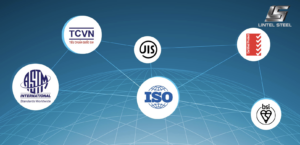
The most common standards for hot-dip galvanized steel pipes are the US ASTM standard, the UK BS EN standard, the ISO standard, the Japanese JIS standard, and the Vietnamese standards TCVN.
ASTM US Standard
- ASTM A653/A653M: Technical standard for hot-dip galvanized or iron-zinc alloy coated steel sheets/coils.
- ASTM A153/A153M: Specification for zinc coatings on small parts, hardware, and fittings (such as bolts, nuts, and screws).
- ASTM A53/A53M: Specification for seamless or welded hot-dip galvanized steel pipes.
- ASTM A767/A767M: Specific standard for hot-dip galvanized reinforcing steel (rebar).
- ASTM A123/A123M: Specification for hot-dip galvanized coating requirements regarding thickness, adhesion, surface finish, and quality control.
UK BS EN Standard
- BS 1387-1985: Standard for hot-dip galvanized welded steel pipes
- BS EN 10255 (replaces BS 1387:1985)
ISO Standard
- ISO 9001: Quality management system ensuring the galvanizing production process meets standards.
- ISO 1461: Specifications for technical requirements and test methods for coatings on iron and steel.
- ISO 1460: Standard for determining the weight of the coating.
- ISO 16172: Specifications for technical requirements for continuously hot-dip galvanized or zinc alloy coated steel sheets, specifically for the production of corrugated steel pipes.
JIS Standard
- JIS G3444/G3466: Specifies the requirements for hot-dip galvanized carbon steel pipes for general structural use (round, square, rectangular).
- JIS H 8641: Specifies the technical requirements for hot-dip galvanizing coatings.
- JIS G3302 (Plates/Coils): Specifies the requirements for continuous hot-dip galvanized steel sheets and strips. Common steel grades: SGCC, SGC340, SGC400, SGC440.
TCVN Vietnamese standards
- TCVN 5408: Hot-dip galvanized coatings on cast iron and steel products – Technical requirements and test methods.
- TCVN 10355: Commercial and drawing quality thin carbon steel sheets, hot-dip galvanized and zinc-iron alloy coated continuously.
- TCVN 7665: Determination of the mass of hot-dip galvanized coating per unit area.
- TCVN 12514: Zinc-coated steel for concrete reinforcement.
- TCVN 11375: Continuously hot-dip galvanized sheet steel for corrugated steel pipes.
Hot-Dip Galvanized Steel Process Step
-
Surface cleaning (Degreasing)
Mechanical methods (scrubbing, brushing, sandblasting) and alkaline solutions or industrial detergents
This is a fundamental step to remove grease, dirt, and organic impurities from the steel surface, helping the zinc coating adhere better in subsequent stages.
-
Rinsing
After degreasing, the steel is rinsed with clean water to remove any remaining chemicals completely.
If not rinsed thoroughly, these chemicals can affect the quality of the coating.
-
Pickling:
Remove the iron oxide layer (rust) on the steel surface by soaking the steel in an acid solution (usually HCl or H₂SO₄).
This step activates the steel surface, preparing it to react with zinc.
-
Second rinsing
This helps prevent contamination of the zinc bath and ensures the quality of the coating.
-
Fluxing
Using a zinc ammonium chloride solution (ZnCl₂ + NH₄Cl) prevents the steel from re-oxidizing before galvanizing and increases the adhesion of the zinc layer.
This is a very important step to ensure a uniform and defect-free plating.
-
Drying
Ensuring a dry surface helps the hot-dip galvanizing process to be more stable and avoids zinc splatter during dipping.
-
Hot-Dip Galvanizing
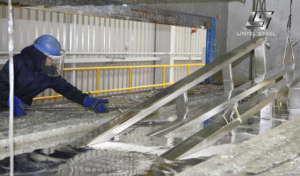
This step will determine the quality of the finished product. The material will be immersed in a bath of molten zinc (~450°C), forming layers of Zn-Fe alloy, creating a strong protective coating.
-
Cooling/Quenching
After galvanizing, to stabilize the coating and increase mechanical strength, the steel is cooled with water and air.
-
Quality Inspection
The final step ensures the product meets requirements before shipment.
Advantages and Disadvantages
HDG also has outstanding advantages like Galvanized Steel, but surpasses them. However, it also has certain limitations.
Advantages
-
Superior corrosion resistance
This is the biggest advantage, making the product widely used outdoors.
-
Long lifespan
Up to 20–50 years, depending on the environment (coastal, industrial, urban). Suitable for long-term projects such as infrastructure, factories, and water supply and drainage systems.
-
Even coating, comprehensive protection
Thanks to the hot-dip process, the zinc coating is even on both the outside and inside of the steel, even in hard-to-reach areas such as corners and edges.
-
High mechanical strength
Good load-bearing capacity and minimal deformation upon impact, making it very suitable for load-bearing structures or industrial piping systems.
-
Low maintenance cost
Optimizes lifecycle cost for businesses because the product does not require frequent recoating.
Disadvantages
The initial cost of this type of pipe is usually higher than that of regular steel due to the complex galvanizing process. In addition, the coating surface is not perfectly smooth and may have zinc speckles, making it unsuitable for applications requiring high aesthetic standards.
If the purity of the zinc coating is not met, or if the surface rust removal process is not thorough, leaving behind impurities, the galvanized surface may have black spots. Exposure to moisture or rainwater can lead to zinc oxide formation, significantly reducing corrosion resistance and affecting usability.
Applications of Hot-Dip Galvanized
Galvanized Steel in general, and Hot-Dip Galvanized Steel in particular, is widely used in various manufacturing industries today. The application areas of hot-dip galvanizing are diverse, including:
- Industry and manufacturing: Chemical industry, automotive manufacturing, pulp and paper, etc.
- Telecommunication system
- Lighting systems and transportation
- Water and gas pipelines
Most industries applying this method use large quantities of iron and steel, but these materials often rust due to oxidation under the influence of the environment. The application of hot-dip galvanized steel has helped to control corrosion more effectively, thereby extending the lifespan of equipment and structures.
Choose Lintel Steel for Superior Steel Solutions
At Lintel Steel, we offer premium-grade steel solutions for many applications across Perth and Western Australia. With over 11 years of industry experience, we deliver reliable products that meet strict engineering standards.
We also provide expert advice to help you select the best materials for your needs. Our team offers custom sizes, prompt delivery, and free quotes within 48 hours, helping you complete your project with confidence and precision.
Choose Lintel Steel – your trusted partner for galvanized products, strong, and superior steel solutions.
Click here to get a quote and quantity takeoff for free at Lintel Steel.
You can find out more about us at our Fanpage Lintel Steel.


