
Top 10 Steel Exporting Countries You Must Know

In the early months of 2026, escalating tensions between the US, Israel, and Iran are pushing the global steel market into new challenges. The steel industry is fundamental to many sectors such as construction, infrastructure, and industrial manufacturing; therefore, any disruption in global tensions can create a ripple effect. This is causing significant challenges for the steel export industry, including declining demand and volatile prices.
This article will review the top 10 steel exporting countries in 2025, the challenges they need to overcome, and how they are adapting to the current context.
Top list of steel exporting countries
The latest steel production statistics show that the world’s leading steel-producing countries operate based on developed industrial systems and abundant natural resources.
China
China is the world’s largest producer of steel, used in construction and manufacturing. Although steel production in 2025 fell below 1 billion tons, marking a seven-year low due to weak domestic demand and the real estate crisis, forcing a push for cheaper exports, China’s steel exports that year reached a record high of over 119.02 million tons, a 7.5% increase year-on-year.
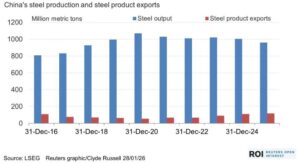
Chinese steel exports are primarily targeted at markets without trade barriers, including the Middle East, Southeast Asia, and Central America. Meanwhile, the European market has seen contrasting trends. For example, in 2023, export value to Europe remained almost stagnant, mainly due to the increasing number of trade protection measures against Chinese steel.
Japan
Despite being the world’s second-largest steel exporter, Japan’s growth has been relatively modest. Its main steel export markets are developed Asian economies such as South Korea, which remains its number one partner, with steel imports reaching 3.8%. In 2025, Japan’s steel exports reached 30.39 million tons, a decrease of 4.2% compared to the previous year.
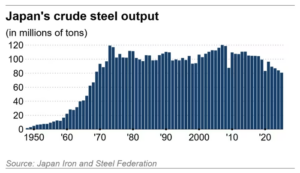
Japan’s steel export industry is facing pressure from multiple sides. According to data from the Japan Iron and Steel Federation (JISF), Japan’s crude steel production in 2025 fell 4% to 80.67 million tons, the lowest level since 1969. This allowed the United States to surpass Japan in steel production for the first time since 1999, to take second place. This decline is due to project delays caused by labour shortages, impacting demand from the construction industry, and a prolonged slump in domestic new car sales, contributing to reduced steel demand. While China remains a significant factor, the influx of cheap imports has pushed domestic steel prices to record lows and crude steel production has plummeted.
To restore its position in the industry, Japan is strengthening trade protection measures, including anti-dumping investigations targeting stainless steel imports from China and Taiwan.
Korea
With 27.7 million tons of export steel in 2025, totaling $30.4 billion, South Korea’s export market is highly diversified. The five largest importers of steel (including iron and finished steel) from South Korea in 2025 are the United States, China, Japan, India, and Vietnam (OEC World). South Korea continues to maintain its position as the leading supplier of finished steel to India, with exports reaching 2.8 million tons that year.
Steel is a vital part of South Korea’s economy, serving as a core raw material for its industries. However, the country’s steel exports decreased by 10.6% in April 2025 (according to Reuters). This is primarily due to changes in policy and priorities among partner countries, limiting export potential. Specifically, India has implemented a “Domestic Steel Priority” policy, encouraging the use of domestically produced steel instead of imports. Similarly, China has shifted its carbon emission reduction policies and adjusted its production. Furthermore, the US government’s decision to double import tariffs to 50% is expected to inflict significant damage on Korean steel exporters.
It is predicted that the Korean steel export landscape will undergo significant changes in 2026 due to market pressures and protectionist policies, with a trend towards concentrating resources in large enterprises, while access to the US market becomes increasingly limited.
Germany
Germany recorded a slight decline in steel export volume, around 22.5 million tonnes in 2023. Partners included neighbouring European countries such as Poland, Denmark, Austria, the Netherlands, and the United Arab Emirates (UAE). Germany’s crude steel production in 2025 is projected to reach only about 34.1 million tonnes, down 8.6% from 2024, indicating a weak production environment.
The first factor is declining production, leading to a decrease in export volume. In 2025, despite year-on-year growth, production remained below 40 million tonnes for the fourth consecutive year – a level considered indicative of recession for the German steel industry. This trend reflects ongoing difficulties, including high energy costs and weak domestic demand. The second factor is the US increasing import tariffs on steel, causing disruptions to the sector by increasing difficulties in exporting and putting further pressure on prices.
Italy
Besides Germany, Italy is also one of Europe’s major steel exporters. In 2025, Italy’s steel exports reached 20.7 million tons, a 3.6% increase compared to the previous year. Key export items include hot-rolled steel, wire rods, and coated steel sheets. The main markets are the US and several EU countries, such as Spain.
Similar to Germany, Italy’s steel export industry is facing a challenging and volatile environment. Issues related to trade policy, particularly tariffs and protectionist measures, are hindering export flows to many key markets. Furthermore, high energy costs in Europe continue to significantly increase production costs, diminishing the competitiveness of Italian steel in the international market. In addition to these economic pressures, Italy also faces the requirement to lead the trend in “green steel” production. This is a transition process that requires significant time and resources, thus creating short-term challenges in terms of production and exports.
The Impact of Global Demand on Steel Exports
Global demand is the primary factor determining the volume, scale, speed, and trends of steel exports. Steel exports are directly dependent on consumption demand from international markets. As major economies grow, demand for construction, manufacturing, and infrastructure increases, leading to increased demand for steel imports.
Recent market studies show that global political situations and new construction and infrastructure development activities mainly drive changes in demand. For example, increased urbanisation in Asia and Africa has led to a sharp increase in steel demand in the construction industry, rapidly shifting export flows to these developing regions. Conversely, recent political conflicts in the Middle East have reduced steel production and exports due to decreased demand, thus putting pressure on prices.
Furthermore, the trend towards sustainable development and the inevitable shift present a major challenge as exporting countries need to meet stringent requirements for permissible carbon emissions. However, it also presents an opportunity for the steel industry to modernise, apply technology, and become a technologically advanced and sustainable industry. Despite the difficulties, the steel industry must transform towards a circular and sustainable economy if it does not want to be excluded from the global supply chain.
What direction should businesses take in the current steel industry landscape?
To overcome current obstacles, global steel exporters need to prioritise market diversification and flexibility in their business strategies. Seeking new export partners helps businesses reduce dependence on traditional markets, especially in the face of unexpected trade fluctuations such as tariffs, sanctions, or competition from cheaper sources.
Furthermore, investing in modern technology to meet sustainability and emissions regulations is a top priority. New technologies such as carbon capture and hydrogen-based steel production help exporters ensure production complies with the latest environmental standards while anticipating the global decarbonization trend. Additionally, with projected global capacity utilisation decreases, businesses need to focus on improving efficiency and resource management to maintain profitability even in a low-price environment.
Lintel Steel – Your Trusted Steel Merchant in Perth
At Lintel Steel, we have been a trusted steel merchant in Perth for more than 11 years. Our team supplies high-quality steel products for residential, commercial, and industrial projects across Western Australia.
We offer:
- A full range of steel beams, tubes, angles, plates, and C sections
- Custom cutting and basic fabrication
- Fast delivery across Perth
- Friendly service and expert guidance
Free quotes within 48 hours
No matter the size of your project, we make sure you get the right steel, on time, and at a fair price.

Conclusion
Working with the right steel merchant in Perth makes your construction or fabrication project easier, faster, and more reliable. From high-quality steel products to cutting services and quick delivery, a trusted supplier ensures your project stays on track.
For dependable steel supply in Perth, get in touch with Lintel Steel today and request your free, no-obligation quote.
Click here to get a quote and quantity takeoff for free.
You can find out more about us at our Fanpage Lintel Steel.


